
Heated floors in Chatham extensions and garage conversions
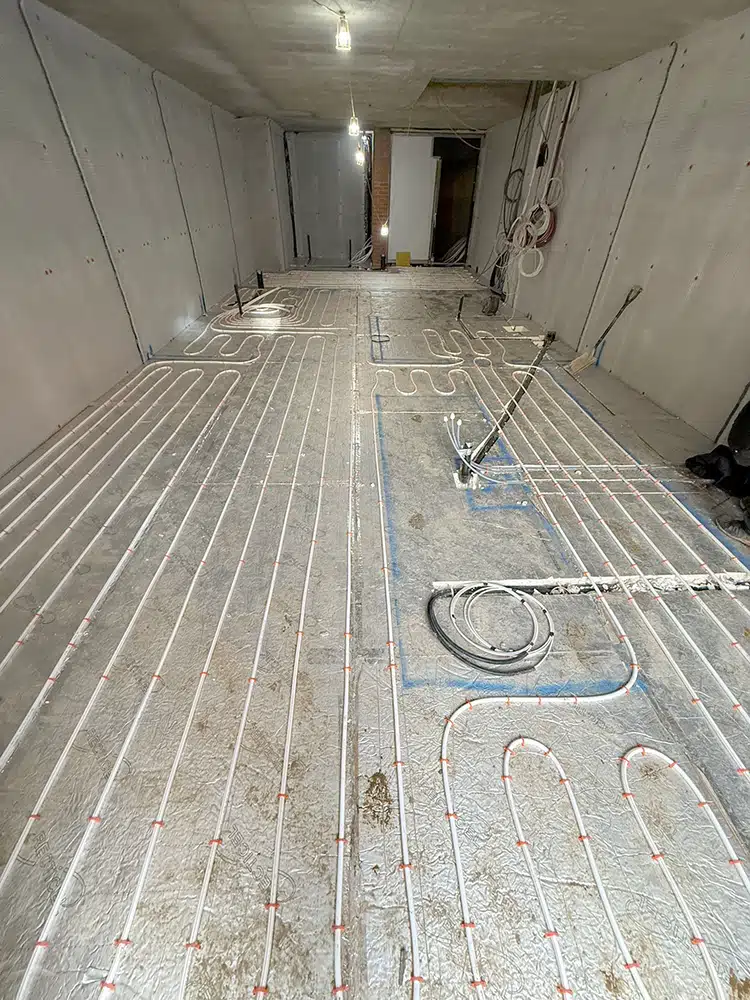
Underfloor heating works through the screed. The pipes sit on insulation, and the screed around them has to encapsulate every pipe with no air gaps and cover them deeply enough for strength and even heat. A liquid screed needs 25mm or more on top of the pipes, which puts the floor at 45 to 50mm overall. Hand-laid sand and cement wants nearer 45mm above the pipes, so the whole floor sits deeper.
In a Victorian terrace, the chance to add heating comes when the suspended timber or unprotected solid floor is replaced with an insulated slab. The depth for insulation, pipes and screed can be designed in from the start, so a heated floor costs little extra height. Retrofitting heating over an existing floor is harder, because thresholds and door heights limit how much can be added.
Homes built from 1973 to 1999 account for 32% of Chatham's stock, and extensions to houses of that period face the same questions: whether to heat the new room, and how to match the old floor level. A converted garage in Walderslade is similar, since its floor has to be raised and insulated anyway.
Before pouring, we look at the edge strip, insulation and membrane, and can provide any that are missing. That strip around the walls takes up the movement when the heating warms the floor. For typical depths across different build-ups, read our screed thickness guide. If the old floor itself is the problem, see sand and cement screed in Chatham.
Switching on Chatham underfloor heating after screeding
A new heated floor must be brought up to temperature slowly. Calcium sulphate can normally be warmed from about day 7, while sand and cement has to wait 21 days or more. On that first run, the flow temperature goes up a little at a time over several days and then holds, instead of being turned straight to full.
You get the heat-up plan in writing, so your heating engineer and flooring fitter both work from it. Warming it up under control also dries the floor out before tiles, LVT or engineered wood go down.
In Capstone Valley or Brompton, as anywhere in Chatham, book the screed once the pipes are fixed and pressure tested, so there is no long gap in which they can be damaged by other trades on site.
Liquid is a common pick over heating pipes, as it surrounds them completely and warms the room sooner. On 2026 published figures, liquid screed laid over underfloor heating comes in at £20 to £35 per m². Read about anhydrite flow screed in Chatham if your specification names a calcium sulphate grade, and see underfloor heating screed in Maidstone for homes about 8 miles away.
Underfloor Heating Screed prices in Chatham
Liquid screed over underfloor heating: £20 to £35 per m² supplied and laid (trade2base, June 2026), so £700 to £1,230 for 35 m². trade2base gives these figures excluding VAT. See our floor screeding cost guide or screed calculator.
Who lays your underfloor heating screed in Chatham
K & B Screeding’s own team, led by director Donatas Bardisevicius. Founded 2019, company 12298780.
See what customers say in our Google reviews and on our testimonials page.
Underfloor Heating Screed from Slough to Chatham
On the map, Chatham sits east of Slough, about 51.6 miles from our base in a straight line (postcodes including ME4 and ME5), next to Rochester (1 miles), Gillingham (2.5 miles), Snodland (5.2 miles) and Maidstone (7.7 miles).
More on underfloor heating screed, part of our screeding services.
