
Pipe cover and floor height in Northfleet retrofits
The screed is what turns a grid of warm pipes into a warm floor. It has to wrap every pipe with no air pockets and be deep enough over the top to spread the heat and carry the load.
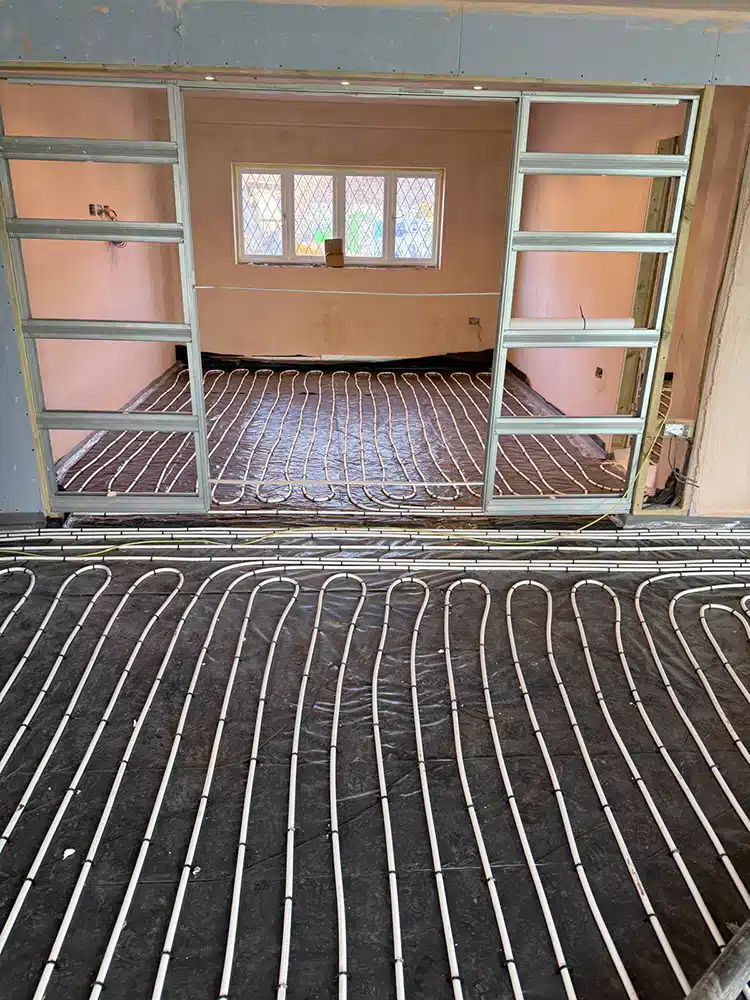
Pumped liquid needs 25mm or more above the top of the pipes, which puts the finished layer at roughly 45 to 50mm. A traditional mix laid by hand needs roughly 45mm above them, which makes the whole floor thicker. Below the pipes sit the insulation and a membrane, with an edge strip round the walls to let the screed expand.
In an older house the difficulty is height. Doors, skirting and the step into the hall are already fixed, and digging deeper may mean taking out the old slab altogether. A liquid screed usually helps, because it reaches the required cover in a thinner layer. Add up your own build with our guide to screed depths.
Extensions are simpler, since the floor level can be designed around the heating from the start. Only 7% of Northfleet homes date from 2000 to 2014, and on newer builds the insulation depth is generally allowed for in the design. On pour day the pipes need to be down, clipped and through their pressure test, with the insulation and edge strip in place for us to check. Where either of those is still to do, we can supply it through our insulation, membrane and edge strip work.
Switching the heating on in a Northfleet screed
The first weeks after a pour decide how long a heated floor lasts. Turn the heating up too soon or too fast and the screed can crack or curl at the edges.
Timings depend on the material. With calcium sulphate, warmth can usually be introduced from about the seventh day. A sand and cement floor stays unheated for 21 days or longer. Either way, the flow temperature begins low and is stepped up over several days, in line with the screed maker's heat-up schedule and your engineer's commissioning plan. You get that guidance from us on paper when we finish.
This matters for flooring too. A heated floor is usually the fastest route to a dry screed, because controlled warmth drives out moisture that would otherwise take weeks to leave. Even so, test the moisture before any tiles, LVT or engineered boards are laid on it.
If the heated room is a large open kitchen or a garden room, a pumped liquid screed over the pipes is usually the quicker choice. The same service is available 4.5 miles away for underfloor heating screed in Dartford.
Underfloor Heating Screed prices in Northfleet
Liquid screed over underfloor heating: £20 to £35 per m² supplied and laid (trade2base, June 2026), so £700 to £1,230 for 35 m². trade2base gives these figures excluding VAT. See our floor screeding cost guide or screed calculator.
Who lays your underfloor heating screed in Northfleet
K & B Screeding’s own team, led by director Donatas Bardisevicius. Founded 2019, company 12298780.
See what customers say in our Google reviews and on our testimonials page.
Underfloor Heating Screed from Slough to Northfleet
Northfleet is about 43.3 miles east of our Slough base as the crow flies, with postcodes including DA11. The nearest towns to it are Gravesend (1 miles), Tilbury (1.7 miles), Swanscombe (2.8 miles) and Grays (2.9 miles).
More on underfloor heating screed, part of our screeding services.
