
Levelling floors for Northfleet shop and office refits
When a unit changes hands, the new tenant usually wants a new floor finish, and the slab under the old carpet tiles is rarely flat enough for it. Adhesive residue, patched trenches and old screed repairs all show through thin sheet vinyl or LVT.
Flatness is measured against BS 8204 using a 2m straightedge. SR1 means a gap no wider than 3mm beneath the straightedge, while for SR2 the figure is 5mm and for SR3 10mm. Thin sheet finishes often need SR1, and shop and office fit-out specifications normally ask for it.
Preparation comes first in any Northfleet unit. We strip old glue and any weak top layer, fill the cracks and holes, and prime to suit whatever is underneath, be it concrete, screed or an existing finish. The compound goes on after that, normally between about 2mm and 10mm thick. Fast drying products let flooring follow soon after, which helps when a refitted unit has to reopen quickly.
Some floors need more than a compound. A slab that is badly worn, cracked or out by more than the compound can take may need concrete floor repair or grinding first. Large warehouse floors, such as the one at Northfleet 168, fall under heavy commercial work rather than a fit-out levelling job. For shallow build-ups in tight spots, a thin latex screed of a few millimetres can also be the right answer.
Old floors and extension joins in Northfleet homes
At home, levelling usually comes up in two situations. One is a solid ground floor, laid long ago, that has sunk unevenly with age. Semi-detached houses make up 32% of Northfleet homes, and in any house with some age to it, a ground floor that has been patched and re-covered several times can end up uneven. Taking those back to a sound base and pouring a thin compound gives a floor that LVT will lie flat on.
The second is the line where an old house meets a new extension. Even when the two floors were meant to match, there is often a small step or a slope across the join. A levelling compound feathers the two together so one continuous floor can run through.
There is a limit. Compound is meant for a few millimetres, not a few centimetres. Used thickly as a stand-in for a new screed, compound tends to crack and part company with the base. When the dip goes past about 10mm, or the base itself is crumbling, the right repair is a new sand and cement floor in Northfleet. We will say so at the survey, rather than sell a compound that fails.
How we price floor levelling in Northfleet
A fixed written price within 24 hours, once we know the area and the base. See our floor screeding cost guide.
Who levels your floor in Northfleet
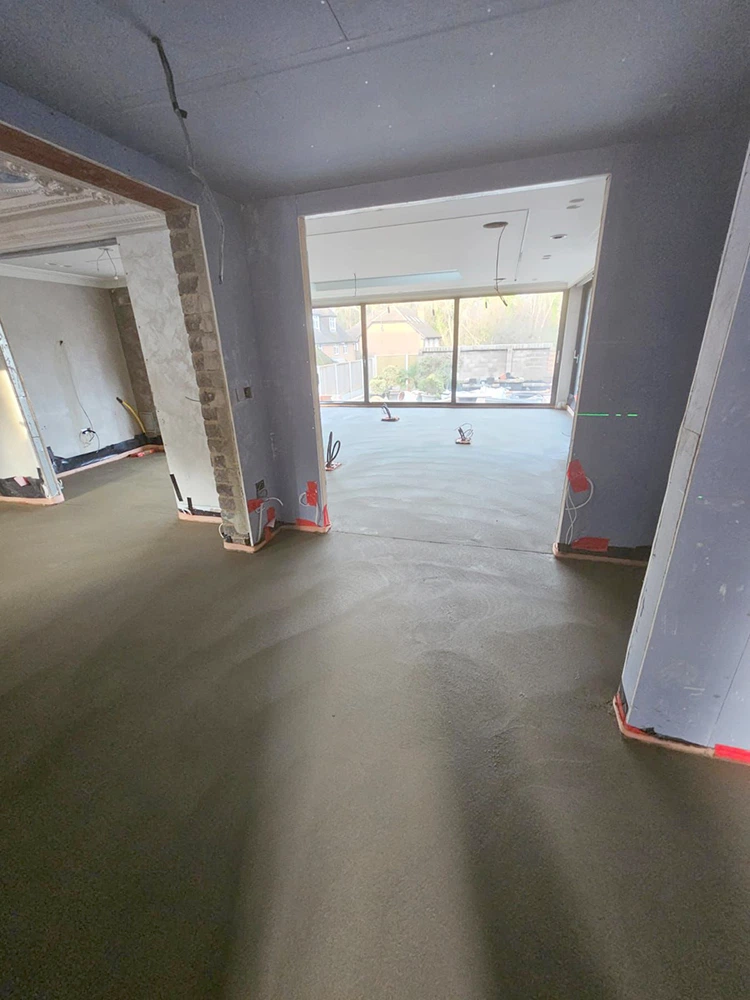
K & B Screeding’s own team, led by director Donatas Bardisevicius. Founded 2019, company 12298780.
See what customers say in our Google reviews and on our testimonials page.
Floor Levelling from Slough to Northfleet
Northfleet is about 43.3 miles east of our Slough base as the crow flies, with postcodes including DA11. The nearest towns to it are Gravesend (1 miles), Tilbury (1.7 miles), Swanscombe (2.8 miles) and Grays (2.9 miles).
More on floor levelling, part of our screeding services. Not sure whether you need a thin compound or a full flowing screed? See self levelling screed explained.
