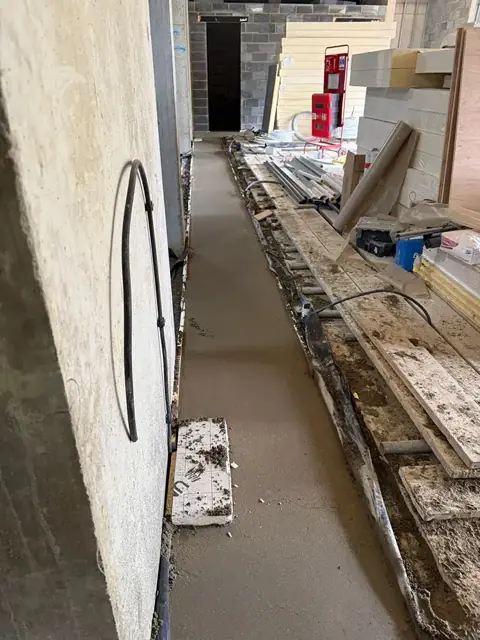
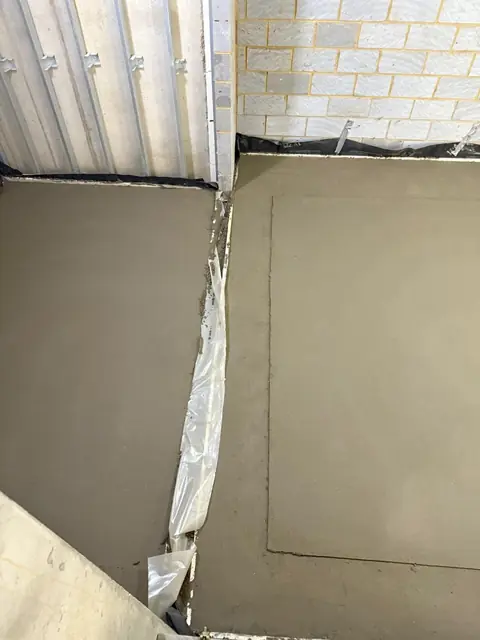
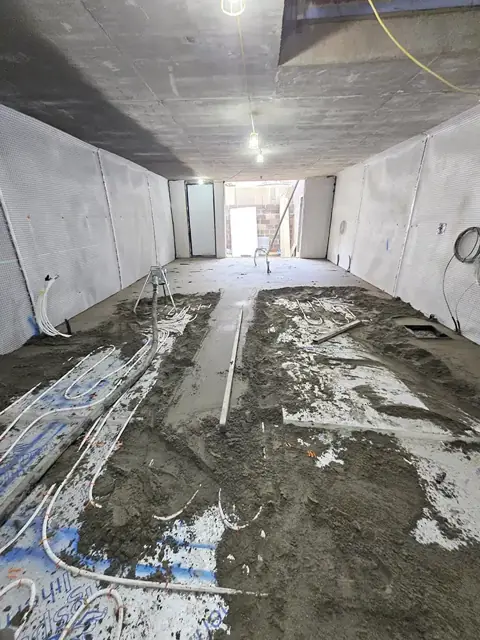
Garage slabs carry cars, workshop floors take dropped tools and jacks, and warehouse floors see pallet trucks crossing the same joints many times a day. Over time that shows as cracks, broken joint edges, spalled patches and dips where water sits. Left alone, most of these problems get worse and show through any coating or floor covering laid on top. K & B Screeding finds the cause and repairs the slab before any new finish goes down.
We repair concrete slabs in homes, garages, warehouses and commercial units across London and the Home Counties. This page covers the concrete itself. If the problem is in a sand and cement or liquid screed laid over the slab, our screed repairs page is the one you need.
Common concrete floor problems we repair
- Cracks. Fine shrinkage cracks, straight cracks across the slab, and cracks that open and close as the floor moves.
- Spalling. The top of the concrete breaking away in flakes or chunks, often around joints, drains and heavily used areas.
- Damaged joints. Broken arrises, the edges either side of a joint, which catch wheels and get worse every time something crosses them.
- Dusting and surface wear. A weak surface that keeps producing dust, or a worn top that has exposed the aggregate.
- Uneven and sunken areas. Dips, trips and ponding where the slab has settled or was never finished flat.
Finding the cause before we repair
A crack is a symptom. Before we price anything, we look at the pattern of damage, tap for hollow areas, check whether cracks are moving and look for damp. If the ground under the slab has settled, that is a matter for an engineer, and we will say so.
| Problem | Typical signs | Usual repair |
|---|---|---|
| Shrinkage cracking | Fine cracks, often at corners, columns and doorways | Cut out, clean and fill with resin or repair mortar |
| Moving crack | Crack that reopens after filling or has a step either side | Crack stitching, or forming a proper joint |
| Spalled surface | Flaking, pitting or broken patches | Cut back to sound concrete and patch repair |
| Broken joint edges | Chipped arrises, rattling as wheels cross | Joint arris repair with a suitable repair mortar |
| Worn or dusting surface | Dust that keeps coming back, exposed aggregate | Grind back and resurface with a bonded screed or compound |
| Uneven or sunken areas | Dips, trips and standing water | Bonded screed or levelling compound to restore the level |
Swipe the table sideways to see every column.
How we repair concrete floors
- Assess. We inspect the slab, map the cracks, hollow areas and damaged joints, and agree the repair and the finish it must suit.
- Cut back. Damaged concrete is removed to sound material, with the edges of each repair cut square so the patch does not feather out and break away.
- Prepare. The repair area, and the wider floor if it is being resurfaced, is mechanically cleaned to remove dust, laitance, oil and old coatings.
- Prime or bond. A primer or bonding coat suited to the repair product is applied, at the right time, so the new material bonds to the old slab.
- Repair. Cracks are filled or stitched, patches and joints are rebuilt with repair mortar, and larger areas are resurfaced where needed.
- Finish and hand over. Repairs are finished flush with the floor, and we tell you when the floor can be used and when coatings or floor coverings can go down.
Crack repairs
Stable cracks are opened up along their length, cleaned out and filled with a resin or repair mortar that suits the width and the use of the floor. A moving crack filled rigidly will simply crack again beside the repair, so we stitch it or form a joint that allows the movement.
Patch and joint repairs
Spalled and broken areas are cut back with straight edges, prepared and rebuilt with a repair mortar chosen for the depth and the traffic the floor takes. On warehouse and workshop floors we rebuild broken joint edges and keep the joint open so the slab can still move.
Resurfacing
When the whole surface is worn, uneven or covered in old repairs, patching stops making sense. A thin bonded screed laid onto the prepared slab gives a new, hard wearing surface and can correct the level at the same time. On heavily loaded floors, a high strength screed may suit better. Where the slab is sound and only needs to be flat and smooth for a floor covering, a levelling compound is often enough. Our screed thickness guide explains typical minimum depths for bonded screeds.
Preparation decides whether a repair lasts
A repair usually fails at the bond, not in the repair material. Repair materials will not stick to dust, laitance, oil or paint, so we prepare the concrete mechanically, usually by grinding or shot blasting. Our floor preparation page describes the methods we use.
Repair or replace?
Repair makes sense when the slab is sound in most places and the damage is local or on the surface. Replacement, or an engineer's assessment, is the better route when the slab is breaking up across the floor or has settled. We will tell you which applies and why.
Garage, domestic and commercial floors
In homes, most repairs are in garages, outbuildings and older ground floors being prepared for new flooring. A garage being converted into a room usually needs more than a repair, and our garage floor screed guide covers the full build-up. We also repair slabs as part of residential screeding projects.
On commercial floors such as warehouses, workshops and retail units, we can plan repairs in sections so the building stays in use.
What affects the cost
Every repair is priced on the floor itself. The main factors are the number and width of cracks, the area and depth of patch repairs, the length of joints to rebuild, the preparation needed, access, and whether the work has to be done in phases around an occupied building. Our floor screeding cost guide explains how resurfacing with a screed is usually priced. Once we have seen the floor, you get a fixed price, agreed before any work starts.
Where we repair concrete floors
We cover London and the Home Counties from our base in Slough, including Slough itself, Reading, Uxbridge and across London. We also take on preparation and remedial work further afield, including Northampton.
“I used K & B for a screeding job at the beginning of the year (Jan 2023), extremely competitive quotation and first class delivery, on time and on budget.”
Part of our screeding and floor screeding services, laid by our own team across London and the Home Counties.