
Flat floors for Tilbury terraces and estate homes
Homes built between 1973 and 1999 make up 28% of Tilbury's housing, with inter-war and post-war houses alongside them. Where those houses have concrete ground floors, decades of use, patching and old floor coverings mean they are rarely flat enough for modern finishes.
Rigid click LVT, large format tiles and engineered boards all show the problem quickly. A dip makes a board flex and click, a hump lifts a tile edge, and sheet vinyl shows every ridge beneath it. To judge flatness, lay a 2m straightedge across the floor: SR2 permits 5mm of gap beneath it, SR1 just 3mm, and plenty of thin sheet coverings insist on SR1.
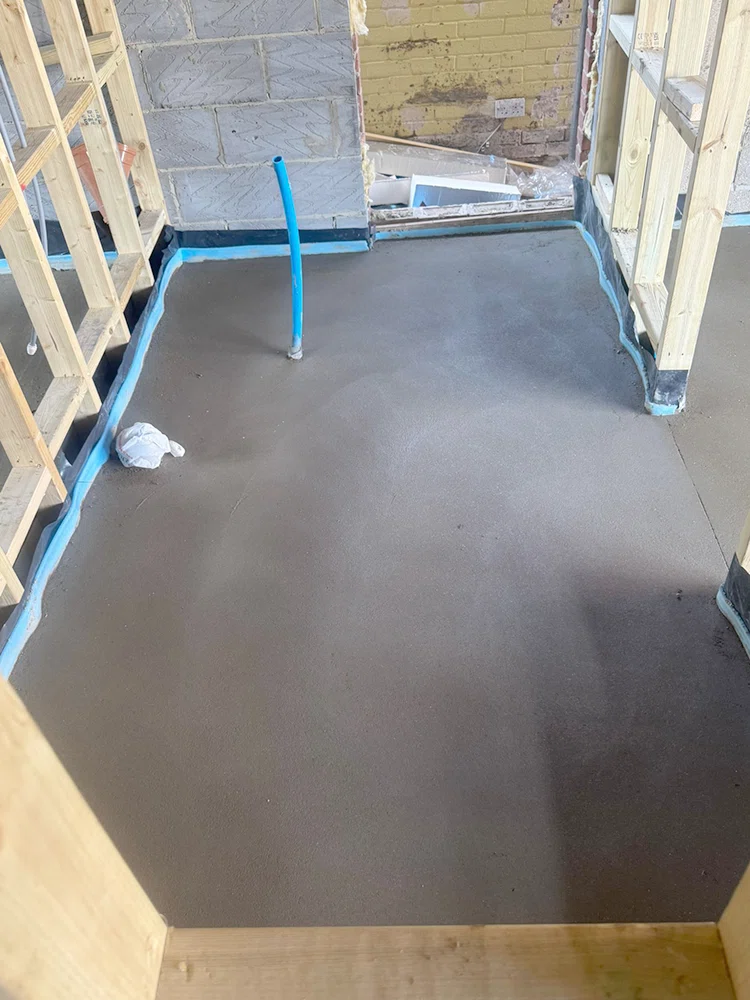
A pour of compound brings the floor within those limits. We scrape off old glue and anything loose, prime the surface, then pour and spread the compound, which settles flat at a depth usually between 2mm and 10mm. Fast drying products mean the flooring fitter is not kept waiting long, because a layer only a few millimetres deep holds far less water than a screed.
It is not the right fix for every floor. Where the slab has cracked, come loose or turned damp, or the dip is deeper than compound will take, the right fix is rescreeding, since compound piled thick in place of a screed is prone to cracking and debonding. In that case the Tilbury sand and cement screed page explains the rebuild.
Refurbished flats and commercial units in Tilbury
Flats bring their own constraint, which is height. When a flat is refurbished, raising the floor by a screed's depth would upset doors, kitchen units and the threshold to the communal hall. A thin latex or self-levelling finish instead brings the existing floor back to tolerance while adding only a few millimetres. Latex compounds are typically a few mm thick, and the latex screed service covers them.
Primers matter on every base. Bare concrete, calcium sulphate and sand and cement screeds all need their own primer, and the wrong pairing can leave the compound loose. We check the base before choosing products, and old adhesive or loose patches are scraped off first so the primer reaches sound material.
Refitting a shop or office in Tilbury works the same way. When a unit changes tenant, the old covering comes up and the base underneath is often uneven, so a skim of compound gives the new finish a flat start. The industrial units on Hume Avenue and the warehouse and yard floors at London Distribution Park and the Port of Tilbury are a heavier job, where concrete floor repair and grinding come before any finish.
How we price floor levelling in Tilbury
A fixed written price within 24 hours, once we know the area and the base. See our floor screeding cost guide.
Who levels your floor in Tilbury
K & B Screeding’s own team, led by director Donatas Bardisevicius. Founded 2019, company 12298780.
See what customers say in our Google reviews and on our testimonials page.
Floor Levelling from Slough to Tilbury
Tilbury is about 43.8 miles east of our Slough base as the crow flies, with postcodes including RM18. The nearest towns to it are Gravesend (1.3 miles), Northfleet (1.7 miles), Grays (2 miles) and Swanscombe (3.5 miles).
More on floor levelling, part of our screeding services. Not sure whether you need a thin compound or a full flowing screed? See self levelling screed explained.