
Heated extensions on Tilbury terraces and ex-council homes
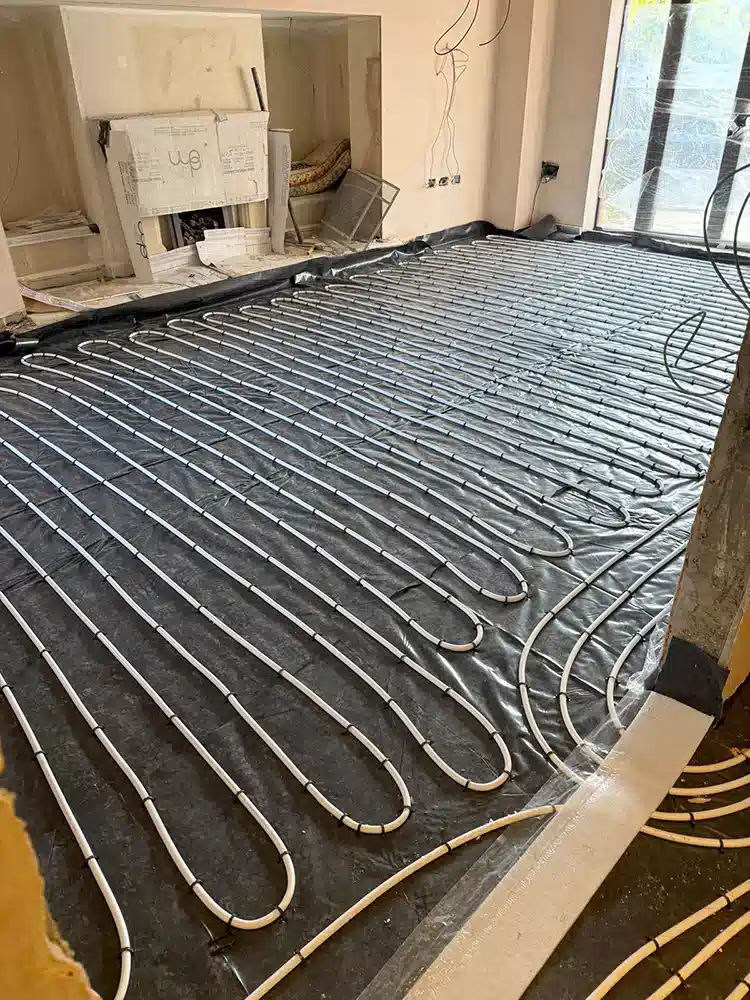
A rear extension is the simplest way to get underfloor heating into a Tilbury house, because its floor is built new from the slab up. From the bottom: insulation, then a membrane, then the pipes (your heating engineer's job, pressure test included), an edge strip at the walls and finally the screed.
How much screed goes over the pipes depends on the type. Pumped liquid wants 25mm or more over the pipes, giving a layer of roughly 45 to 50mm. Trowel-laid sand and cement must sit roughly 45mm deep over those pipes, so that floor finishes higher. When the extension has to sit flush with the existing kitchen, those few millimetres often settle it. A liquid screed also flows fully around the pipes, which leaves no air gaps and helps the floor warm up faster.
Retrofitting heating into the older part of the house is harder. Digging out the old solid floor makes space for insulation and pipes, while the doors and thresholds dictate where the new surface finishes. It can be done, but it is a bigger job than the extension, so plan it early and price both parts together.
New homes are usually built with the system from the start. Some 8% of Tilbury's homes were built since 2015, and recent schemes of that kind typically use insulation and a flowing screed over the pipes. The screed thickness guide sets out typical depths for other build-ups.
Bringing Tilbury heated floors up to temperature
The screed has to cure before the heating can help dry it. Calcium sulphate will normally take low heat from about the seventh day. With sand and cement, leave it 21 days or more before switching on.
Start low. The heating engineer commissions the system at a gentle flow temperature and raises it in steps over several days, then holds it before any finish is laid. Rushing to full heat can crack the screed or lift its edges, and the damage often shows only after the flooring is down. Our written notes give your heating engineer and floor fitter one timetable to follow.
Floor finishes then follow the moisture test, not the calendar. Tiles, LVT and engineered wood each have their own moisture limit, and a heated floor that has been commissioned properly reaches it sooner. If calcium sulphate is named on your plans, the sanding and testing it needs are covered on our Tilbury anhydrite page. Pumped over heating pipes in a Tilbury extension, liquid screed costs from £20 up to £35 per m², going by the 2026 published figures.
Underfloor Heating Screed prices in Tilbury
Liquid screed over underfloor heating: £20 to £35 per m² supplied and laid (trade2base, June 2026), so £700 to £1,230 for 35 m². trade2base gives these figures excluding VAT. See our floor screeding cost guide or screed calculator.
Who lays your underfloor heating screed in Tilbury
K & B Screeding’s own team, led by director Donatas Bardisevicius. Founded 2019, company 12298780.
See what customers say in our Google reviews and on our testimonials page.
Underfloor Heating Screed from Slough to Tilbury
Tilbury is about 43.8 miles east of our Slough base as the crow flies, with postcodes including RM18. The nearest towns to it are Gravesend (1.3 miles), Northfleet (1.7 miles), Grays (2 miles) and Swanscombe (3.5 miles).
More on underfloor heating screed, part of our screeding services.