Heated extensions on Basildon's new town houses
A rear extension or a knocked-through kitchen diner is the natural place for underfloor heating in a Basildon house. The new floor has to carry the pipes, insulation below them and enough screed above, while still finishing level with the old concrete slab in the rest of the house. That is where the screed choice matters.
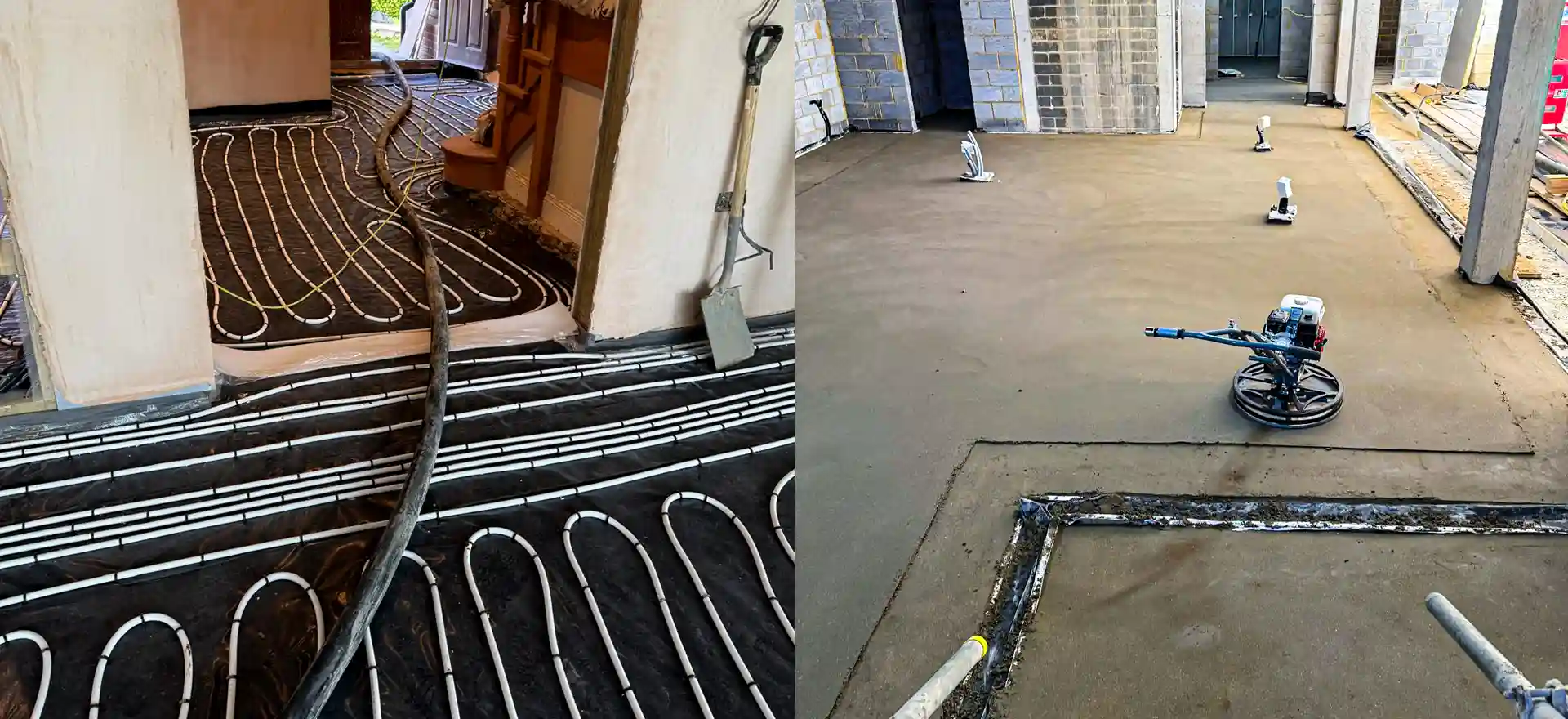
With a pumped screed, 25mm above the pipes is the minimum, giving a floor of 45 to 50mm overall in most cases. Because it surrounds each pipe completely and leaves no air gaps, warmth travels evenly and reaches the surface sooner. Hand-laid sand and cement wants about 45mm above the pipes instead, so the build-up gets thicker. Where a Basildon extension has to line up with the existing threshold, that difference in depth often settles the choice.
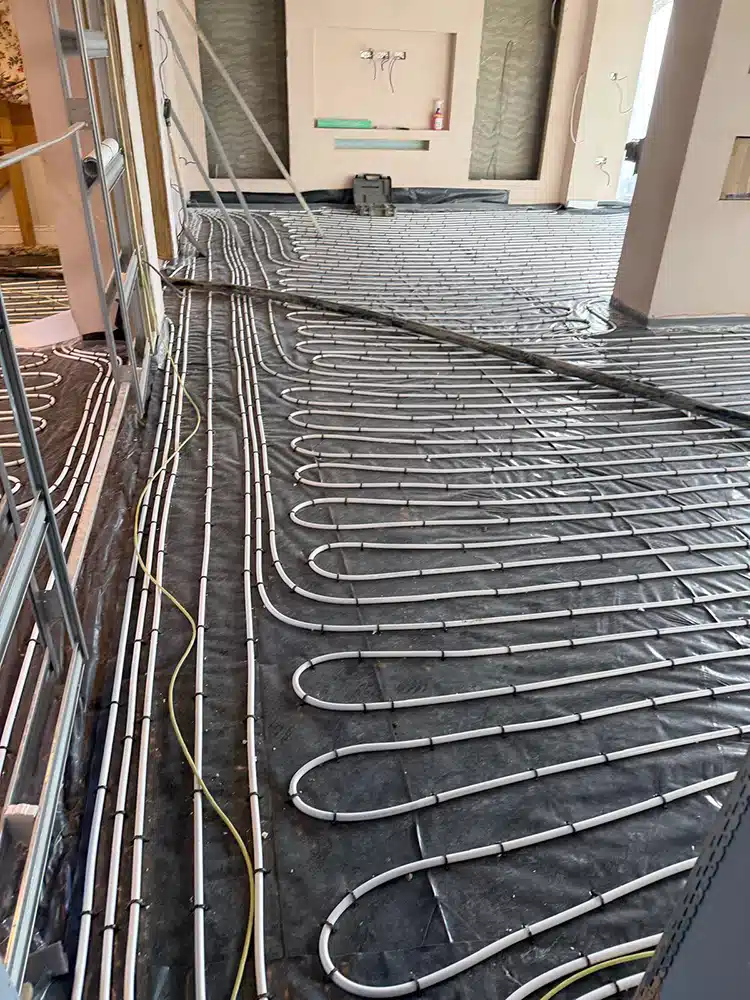
Some preparation comes before our visit. The pipes should be clipped down and pressure tested, the insulation and membrane laid, and an edge strip fixed around every wall to take the expansion when the floor warms. On arrival we go over each item, and we can provide the insulation and membrane ourselves if you need them.
For a larger or more open floor, the liquid screed page covers pumping and flatness in more detail. Where heating is going into an older room and the existing slab is being dug out, the hand-laid sand and cement option explains the depths and the dig.
Switching the heating on after a Basildon pour
The heating must not be used to dry a new screed straight away. With a calcium sulphate pour, gentle warming can normally start around day 7. Sand and cement needs a minimum of 21 days before any heat goes in. After that, the system is brought up gently over several days, a few degrees at a time, and held before the floor goes to full temperature. Commissioning it too fast can crack the screed or pull it away from the edges.
You get the warm-up steps from us on paper, so the heating engineer and the flooring fitter follow one schedule. Force drying with the heating is one way to get a calcium sulphate floor ready for coverings sooner, and our guide to how long screed takes to dry explains what to expect.
Price comes down to floor size, depth and the screed chosen. Liquid screed over heating pipes is listed at £20 to £35 per m² in the published 2026 UK prices. A heated kitchen diner in Laindon or an extension in Langdon Hills is priced within that range once access and depth are known, and the same service covers heated floors in nearby Wickford.
Adding heating when a cold Basildon ground floor is replaced
Terraced houses make up 44% of Basildon's homes, and new town terraces from the 1950s to the 1980s often have cold, uninsulated ground floors. When one of those floors is broken out and replaced, the new build-up already includes insulation and a screed, so adding wet underfloor heating at the same stage is far simpler than retrofitting it later.
The new floor has to finish where the old one did, at the front door, the stairs and the kitchen units. Working down from that level, the floor covering, the screed and the insulation all need space, and the dig depth follows. Because a liquid screed is thinner than a hand-laid one over the same pipes, the choice of screed changes how much has to come out, and it is settled before the digging starts.
Access is the other planning point in a terrace. With no side passage, everything comes through the house. A hand-laid sand and cement screed is barrowed through the hall, while a liquid screed arrives by pump hose, which avoids barrow traffic but needs the lorry and pump parked close to the front.
Room by room, the heating zones are agreed with your heating engineer, and movement joints sit at the doorways between them. The old slab and any rubble have to leave by the same route the new materials come in, so a skip or grab lorry is booked for the front of the house.
Underfloor heating screed prices for Basildon floors
Liquid screed over underfloor heating: £20 to £35 per m² supplied and laid (trade2base, June 2026), so £700 to £1,230 for 35 m². trade2base gives these figures excluding VAT. See our liquid screed cost per m² guide, the floor screeding cost guide or the screed calculator.
Who lays your underfloor heating screed in Basildon
K & B Screeding, led by director Donatas Bardisevicius. Founded 2019, company 12298780.
See what customers say in our Google reviews and on our testimonials page.
Underfloor heating screed from Slough to Basildon
On the map, Basildon sits east of Slough, about 47.4 miles from our base in a straight line (postcodes including SS13, SS14, SS15 and SS16), next to Stanford-le-Hope (3.1 miles), Billericay (4 miles), Wickford (4.2 miles) and Rayleigh (6.7 miles).
Where the screed lorry must park in a marked bay in Basildon, a suspension or dispensation from the South Essex Parking Partnership (dispensation and suspension permits) covers it; the quote tells you if it is needed.
More on underfloor heating screed, part of our floor screeding service. For every screed we lay locally, see floor screeding in Basildon.
Further reading: screed depth for underfloor heating and underfloor heating on a concrete floor.