
Relaying failed solid floors in older Northfleet terraces
A tired solid floor gives itself away. Tiles crack along the same line, floor coverings lift, or a dip runs across the back room. When the damage goes deeper than the surface, patching rarely lasts, and the better answer is to take the floor out and build it again.
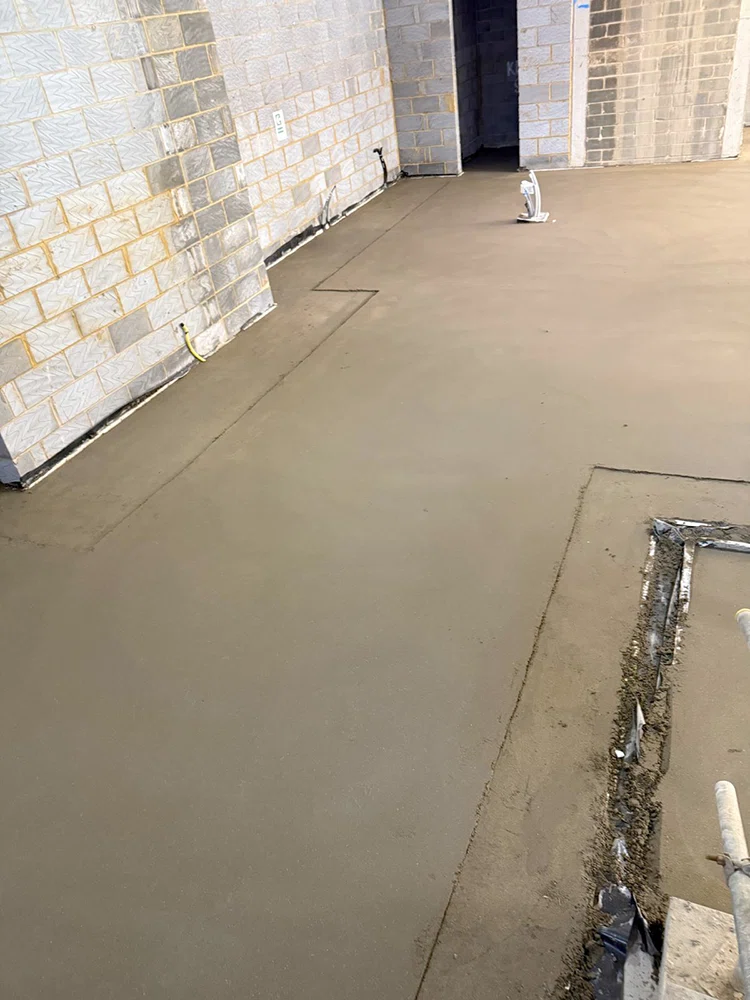
The new floor goes down in layers. A damp proof membrane comes first, then rigid insulation, then the screed laid over the top as a floating screed. For a house we lay it 65mm deep, and a commercial floor gets 75mm. We mix it on site, place it bay by bay, compact it by hand and finish it level, ready for tiles, wood or vinyl.
Sand and cement suits these houses for practical reasons. Rooms are small, hallways narrow and door thresholds fixed, and a hand-laid screed can be worked into every corner without a pump parked outside. Where a terrace has no spare height for insulation, a bonded layer of 25 to 40mm can go directly onto concrete that is still sound.
Patience is the price of this mix. This mix gives up its water more slowly than a pumped floor, so allow around one day for each millimetre through the first 40mm. Where that holds up a project, rapid drying additives help, and our quick drying screed service covers them. Fibres can be added to reduce cracking, and Northfleet also has 17% of homes built between the wars, whose floors can need the same treatment.
Garages, wet rooms and falls in Northfleet houses
Certain rooms in a Northfleet house call for cement regardless of what the rest of the floor is made of. A walk-in shower or a full wet room is the clearest case. Water must run to the drain, sometimes from two or more sides, and calcium sulphate is the wrong material for a floor that may sit damp. Laying by hand lets us trowel those slopes in precisely.
Garage conversions are another. Expect the garage floor to sit below the house, quite possibly cracked or stained with oil. Building it up with insulation, a membrane and sand and cement lifts it level with the hallway and turns it into a room warm enough to use every day. The full build-up is in our garage conversion floor guide.
Where a floor has to take load early, such as a workshop or a room where heavy units go in soon after, cement screed is the sensible base. It can be strengthened with fibre reinforcement at an extra £1 to £3 per m².
About 2.8 miles away, we also lay sand and cement screed in Swanscombe on the same terms.
Sand and Cement Screed prices in Northfleet
Sand and cement screed: £18 to £25 per m² supplied and laid (MyJobQuote, August 2026), so £450 to £630 for 25 m². MyJobQuote does not say whether these figures include VAT. See our floor screeding cost guide or screed calculator.
Who lays your sand and cement screed in Northfleet
K & B Screeding’s own team, led by director Donatas Bardisevicius. Founded 2019, company 12298780.
See what customers say in our Google reviews and on our testimonials page.
Sand and Cement Screed from Slough to Northfleet
Northfleet is about 43.3 miles east of our Slough base as the crow flies, with postcodes including DA11. The nearest towns to it are Gravesend (1 miles), Tilbury (1.7 miles), Swanscombe (2.8 miles) and Grays (2.9 miles).
More on sand & cement screed, part of our screeding services.
