
Matching new floors to old in Swanley extensions
The hardest part of an extension floor is the join. The new room has to finish at exactly the same level as the house it adjoins, and an existing floor is not always dead level to begin with.
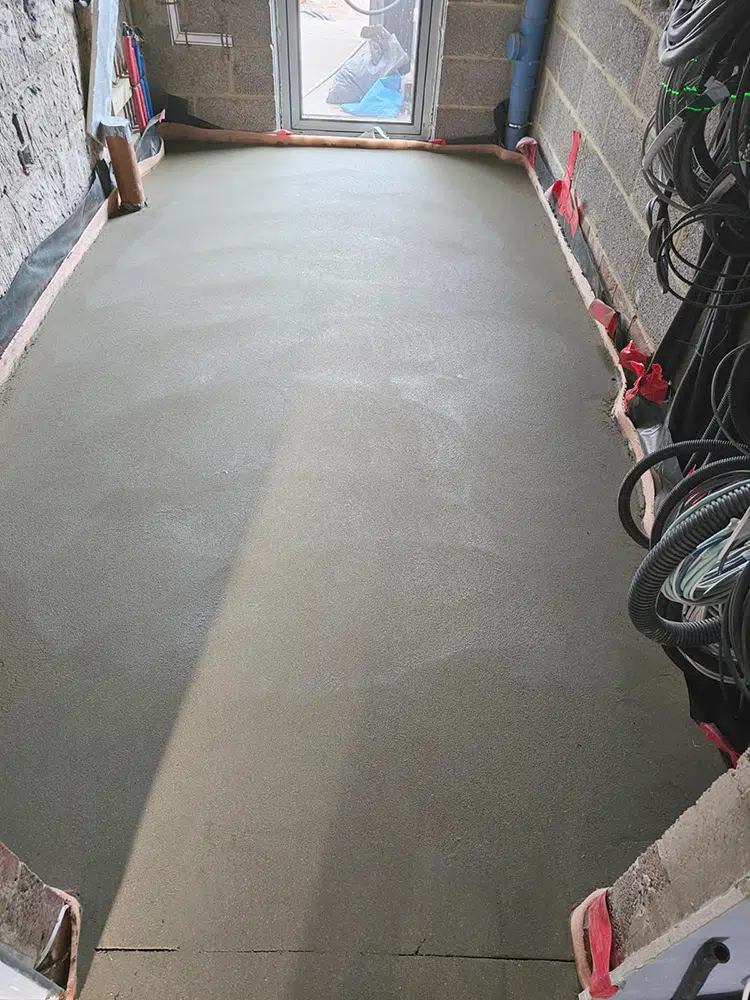
A hand-laid sand and cement screed solves that by being set out to the existing floor. We fix the level at the doorway and rule the new screed to it, adjusting the depth where the old floor runs out. The same approach works in a narrow utility, a hallway or a small room where a pumped screed would be awkward.
It goes down in one of two forms. A floating screed sits on insulation and must be at least 65mm thick in a house, or 75mm in commercial use. Bonded, it is glued to sound concrete with a bonding agent and may be just 25 to 40mm deep. Our bonded screed page explains when a thinner bonded layer is possible.
Houses built before 1919 are only 6% of Swanley homes, with another 10% from between the wars. In that older stock, a failed solid floor is sometimes dug out and rebuilt with insulation, a membrane and new screed, and sand and cement suits that work well.
Under a heated extension floor, sand and cement has to clear the pipework by about 45mm. The liquid screed page for Swanley shows the thinner pumped alternative.
Swanley garages, wet rooms and drying time
Garage conversions are a steady reason to choose sand and cement. A garage floor in Swanley normally sits a step below the house, and building it up with insulation, a membrane and screed brings it level with the hall. Our garage conversion floor guide walks through each layer.
Wet rooms suit it too. A level-access shower only works if the floor slopes to the drain, and that slope can be formed by hand in a way no self-levelling screed allows. The result is a cement surface, which is what tanking kits and tile adhesives are made for, and unlike calcium sulphate it does not mind getting wet.
Drying is the slower side. The hand-laid mix gives up its water slowly, about 40mm in the first 40 days and less quickly after, so a 65mm floor waits weeks before wood or vinyl. If the kitchen is booked in, a faster drying sand and cement mix cuts that down, published at £20 to £28 a square metre. Standard hand-laid screed, by comparison, is listed at £18 to £25 a square metre.
Sevenoaks, about 8.8 miles off, has its own traditional screed page.
Sand and Cement Screed prices in Swanley
Sand and cement screed: £18 to £25 per m² supplied and laid (MyJobQuote, August 2026), so £450 to £630 for 25 m². MyJobQuote does not say whether these figures include VAT. See our floor screeding cost guide or screed calculator.
Who lays your sand and cement screed in Swanley
K & B Screeding’s own team, led by director Donatas Bardisevicius. Founded 2019, company 12298780.
See what customers say in our Google reviews and on our testimonials page.
Sand and Cement Screed from Slough to Swanley
As the crow flies, our yard in Slough is about 36.5 miles from Swanley, which lies to the east-south-east. Postcodes here include BR8, and Bexley (4.4 miles), Dartford (5.2 miles), Bromley (5.5 miles) and Swanscombe (6.2 miles) are close by.
More on sand & cement screed, part of our screeding services.