
Rebuilding terrace floors in Plumstead and Charlton
A failed ground floor in an older terrace usually shows itself slowly: tiles that lift, a floor that sounds hollow, damp at the skirting. The dependable fix is to break out the old floor, lay a damp proof membrane and insulation, and screed over the top at the right depth.
Sand and cement is well suited to that. A floating domestic screed over insulation goes down at about 65mm, while commercial floors are usually laid at about 75mm. It is mixed at the house, so each room can take its own depth, and it copes with the steps, recesses and back additions that older houses tend to have.
The screed is compacted and then power floated or trowelled to a dense finish. On a narrow terraced street, materials are barrowed through the front door, so we need to know where a delivery can be dropped and how far it is to the back room.
Where only the top of a sound concrete floor has broken down, a bonded screed of 25 to 40mm fixed to the prepared slab can save height. The concrete may need floor preparation or shot blasting first to give a good key.
Drying is slower than with pumped screed. A day per millimetre for the first 40mm is the usual rule, so a 65mm floor is a matter of weeks. If the programme cannot absorb that, a fast drying screed mix at £20 to £28 per m² can shorten the wait.
Wet rooms, falls and garages in Greenwich homes
Calcium sulphate screeds are not the right choice where water is part of daily life, so wet rooms, walk-in showers and utility areas are laid in sand and cement. A walk-in shower floor has to run down towards its drain too, and only a screed laid by hand can be trowelled to that slope; a self-levelling one settles flat.
Garages follow the same logic. A garage conversion usually means raising a low slab to the height of the house floor with insulation, a membrane and a screed, and a cement screed can take early load and knocks during the build. Our guide to screeding a garage floor walks through each layer.
A sand and cement floor also accepts extras. Mixing in fibres to cut cracking adds roughly £1 to £3 per m², and a stronger mix can be specified for floors that will take heavier use.
With 27% of homes in the borough terraced, many floors sit in narrow houses where a pump would be more trouble than it saves. For the open extension at the back of the same house, though, liquid screed for Greenwich extensions is worth comparing. Planning heating pipes under it? Hand-laid, the screed then has to sit roughly 45mm above them.
Hard wearing screeds for Charlton Riverside and Woolwich units
Charlton Riverside, between Woolwich and Greenwich Peninsula, remains largely industrial, with protected wharves such as Angerstein and Murphy's Wharf and the Westminster Industrial Estate nearby. Units like these, and the commercial space appearing with regeneration at Woolwich, need floors that are hard wearing and level. Where an old screed in a unit has broken up, or a new area needs one, a hand-laid sand and cement screed is usually the right material.
Its strength is that it puts up with use. A cement screed takes early load, copes with water from a wash-down or a leaking roof better than calcium sulphate, and a damaged area can be cut out and patched rather than the whole floor relaid. That matters in a unit that cannot be out of use for long, and our page on screed repairs covers patching.
Before pricing, it helps to know what the floor will carry: foot traffic and trolleys, pallet trucks or racking. That decides whether a standard mix is enough or a high strength screed is needed, and the depth follows the commercial figure given above.
This is still a screed, not a structural slab. New power floated warehouse slabs, resin and polished concrete are specialist trades outside our work. Where a resin finish is planned, the new screed can later be prepared for the resin contractor by concrete floor grinding in Greenwich.
Sand and cement screed prices in Greenwich
Sand and cement screed: £18 to £25 per m² supplied and laid (MyJobQuote, August 2026), so £450 to £630 for 25 m². MyJobQuote does not say whether these figures include VAT. See our screed cost per m³ and per tonne guide or screed calculator.
Who lays your sand and cement screed in Greenwich
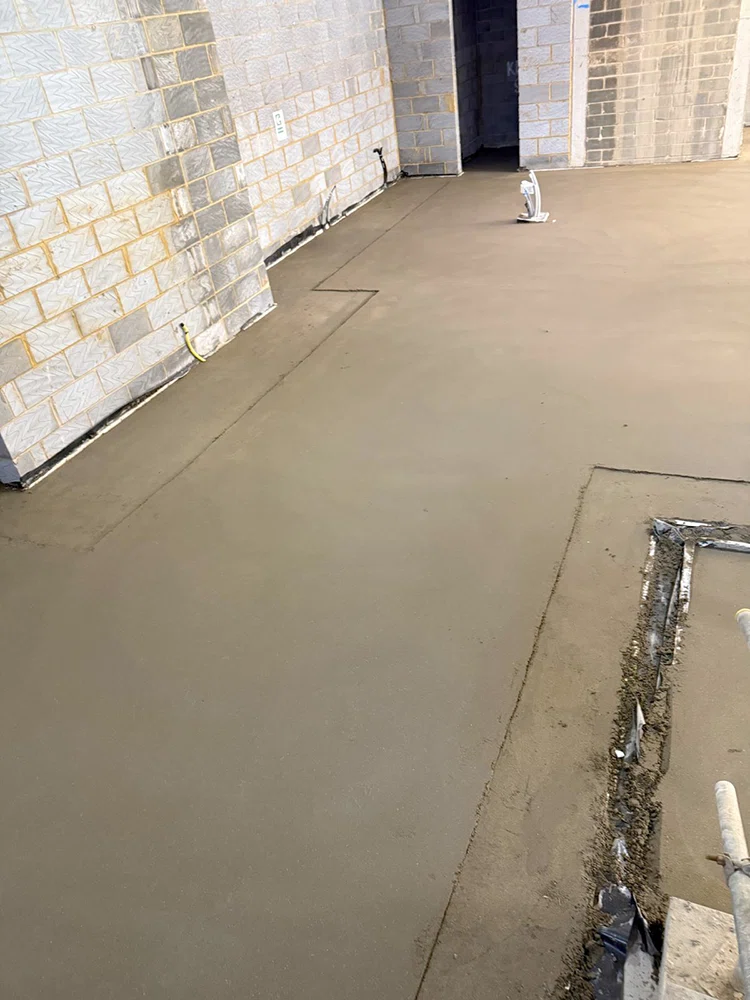
K & B Screeding’s own team, led by director Donatas Bardisevicius. Founded 2019, company 12298780.
See what customers say in our Google reviews and on our testimonials page.
Sand and cement screed from Slough to Greenwich
Greenwich is about 30.8 miles east of our Slough base as the crow flies, with postcodes including SE2, SE9, SE3 and DA16. The nearest towns to it are Bexley (3.6 miles), Newham (3.7 miles), Lewisham (4.3 miles) and Tower Hamlets (5.2 miles).
Your quote will say whether the screed pump needs road space in Greenwich. If it does, a bay suspension can be requested from Royal Greenwich (parking bay suspension). New floors in Greenwich extensions usually need building regulations approval, with Part L insulation rules in England; Royal Greenwich Building Control is the council building control service.
More on sand & cement screed, part of our screeding services. For every screed we lay locally, see floor screeding in Greenwich.
Further reading: screed thickness guide and sand and cement screed mix ratio.
