
Latex over boards and tiles in Greenwich refits
What sets latex apart is the liquid. Ordinary levelling compound is mixed with water, but latex screed comes as a cement based powder and a separate latex liquid, combined on site. The latex gives the cured layer a little give and a strong grip, which is why it is chosen over bases that a plain compound would not trust.
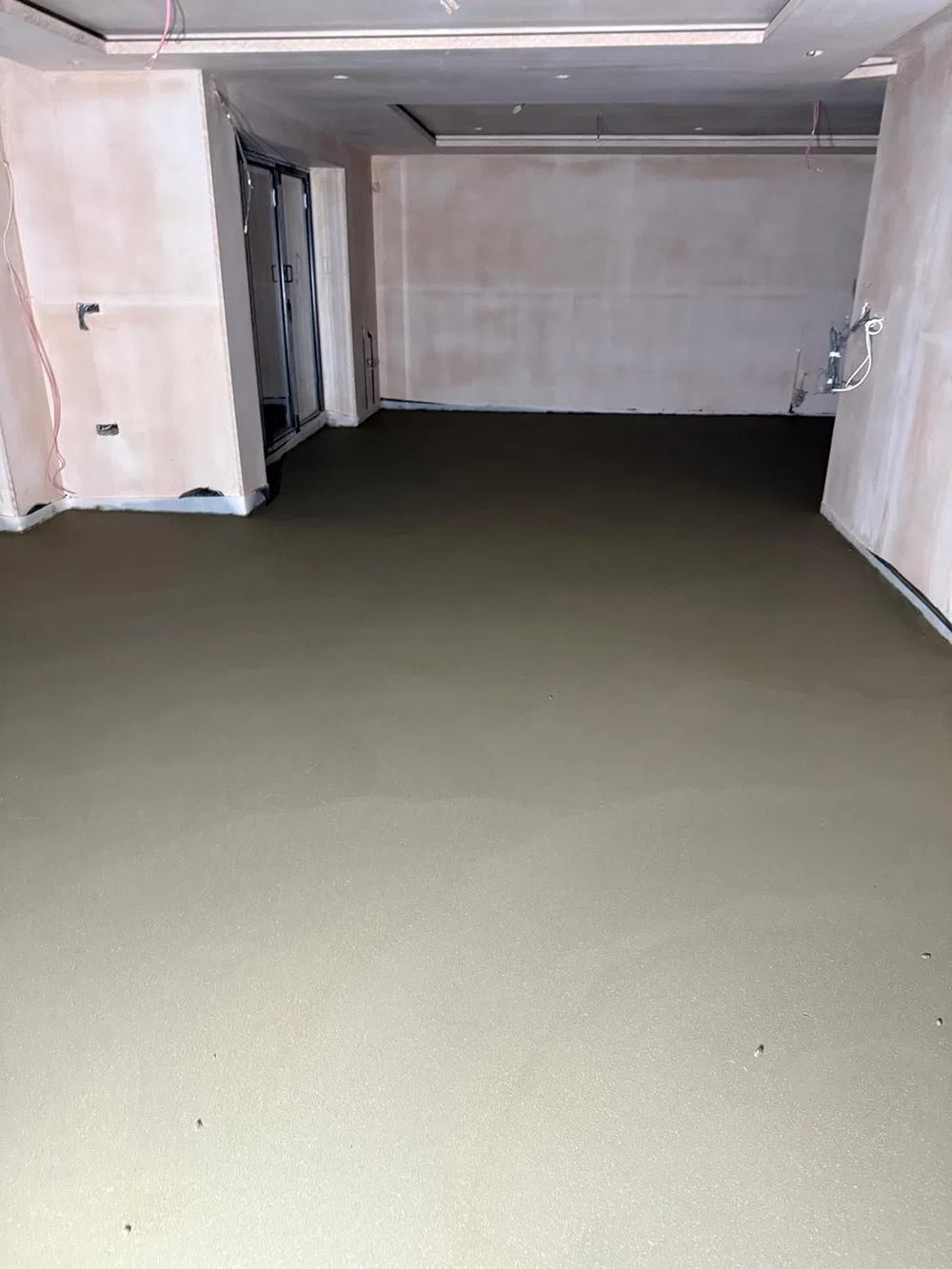
It is a finishing layer, a few millimetres deep. Think of it as the step between a sound but imperfect floor and a thin covering that would otherwise show every flaw.
Three kinds of base suit it in a refit. Timber is the first, but only once the old boards are covered with plywood sheets of flooring grade, screwed down tightly; latex is never spread on the boards themselves. Old quarry or ceramic tiles that are still firmly bonded can be primed and covered rather than chipped off. And older concrete that is sound but scarred, or carries thin, well stuck adhesive, can be brought back to a smooth face.
Almost one Greenwich home in five, 19%, was built between 1945 and 1972, and kitchens and bathrooms in housing of that era may have been refitted more than once, leaving tiles, glue or boards over the original floor. Latex lets a new finish go over those layers without tearing everything out.
Sheet vinyl, LVT, lino, rubber, safety flooring and carpet all sit better on it. Whether the refit is in Blackheath Park, Avery Hill or Abbey Wood, the floor is checked, primed for its type and then poured. If you are just over the border, see latex screed in Lewisham.
Checks before latex goes down in Greenwich
Latex will not rescue a floor with a deeper problem, so each Greenwich job starts with a look at what is underneath.
Springy boards come first. If timber flexes when you walk on it, a thin layer over the top will crack. The boards are fixed, any weak lengths replaced and plywood laid before latex is considered.
Damp is next. In the older terraces of Plumstead, Charlton and East Greenwich, a damp ground floor usually has to be rebuilt with a membrane and insulation, and no compound replaces that. Covering a damp floor with latex simply traps the problem under new vinyl.
Then the overall shape. A room that falls noticeably from one wall to another is beyond a few millimetres of latex, so a deeper levelling compound or screed repairs come first.
Primer is chosen for the base: timber, tile, concrete and calcium sulphate all differ. Calcium sulphate screeds always need their laitance sanded off and a primer made for them, which matters in newer flats where the original screed may be that material; our calcium sulphate screed page explains why.
How we price latex screed in Greenwich
A fixed written price within 24 hours, once we know the area and the base. See our floor screeding cost guide.
Who lays your latex screed in Greenwich
K & B Screeding’s own team, led by director Donatas Bardisevicius. Founded 2019, company 12298780.
See what customers say in our Google reviews and on our testimonials page.
Latex Screed from Slough to Greenwich
Greenwich is about 30.8 miles east of our Slough base as the crow flies, with postcodes including SE2, SE9, SE3 and DA16. The nearest towns to it are Bexley (3.6 miles), Newham (3.7 miles), Lewisham (4.3 miles) and Tower Hamlets (5.2 miles).
More on latex screed, part of our screeding services.
