
What latex screed does in Southwark kitchens and bathrooms
Flooring fitters call it latex, but the product is a two part levelling compound. One part is a cement based powder; the other is a latex liquid, used in place of the water an ordinary compound is mixed with. That latex gives the cured layer a little flexibility and a stronger grip on difficult surfaces, which is why it is chosen for awkward bases rather than for open, clean slabs.
It goes down thin, usually no more than a few millimetres. That is enough to bury plywood joints, screw heads, grout lines and the small hollows in an old slab, so none of them print through sheet vinyl, LVT, lino, rubber or safety flooring. Carpet benefits too, though it forgives far more.
Terraced houses make up 14% of the borough's homes, and older terraced houses commonly have suspended timber floors in at least some rooms. Boards like those are screwed down and covered with flooring grade plywood first, and the latex goes over the ply. It never goes straight onto bare floorboards, which shift with every step and would crack it.
Old quarry or ceramic tiles can stay where every one is firmly bonded. We tap them over, lift any that ring hollow, and degrease the rest. Rough concrete and some well stuck old adhesive can be covered the same way once checked.
Each base takes its own primer. A calcium sulphate screed in a newer block has its laitance sanded away and is always primed before latex goes on. Where a floor needs stripping or sanding first, our floor preparation service handles that stage.
When a Southwark floor needs more than latex
Latex smooths a floor. It does not repair one, and three problems have to be ruled out before any is mixed.
Damp is the first. Renovations of Victorian terraces in the south of the borough often uncover original solid floors with no damp proof membrane underneath. A skim of latex over a damp slab will not hold the moisture back, and the vinyl on top can lift or stain. We take a reading first, and a floor with no membrane usually needs digging out and rebuilding with insulation, a membrane and hand-laid sand and cement.
Movement is the second. Boards that bounce or creak underfoot will crack any compound. The timber is fixed down and the plywood laid before latex goes near it.
The third is a floor that is well out of level. Latex is made for millimetres, not for a room that falls away noticeably from one wall to the other. Deeper correction is covered on our Southwark floor levelling page, which explains whether a deeper compound will do or the floor wants rescreeding.
The same checks apply wherever the job is, from Bermondsey and Walworth down to Herne Hill, Honor Oak and postcodes such as SE23 and SE24. We look at the base before pricing, so you know whether latex alone will last or whether another step has to come first.
How we price latex screed in Southwark
A fixed written price within 24 hours, once we know the area and the base. See our floor screeding cost guide.
Who lays your latex screed in Southwark
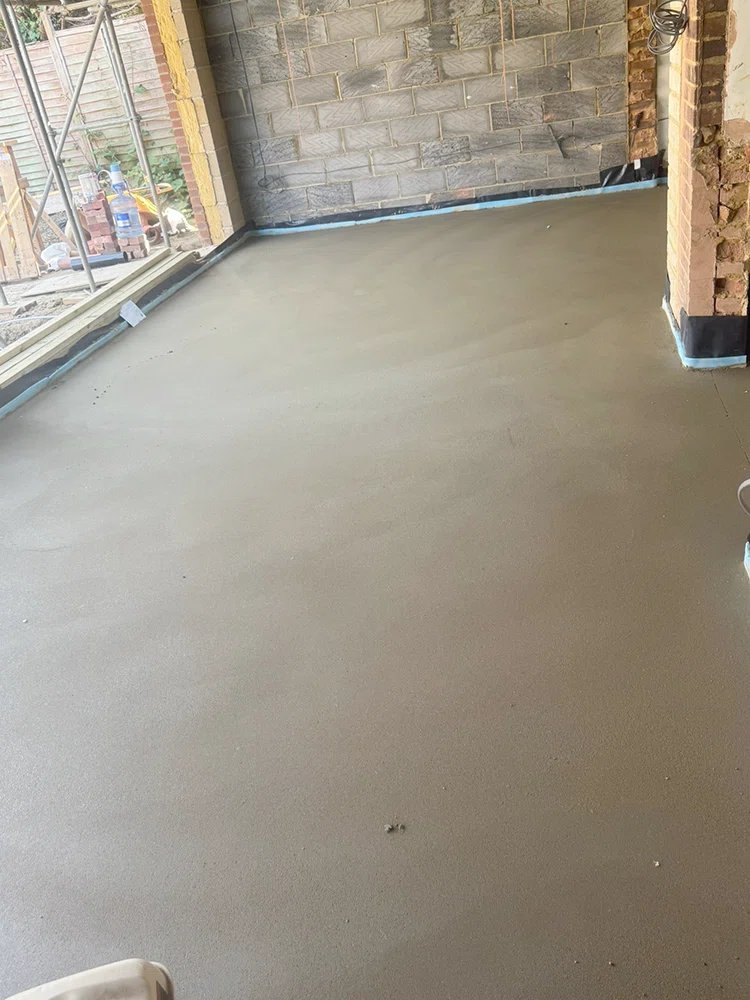
K & B Screeding’s own team, led by director Donatas Bardisevicius. Founded 2019, company 12298780.
See what customers say in our Google reviews and on our testimonials page.
Latex Screed from Slough to Southwark
Southwark is about 24.7 miles east of our Slough base as the crow flies, with postcodes including SE1, SE5, SE21 and SE22. The nearest towns to it are Lambeth (2.1 miles), Lewisham (3.2 miles), Tower Hamlets (3.5 miles) and Westminster (4.2 miles).
More on latex screed, part of our screeding services.