
Latex over timber in Westminster house conversions
Above the ground floor, a Victorian house being turned into flats generally has timber floors. Some are taken up for a lightweight acoustic screed, but where boards stay, a kitchen or bathroom finish still needs a smooth, rigid face, and latex is often the answer.
It cannot go straight on the boards. Floorboards shrink and swell, and any thin compound spread across them will crack along the gaps. So the floor is fixed down, flooring grade plywood is screwed across it at close spacing with its joints staggered, and the ply is primed. Only then is the latex mixed: a cement based powder with latex liquid used instead of water. It flows out to a few millimetres and hides every screw head and sheet edge.
In a flat, height is tight, and that thin section helps. A new bathroom floor can finish level with the hall without raising the threshold.
The acoustic side of a conversion stays with the floor design. Latex is a surface layer, not a sound insulation product, so it goes on top of whatever separating floor build-up has been agreed, never in place of any part of it.
Some floors are past this. If boards bounce, joists have dropped or the room slopes noticeably, the structure is dealt with first, and then the options are overboarding, a full rebuild or a new screed. A deeper dip on a solid floor may suit a levelling compound for flats before any latex goes down.
Safety flooring for Soho restaurants and shops
Restaurant kitchens and shops crowd Soho and the streets around Oxford Street, and many of them use floor finishes that need a very smooth base. Sheet vinyl, rubber and safety flooring in a kitchen or back of house area show every ridge underneath, and a raised tile edge can become a trip or a tear within weeks.
A refit often uncovers a mix of old bases. There may be quarry tiles still firmly bonded, a patch of concrete where equipment once stood and thin, hard adhesive left from an old vinyl. Where each is sound, latex can bridge them into one smooth surface once every area has had the right primer. Loose tiles come up first, and soft adhesive is ground off.
Water is the question to ask early. Latex is laid over a dry, sound base; it is not a waterproofing layer, and a kitchen floor that is wet below needs that problem fixed before any thin layer goes on.
Flats raise a related job. When old vinyl is lifted, a thin skin of hard, well bonded adhesive can often stay and be primed and covered, while anything soft, tacky or flaking is taken off first. A slab with cracks or loose areas needs screed repairs first. North of the borough, see latex screed in Camden.
How we price latex screed in Westminster
A fixed written price within 24 hours, once we know the area and the base. See our floor screeding cost guide.
Who lays your latex screed in Westminster
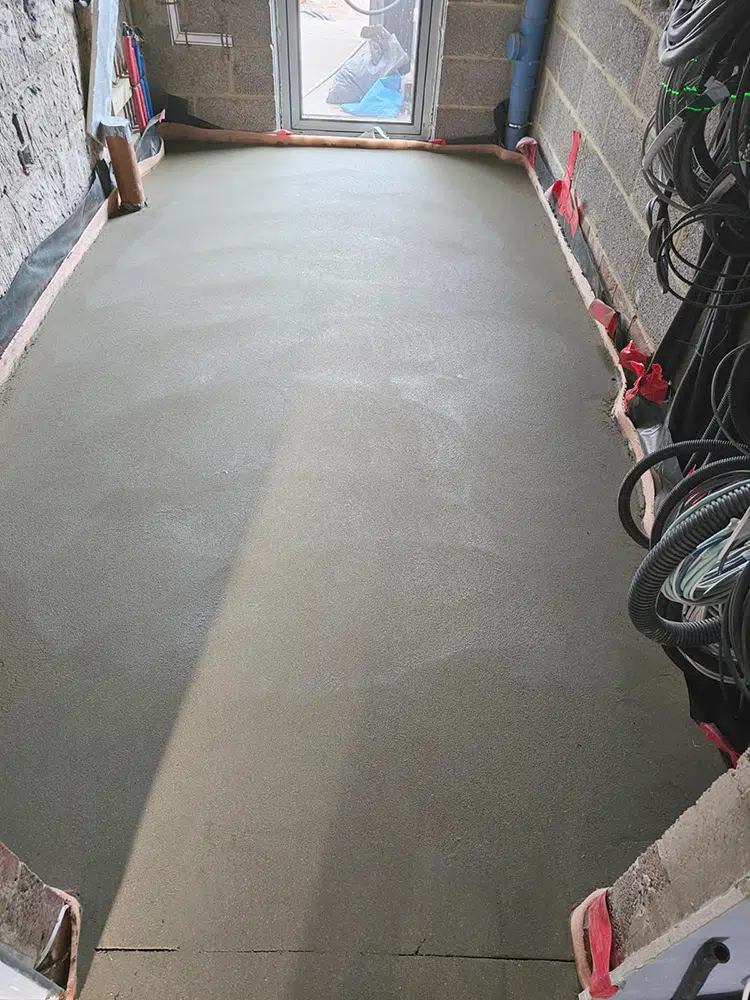
K & B Screeding’s own team, led by director Donatas Bardisevicius. Founded 2019, company 12298780.
See what customers say in our Google reviews and on our testimonials page.
Latex Screed from Slough to Westminster
As the crow flies, our yard in Slough is about 21 miles from Westminster, which lies to the east. Postcodes here include W2, SW1W, SW1X and SW7, and Kensington and Chelsea (1.6 miles), Camden (2.1 miles), Hammersmith and Fulham (2.8 miles) and Islington (3 miles) are close by.
More on latex screed, part of our screeding services.
