
Calcium sulphate grades for Greenwich apartment floors
Drawings for calcium sulphate floors give a code, CA-C25-F5 being a typical one. Read it in three parts: CA for calcium sulphate, the C figure for compressive strength and the F figure for flexural strength, each in N/mm2. Lightly used domestic rooms get CA-C20-F4. Most houses, apartments and offices settle on CA-C25-F5, and harder use steps up to CA-C30-F6.
A few specifications swap in alpha hemihydrate for its quicker drying or thinner depth, and every such product is laid to its own data sheet rather than a rule of thumb.
Low shrinkage is what makes calcium sulphate attractive on a block of flats. Large bays can be poured without the close joint spacing a cement screed needs, and the floor stays flat across open living spaces. The bay and joint layout is still drawn up before the pour, at doorways and wherever heated zones change.
Between one flat and the next, the screed normally floats on an acoustic layer. The new build schemes at Kidbrooke, the Royal Arsenal and the Peninsula use acoustic floating floors between flats, and whichever screed is specified, the edge strip and membrane must isolate it completely from walls and columns.
Water is the one thing it does not tolerate, so keep calcium sulphate out of any area that could get wet. For bin stores, plant rooms or wet rooms, a cement based flowing screed is the alternative, or sand and cement screed in Greenwich for small areas laid to falls.
Drying, laitance and testing on Greenwich new build plots
Calcium sulphate screed behaves differently from cement once it is poured, and the flooring stage is where that difference shows.
The first issue is laitance, a weak, powdery skin that forms on the surface as it dries. It must be sanded off and vacuumed before anything is bonded to the floor. The surface is then primed with a product compatible with calcium sulphate, because the wrong primer or adhesive can fail at the interface.
The second is moisture. Many flooring manufacturers set a lower moisture limit for calcium sulphate than for cement screed, so it is not safe to assume a floor is ready because a cement one of the same age would be. A hygrometer test against the flooring maker's figure is the proper check. Where underfloor heating is fitted, force drying can usually start from about 7 days, as covered on our Greenwich heated floor screed page.
On a large plot, these steps are written into the handover. We give drying and laitance advice in writing so the flooring contractor starts from a clear record.
For the placing side, such as pump access to upper floors, see pumped liquid screed in Greenwich, and for a plain-English primer read anhydrite screed explained.
Anhydrite & Flow Screed prices in Greenwich
Liquid flowing screed (which includes anhydrite): £24 to £31 per m² supplied and laid (MyJobQuote, August 2026), so £960 to £1,240 for 40 m². MyJobQuote does not say whether these figures include VAT. See our floor screeding cost guide or screed calculator.
Who lays your anhydrite and flow screed in Greenwich
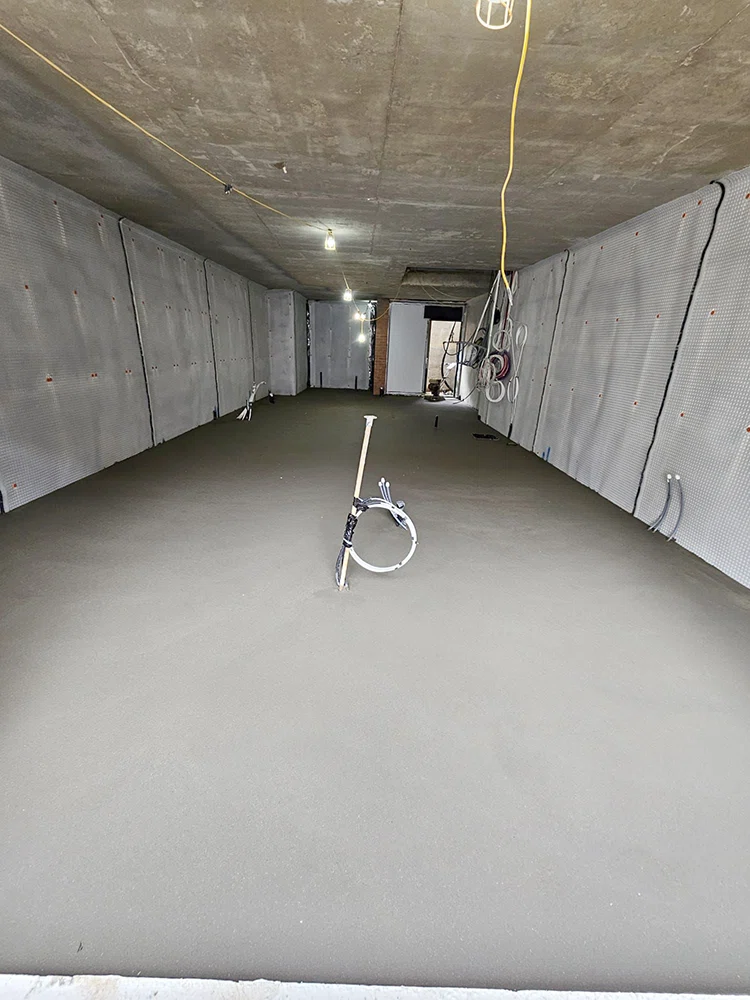
K & B Screeding’s own team, led by director Donatas Bardisevicius. Founded 2019, company 12298780.
See what customers say in our Google reviews and on our testimonials page.
Anhydrite & Flow Screed from Slough to Greenwich
Greenwich is about 30.8 miles east of our Slough base as the crow flies, with postcodes including SE2, SE9, SE3 and DA16. The nearest towns to it are Bexley (3.6 miles), Newham (3.7 miles), Lewisham (4.3 miles) and Tower Hamlets (5.2 miles).
More on anhydrite screed, part of our screeding services.