
Specifying anhydrite for Erith and Belvedere apartments
On the spec for an Erith or Belvedere block, anhydrite screed carries a CA code, which the European screed materials standard sets out. C stands for strength in compression and F for strength in bending, with both numbers in N/mm2. Three grades cover most of what gets laid: CA-C20-F4 for a light-use floor at home, CA-C25-F5 for everyday houses, apartments and offices, and CA-C30-F6 where the floor takes more punishment.
For a new block in Erith or Belvedere, the engineer's specification fixes the grade, and precisely that grade is what goes in. A few schemes call for a product made from alpha hemihydrate, where quicker drying or a slimmer section is wanted, and those go down to their own product sheet.
Flats suit the material because it shrinks so little. Big bays go in with hardly a joint, laid on insulation board, sound-deadening layers and heating pipes. Thresholds and the boundaries between heating zones still get joints, and we draw up the bay and joint plan before pouring so it follows the rooms and heating circuits instead of being cut in later. If nobody has written a grade down, we confirm it with the designer first.
Floors that could get wet are no place for calcium sulphate. Bathrooms, bin stores and plant rooms want a flowing screed bound with cement, or sand and cement for Bexley, laid by hand. The material itself is explained in our anhydrite screed guide.
Laitance and moisture on Bexley anhydrite floors
Once the pump has gone, an anhydrite floor still has work ahead of it before any finish. While it dries, a weak top layer known as laitance forms. Tiles or vinyl glued onto it can come loose, so when the moisture has dropped far enough the laitance is sanded off and the floor primed with a product designed for calcium sulphate.
Then the moisture reading. Flooring manufacturers often allow less moisture in calcium sulphate than in cement, so the hygrometer result must be judged against the correct limit, and that is what we go by, not a calendar date. With heating in the floor, switching it on at about 7 days usually hurries the drying along and takes time out of a busy build.
Across a development with many plots, it is easy for those steps to fall between trades. Our written drying and laitance notes tell the flooring contractor exactly what state each floor is in. If an existing anhydrite floor in Bexley needs its surface cleaned back before new flooring, that is handled by our floor preparation team.
Anhydrite & Flow Screed prices in Bexley
Liquid flowing screed (which includes anhydrite): £24 to £31 per m² supplied and laid (MyJobQuote, August 2026), so £960 to £1,240 for 40 m². MyJobQuote does not say whether these figures include VAT. See our floor screeding cost guide or screed calculator.
Who lays your anhydrite and flow screed in Bexley
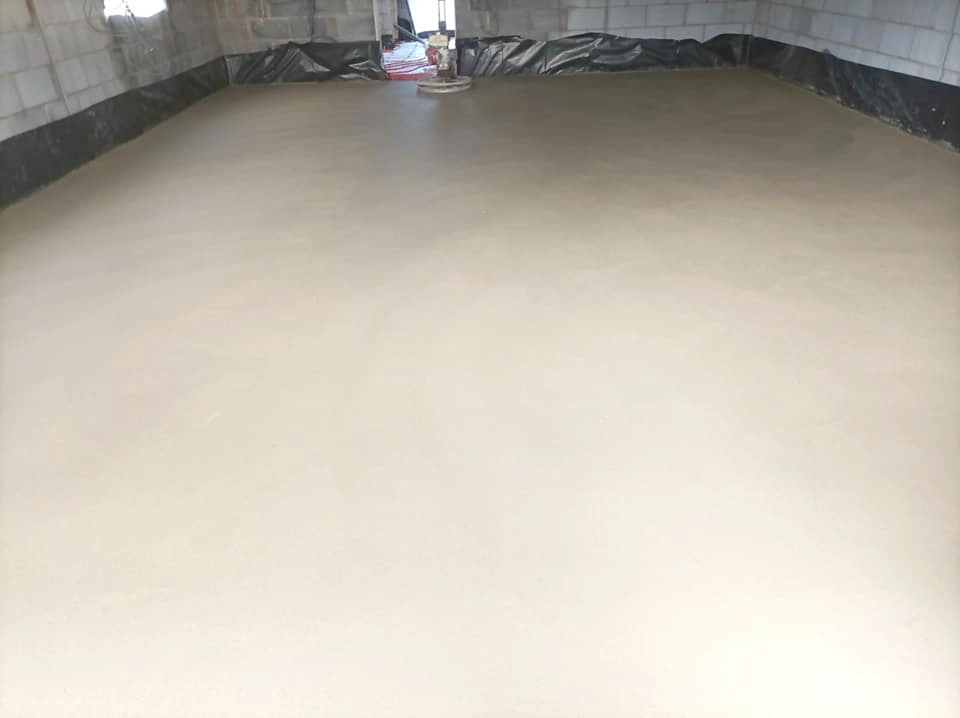
K & B Screeding’s own team, led by director Donatas Bardisevicius. Founded 2019, company 12298780.
See what customers say in our Google reviews and on our testimonials page.
Anhydrite & Flow Screed from Slough to Bexley
As the crow flies, our yard in Slough is about 34.3 miles from Bexley, which lies to the east. Postcodes here include DA7, DA1, DA15 and DA5, and Greenwich (3.6 miles), Swanley (4.4 miles), Dartford (4.5 miles) and Swanscombe (6.2 miles) are close by.
More on anhydrite screed, part of our screeding services.
