
Heated extensions on Eltham and New Eltham semis
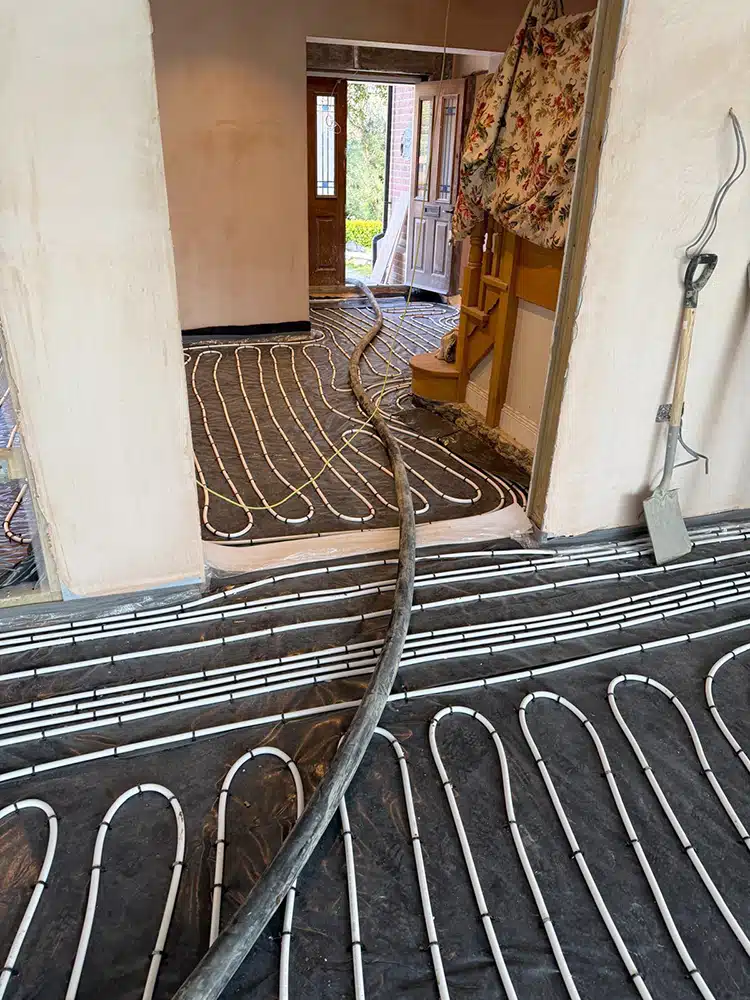
The inter-war semis around Eltham and New Eltham are typical extension jobs, and underfloor heating is often part of the plan. An open kitchen and living space warmed from the floor needs a screed that does two jobs: protect the pipes and spread the heat evenly.
Cover is the first decision. Liquid screed needs at least 25mm above the pipes, and a sand and cement screed about 45mm. Liquid flows under and around every pipe with no air pockets, which helps the floor warm up faster and run more efficiently, so it is the usual choice in a new extension. Sand and cement still has a place where the heated area is small or the room may get wet.
The finished level has to meet the existing house. In a semi of this age the extension floor usually lines up with the original hall or kitchen, so the insulation, pipes and screed have to fit inside a fixed height. We check those heights before choosing the product.
Garden rooms can be heated the same way, provided the base is sound and insulated. Your installer lays and pressure tests the pipes before we arrive; we check the edge strip and membrane, and can supply insulation and membranes for the build-up where they are missing.
Published 2026 UK figures put liquid screed over underfloor heating at £20 to £35 per m².
New build and retrofit heating in Greenwich
The large new build schemes at Kidbrooke, the Royal Arsenal and Greenwich Peninsula rely on liquid screeds over heating pipes, laid on acoustic floating floors between flats. For a flat, that means the screed must float free of the walls on a continuous edge strip, or sound and heat both find their way into the structure.
Retrofitting heating in an older house is harder. Where the terraces of Plumstead and Charlton are having ground floors rebuilt with insulation and a membrane anyway, that is the moment to add pipes, because the dig-out creates the depth. Laying heating over an existing floor raises its level, often by more than doors and thresholds allow.
Whatever the building, heating has to wait. A calcium sulphate screed can usually be warmed from about 7 days after the pour, and a sand and cement one needs at least 21 days. Then comes commissioning: start the water at a low temperature and raise it gradually over several days, holding at each step, rather than turning the system straight up to full.
Tiles, LVT and engineered wood all need a flat, dry surface. Where a heated floor has small undulations, floor levelling before new flooring is the fix; the specification side of calcium sulphate is on our anhydrite screed page.
Underfloor Heating Screed prices in Greenwich
Liquid screed over underfloor heating: £20 to £35 per m² supplied and laid (trade2base, June 2026), so £700 to £1,230 for 35 m². trade2base gives these figures excluding VAT. See our floor screeding cost guide or screed calculator.
Who lays your underfloor heating screed in Greenwich
K & B Screeding’s own team, led by director Donatas Bardisevicius. Founded 2019, company 12298780.
See what customers say in our Google reviews and on our testimonials page.
Underfloor Heating Screed from Slough to Greenwich
Greenwich is about 30.8 miles east of our Slough base as the crow flies, with postcodes including SE2, SE9, SE3 and DA16. The nearest towns to it are Bexley (3.6 miles), Newham (3.7 miles), Lewisham (4.3 miles) and Tower Hamlets (5.2 miles).
More on underfloor heating screed, part of our screeding services.
