Heated rear extensions on Becontree houses
On the Becontree estate, families are adding rear extensions and knocking through kitchens. A heated floor suits that kind of room, which is wide, open and used all day.
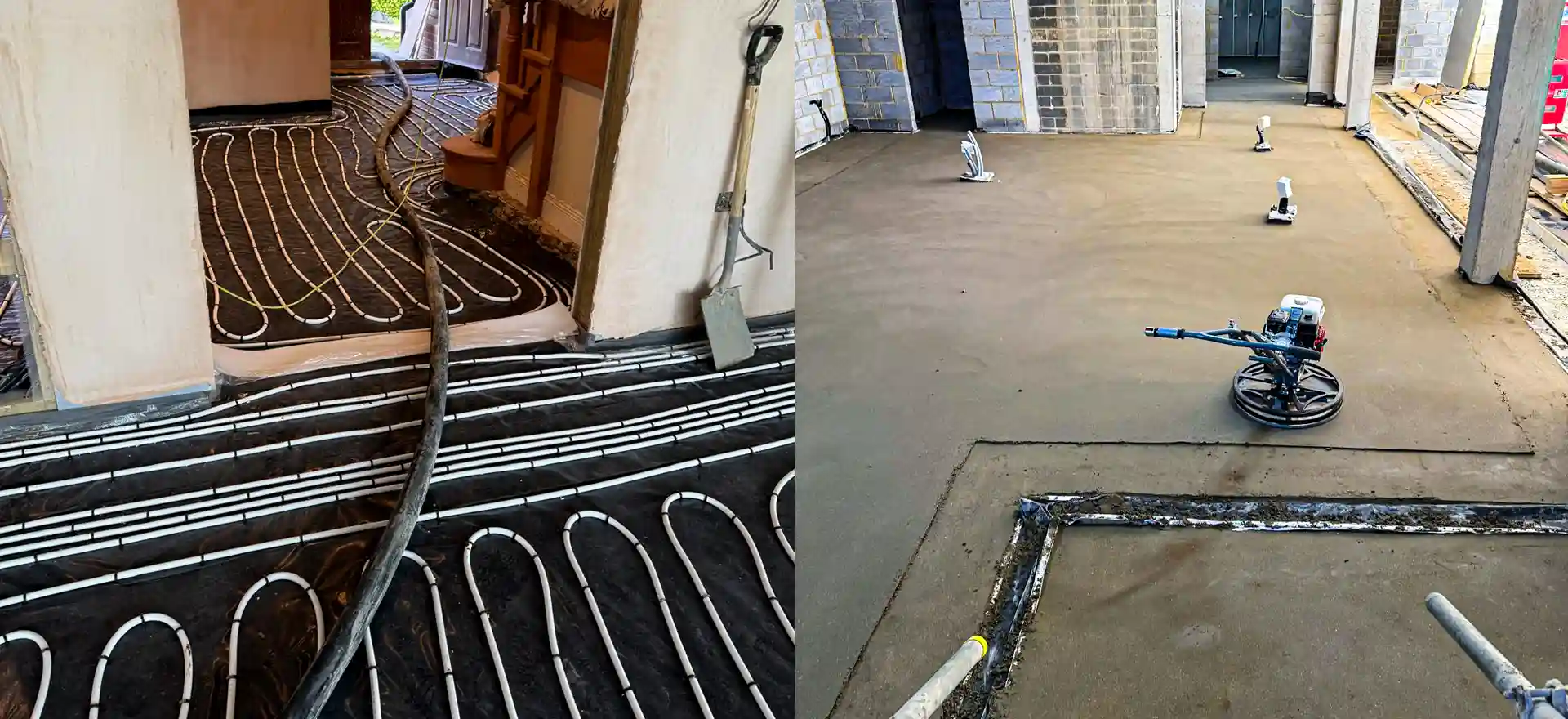
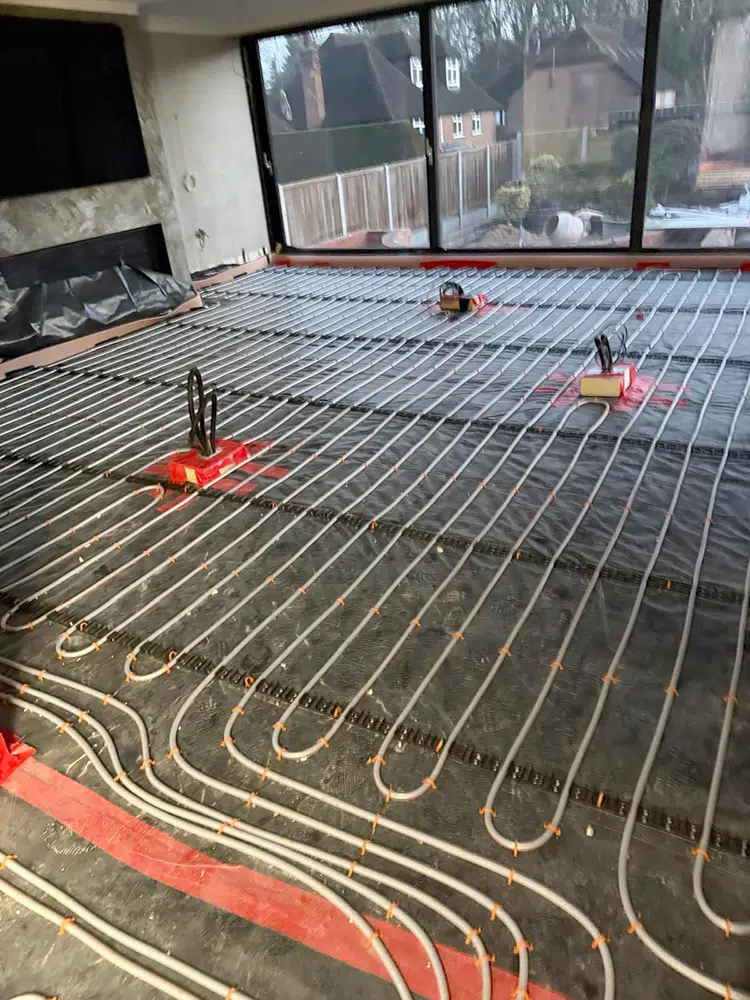
Without the right screed, the heating will not perform. Every pipe has to be wrapped completely, leaving no voids, so warmth spreads evenly over the floor. A pumped liquid screed fills around the pipes as it flows, and needs 25mm or more above them, so the floor ends up roughly 45 to 50mm deep. A traditional mix wants about 45mm on top, so that floor is thicker. Our liquid screed in Barking and Dagenham page covers the pour itself.
The awkward bit is where the new room joins the old kitchen. The new heated floor usually needs to finish level with the existing kitchen, and if that floor is also being dug out because it lacks a membrane, both can be rebuilt with insulation, pipes and screed together. Where the old floor stays, the depth available for heating is limited by the doors and the hallway.
Retrofitting heating into an existing room is harder still, because the height is fixed. We measure the build-up before we price, and tell you honestly if the room cannot take a wet system without digging out. For how long the new floor will take to dry, read how long screed takes to dry.
Barking Riverside flats: heating, acoustics and first heat-up
Homes built since 2000 make up 21% of the borough's stock, and the riverside is where most new homes are now being built. The Barking Riverside flats are designed with liquid screed over their underfloor heating, and acoustic layers separate one flat from the next. The screed floats on that layer, so edge strips and joints must be sealed before the pour to stop it bridging the sound insulation. Our insulation and membranes service supplies or checks those layers.
Bringing a new heated floor up to temperature is a slow job. On calcium sulphate, the first gentle warmth is normally allowed at about 7 days. A cement screed is slower, at 21 days at the earliest. From then on the heat goes up in small steps and is held at each, following the schedule from the screed maker and the heating engineer. We hand the guidance over in writing, which helps a site manager plan when flooring goes in and lets each flat be signed off in turn.
As a guide, the national 2026 rates for pumped screed laid over underfloor heating sit between £20 and £35 per square metre. For a job in Havering, see underfloor heating screed in Havering.
Joints and zones in a heated Becontree knock-through
When a Becontree kitchen is knocked through into a new rear extension, the heated floor often runs across both: the old kitchen floor is dug out, and the extension slab is new. One continuous floor looks simple, but beneath it there are usually two or more heating zones, a line where the old back wall stood and a doorway to the hall.
Each of those needs deciding before the pour. Joints go where the heating zones meet and at thresholds, so the screed can move with the warmth on each side. The line of the old wall is a natural place for one, because the two halves of the floor sit on different bases. An edge strip runs round every wall and around any chimney breast or pier left in the room.
The screed type changes how many joints you end up with. Liquid screed shrinks very little and covers wide bays with few joints, which suits the long, narrow room a knock-through creates. Sand and cement needs more joints and more cover over the pipes, so that floor also sits higher.
Joints matter to the finish as well as the screed. Tiles laid across a screed joint without allowing for it can crack along the line, so the flooring fitter needs to know exactly where each joint is. The joint layout is agreed before the pour and handed over in writing with the heat-up schedule.
Underfloor heating screed prices in Barking and Dagenham
Liquid screed over underfloor heating: £20 to £35 per m² supplied and laid (trade2base, June 2026), so £700 to £1,230 for 35 m². trade2base gives these figures excluding VAT. See our liquid screed cost per m² guide, the floor screeding cost guide or the screed calculator.
Who lays your underfloor heating screed in Barking and Dagenham
K & B Screeding’s own team, led by director Donatas Bardisevicius. Founded 2019, company 12298780.
See what customers say in our Google reviews and on our testimonials page.
Underfloor heating screed from Slough to Barking and Dagenham
Barking and Dagenham is about 33.1 miles east of our Slough base as the crow flies, with postcodes including IG11, RM9, RM8 and RM6. The nearest towns to it are Redbridge (3.5 miles), Newham (4 miles), Havering (4.2 miles) and Chigwell (5.3 miles).
On Barking and Dagenham streets where the screed lorry cannot park off the road, a bay suspension comes from Barking and Dagenham Council (parking bay suspension). We confirm on the quote whether it is needed. An extension floor usually needs building regulations approval (Part L sets the insulation standard in England); the council building control service for Barking and Dagenham is Barking and Dagenham Council Building Control.
More on underfloor heating screed, part of our screeding services. For every screed we lay locally, see floor screeding in Barking and Dagenham.
Further reading: screed thickness guide and underfloor heating on a concrete floor.