
Heated extensions on older Redbridge houses
In an older Redbridge house, a heated floor usually goes into an extension or a dug out ground floor. The new room opens onto the old kitchen or dining room, so the finished floor has to meet the existing one at the threshold, and every layer below must fit into that depth.
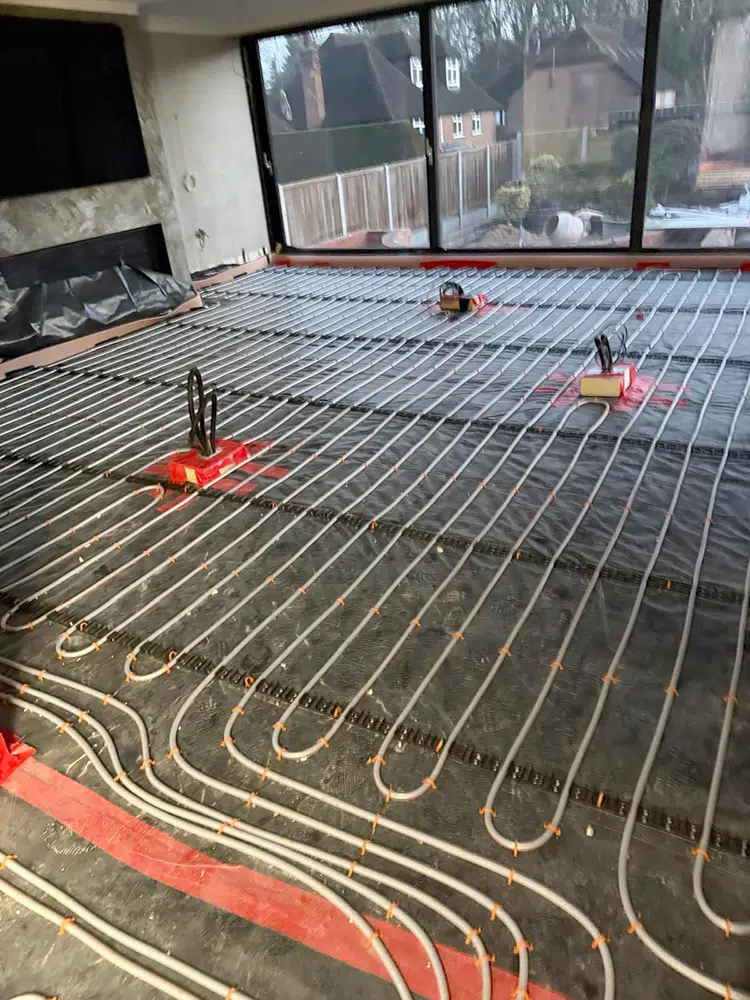
The depth needed above the loops is where the sums start. Pumped screed has to cover them by 25mm or more, so the layer ends up around 45 to 50mm. Sand and cement asks for about 45mm over the pipes, making a thicker and heavier floor. In a tight Redbridge extension, pumped screed that wraps each pipe tends to be the one that fits, and since it closes right round the pipework, no air gaps are left to hold back the warmth.
Insulation below the pipes stops heat going into the ground, and a membrane separates the screed from the insulation. A strip of foam along the foot of each wall gives the floor room to grow slightly as it heats. If these are not already down, we can supply them, as set out on our insulation and membranes page.
Before the pour, the heating engineer fills and pressure tests the pipes and leaves them under pressure. Any leak then shows immediately, not after the floor is finished. Pipes should also be clipped down firmly, because loose pipes can float up in a liquid pour and end up with too little cover.
Commissioning heated floors from Hainault to Woodford
Of the homes in Redbridge, 16% date from 1945 to 1972. The London County Council's Hainault estate, a cottage estate of 2,779 houses built between 1947 and 1953, belongs to that period. On houses of that age, as on older ones, underfloor heating usually arrives with a refit or an extension, so the screed is planned around existing floor levels.
Whatever the house, the heat-up follows the screed. With calcium sulphate, the system can be switched on at about 7 days. With sand and cement, keep the heating off for 21 days or more. Either way the water goes in cool and is turned up a notch at a time across several days, to the pipe maker's schedule, then held for a spell and lowered again.
Rushing this is the common mistake. A floor heated straight to full can crack, and tiles or timber laid on a screed that is still wet can fail later. Our screed drying times explained shows how the first warm up also helps a floor dry.
Underfloor Heating Screed prices in Redbridge
Liquid screed over underfloor heating: £20 to £35 per m² supplied and laid (trade2base, June 2026), so £700 to £1,230 for 35 m². trade2base gives these figures excluding VAT. See our floor screeding cost guide or screed calculator.
Who lays your underfloor heating screed in Redbridge
K & B Screeding’s own team, led by director Donatas Bardisevicius. Founded 2019, company 12298780.
See what customers say in our Google reviews and on our testimonials page.
Underfloor Heating Screed from Slough to Redbridge
As the crow flies, our yard in Slough is about 30.9 miles from Redbridge, which lies to the east. Postcodes here include IG2, E11, IG6 and IG5, and Chigwell (2.4 miles), Waltham Forest (3.2 miles), Barking and Dagenham (3.5 miles) and Newham (4.1 miles) are close by.
More on underfloor heating screed, part of our screeding services.