
Fitting heated floors into Hackney conversions
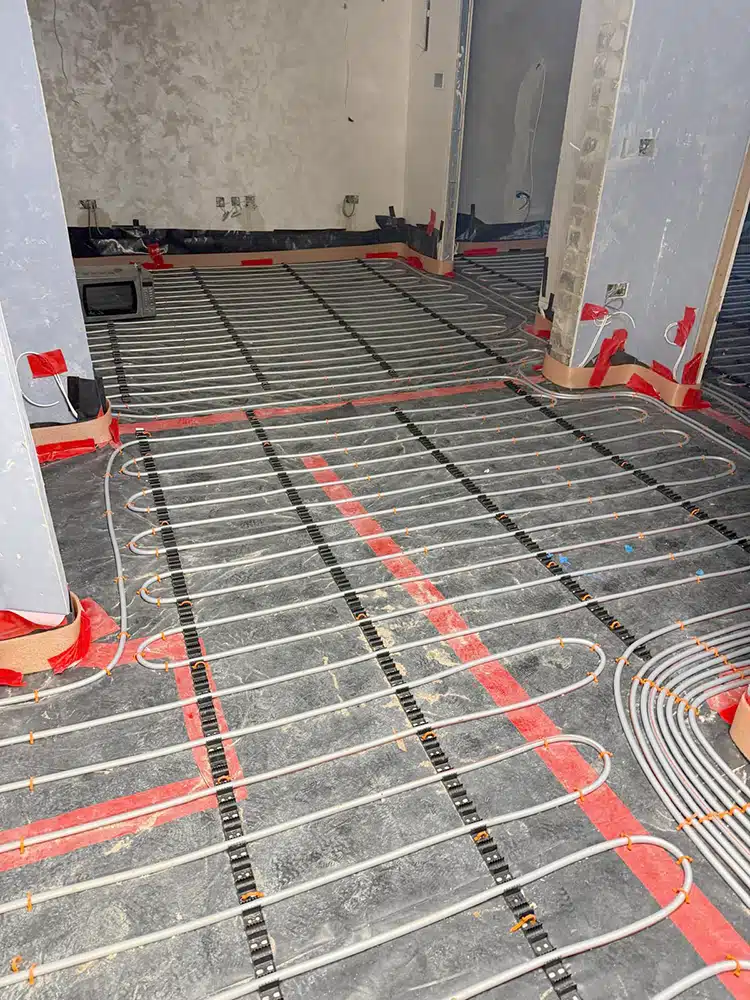
Adding underfloor heating to a flat inside a period terrace is a height puzzle. The floor build-up needs insulation, the pipes and enough screed above them to protect the pipes and spread the heat, and the finished surface still has to meet the front door, the stairs and neighbouring rooms.
Liquid screed usually wins here because it needs less cover. At least 25mm above the pipes is enough for a liquid screed, giving a total of roughly 45 to 50mm, while sand and cement needs about 45mm of cover. The liquid also flows round each pipe with no air pockets, which helps the floor respond faster.
In De Beauvoir, South Hackney and Clapton, period terraces split into flats need acoustic screeds between flats as well. An acoustic layer under the screed adds depth, so the whole build-up is planned with the heating engineer before anything is fixed down.
At ground level, where a new slab goes in with a membrane beneath it, there is more freedom: digging out makes room for insulation and the screed. In a ground floor rear extension, pumped liquid screed suits the open floor.
If depth is short, talk to us early. Sometimes the answer is an alpha hemihydrate screed, chosen where reduced depth matters and laid to its own product sheet. Published 2026 UK figures put underfloor heating liquid screed at £20 to £35 per m².
First heat-up for new Hackney heated floors
New blocks at Woodberry Down use pumped liquid screed with underfloor heating, and the same rules apply to a single flat or an extension anywhere in the borough: the heating has to wait, then start gently.
With calcium sulphate, warm water can normally go through the pipes from about day 7 after the pour. Sand and cement asks for 21 days or more. Commissioning then starts cool: the water circulates at a low temperature, is stepped up a little over several days, then held. Jump straight to full heat and the screed can crack, and the floor finish pays for it later.
For calcium sulphate, the surface laitance also has to be sanded off before flooring, and the moisture reading has to meet the flooring maker's limit. The drying time guide sets out how long each stage usually takes.
Where the dried floor is not flat enough for tiles or LVT, a thin levelling compound over the heated screed fixes minor dips. And before any of this, the build-up beneath needs insulation and membranes laid correctly, with the edge strip running unbroken round every wall.
Underfloor Heating Screed prices in Hackney
Liquid screed over underfloor heating: £20 to £35 per m² supplied and laid (trade2base, June 2026), so £700 to £1,230 for 35 m². trade2base gives these figures excluding VAT. See our floor screeding cost guide or screed calculator.
Who lays your underfloor heating screed in Hackney
K & B Screeding’s own team, led by director Donatas Bardisevicius. Founded 2019, company 12298780.
See what customers say in our Google reviews and on our testimonials page.
Underfloor Heating Screed from Slough to Hackney
Hackney is about 25.1 miles east of our Slough base as the crow flies, with postcodes including N4, E5, N16 and E8. The nearest towns to it are Islington (2.1 miles), Tower Hamlets (2.5 miles), Haringey (3.5 miles) and Camden (3.8 miles).
More on underfloor heating screed, part of our screeding services.
