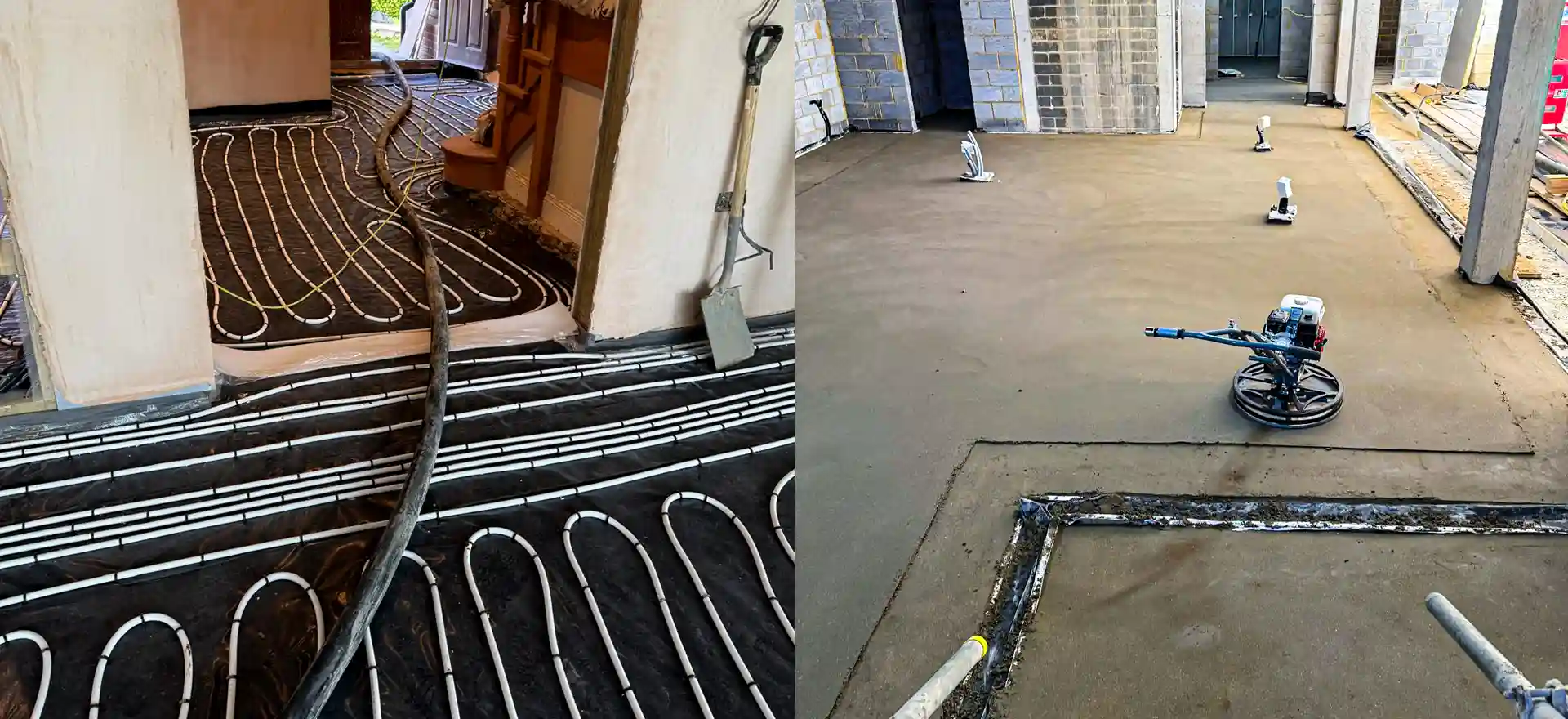
Relaying ground floors in De Beauvoir, Clapton and South Hackney
Period terraces in De Beauvoir, South Hackney and Clapton are often split into flats, and the ground floor flat is where the heaviest floor work happens. At that level the job usually means a membrane under a new slab and a screed on top, so the floor ends up dry, insulated and flat.
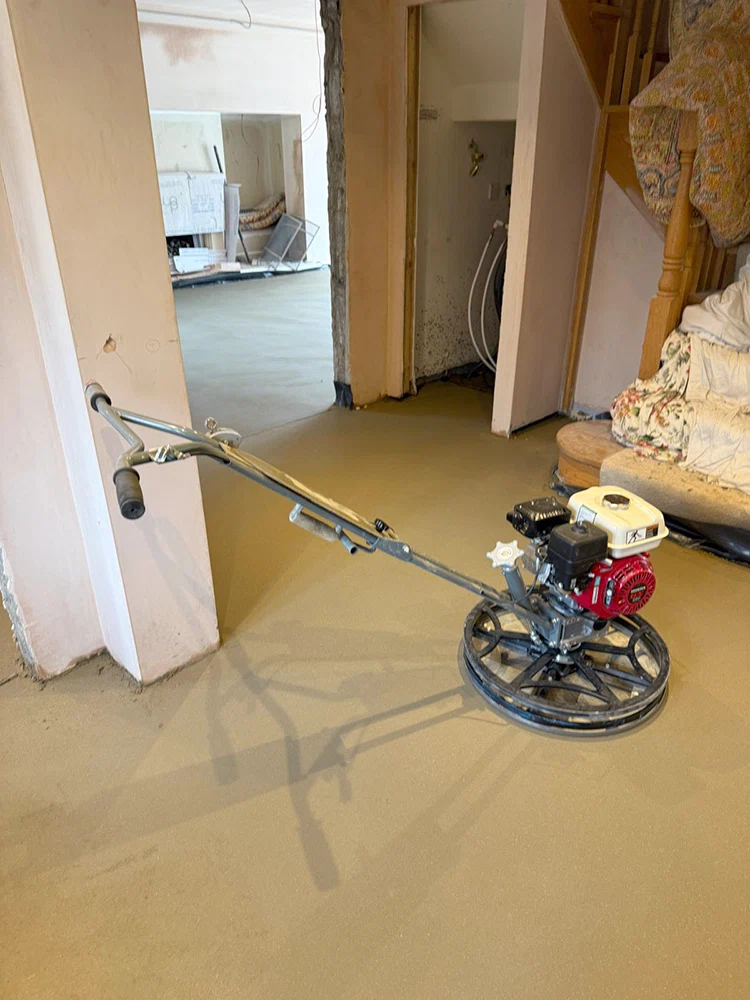
Sand and cement screed suits these houses. It is mixed at the property in small batches and barrowed through the front door, and it handles narrow halls, steps down into a back addition and rooms that are far from square. Over insulation, a domestic floating screed is laid at about 65mm, and commercial floors at about 75mm. Where the base is a sound slab and height is short, a bonded screed is another route.
The screed is compacted by hand and finished to a dense, level surface ready for tiles, wood or LVT once dry. Drying is slower than with a pumped screed, roughly a day per millimetre for the first 40mm and longer beyond that, which matters in a flat where the owner wants to move back in.
If that timing is a problem, a quick drying sand and cement screed shortens the wait, and fibre reinforced screed adds crack resistance on larger rooms. Where the ground floor is getting heating pipes too, see screeding over underfloor heating.
Wet rooms, garages and shop floors in Hackney
Wet rooms are a common part of a flat refurbishment, and they need a cement base. A calcium sulphate screed can soften where water sits, whereas sand and cement tolerates it. It can also be laid to falls so water drains to the gully, something a self-levelling screed cannot do.
The same applies to garages and stores. Converting a garage usually means raising the old slab to meet the house with insulation, a membrane and screed, and a cement screed can take knocks and early load while the rest of the work goes on.
Across Hackney, shops and workspace inside new schemes need level floors, often over existing concrete that needs concrete floor repair before a new screed will bond. Sand and cement, perhaps in a higher strength mix, is a sound base where a durable finish is needed quickly.
With 14% of Hackney homes terraced, the narrow plan is common enough that hand-laid screed stays relevant even in a borough dominated by flats. For a fuller comparison of the two methods, read liquid screed or sand and cement.
Hand screeding inside Hackney estates and post-war blocks
Hackney's homes range from London County Council estates such as Kingsmead and Morningside, built between the wars, to post-war blocks including The Beckers, Granard House and Pitcairn House. When a flat in one of these blocks has its kitchen or bathroom rebuilt, a pump lorry is often more than the job needs, and sand and cement laid by hand is the practical answer.
Small areas suit it. A bathroom, a hall or a kitchen may be only a few square metres, and the screed is mixed in batches and taken up by lift or stairs. Mixing is planned with the managing agent or the estate, because a mixer needs a spot outside, such as a courtyard or a parking bay.
The existing floor decides the work. Under an old kitchen or bathroom in a block there is likely to be a concrete slab with a screed on top. A sound screed can stay and be levelled, while one that has cracked or broken up is cut out and replaced, bonded to the slab where the height at the front door is tight.
Before any of this starts, it is worth checking whether the lease or the estate asks for notice of floor works, since breaking out an old screed is noisy for the neighbours below and beside. Rubble goes out the way the materials come in, bagged, so the stairs and lift are protected for both trips.
Sand and cement screed prices in Hackney
Sand and cement screed: £18 to £25 per m² supplied and laid (MyJobQuote, August 2026), so £450 to £630 for 25 m². MyJobQuote does not say whether these figures include VAT. See our screed cost per m³ and per tonne guide or screed calculator.
Who lays your sand and cement screed in Hackney
K & B Screeding’s own team, led by director Donatas Bardisevicius. Founded 2019, company 12298780.
See what customers say in our Google reviews and on our testimonials page.
Sand and cement screed from Slough to Hackney
Hackney is about 25.1 miles east of our Slough base as the crow flies, with postcodes including N4, E5, N16 and E8. The nearest towns to it are Islington (2.1 miles), Tower Hamlets (2.5 miles), Haringey (3.5 miles) and Camden (3.8 miles).
In Hackney, road space for the screed pump means a bay suspension from Hackney Council (parking bay suspension), and your quote will say whether one is needed. New floors in Hackney extensions usually need building regulations approval, with Part L insulation rules in England; Hackney Council Building Control is the council building control service.
More on sand & cement screed, part of our screeding services. For every screed we lay locally, see floor screeding in Hackney.
Further reading: screed thickness guide and sand and cement screed mix ratio.