
Rebuilding ground floors in Walthamstow and Leyton terraces
When a kitchen or back room in an Edwardian terrace, such as the Warner homes around Markhouse Road and St James Street, is refitted, the old floor is often the problem. It may be cracked, hollow or damp at the edges, and without a damp course there is nothing to stop moisture rising into a new finish. Laying on top only buries the problem.
The usual answer is to break the old floor out, dig down far enough for a proper build-up, and rebuild it: a damp proof membrane, insulation to current standards and then the screed. Laid floating over that insulation, the sand and cement in a house is 65mm thick. Our floor preparation service covers the breaking out and clearing that comes first, and the insulation and membranes page explains what sits under the screed.
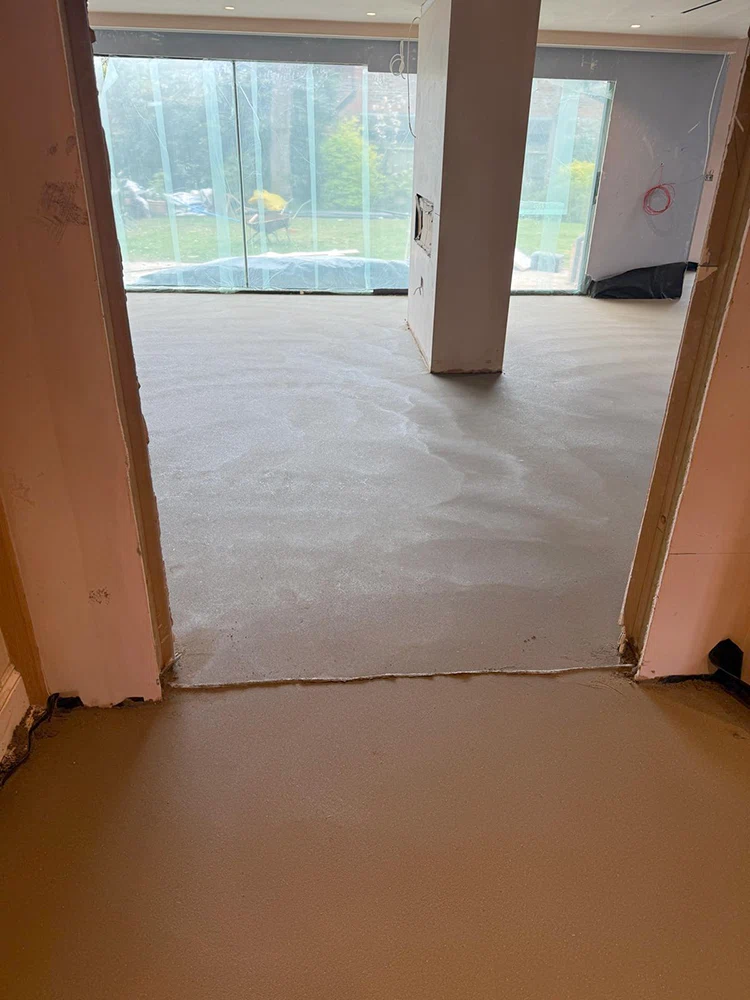
If the concrete underneath is solid and the floor only needs a thin topping, we bond 25 to 40mm of screed straight onto it. That keeps floor height down, which matters when the new floor has to meet an old doorway or a hallway that is staying.
Sand and cement is mixed on site and compacted by hand, so it adapts well to the small rooms, chimney breasts, alcoves and narrow galleys found in houses of this age. We mix each batch for the area in front of us, then finish it to a dense, level surface ready for the floor covering you have chosen.
Wet rooms and garages in Waltham Forest homes
A few rooms in any of these houses have to be cement, whatever the rest of the floor is made of. A wet room floor has to run downhill to the drain. A self-levelling screed will always try to find flat, whereas sand and cement packed by hand holds whatever fall we give it. It also stays sound in areas that may get wet, where calcium sulphate would not.
Garages are the other obvious case. A garage being turned into a room often has a floor lower than the house and a slab that has never been insulated. How to plan the build-up for that conversion is covered in our guide to screeding a garage floor.
The catch is how slowly it dries. At 65mm, the floor needs far more time than a thin liquid pour: roughly one day per millimetre through the first 40mm, then more slowly still. Plan the flooring date around it rather than guessing.
Sand and cement is priced at £18 up to £25 for each square metre on published 2026 figures. Adding fibres to the mix costs a further £1 to £3 per m². On small and awkward jobs it is often the more economical choice, because there is no pump to bring and set up.
Sand and Cement Screed prices in Waltham Forest
Sand and cement screed: £18 to £25 per m² supplied and laid (MyJobQuote, August 2026), so £450 to £630 for 25 m². MyJobQuote does not say whether these figures include VAT. See our floor screeding cost guide or screed calculator.
Who lays your sand and cement screed in Waltham Forest
K & B Screeding’s own team, led by director Donatas Bardisevicius. Founded 2019, company 12298780.
See what customers say in our Google reviews and on our testimonials page.
Sand and Cement Screed from Slough to Waltham Forest
As the crow flies, our yard in Slough is about 27.9 miles from Waltham Forest, which lies to the east. Postcodes here include E4, IG8, E17 and E10, and Redbridge (3.2 miles), Chigwell (3.9 miles), Hackney (4 miles) and Haringey (4.8 miles) are close by.
More on sand & cement screed, part of our screeding services.
