
Replacing solid floors on the Roding Estate
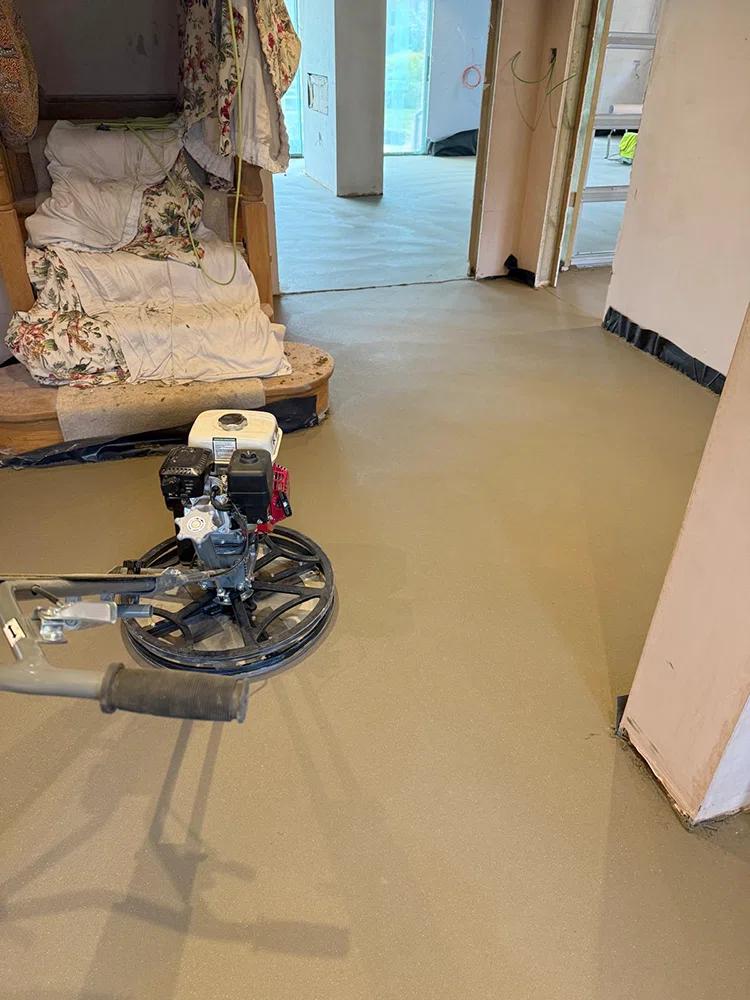
Inter-war semis often have solid ground floors that were laid without insulation, and sometimes without a proper membrane. Decades later they can be cold, uneven and cracked. On the Roding Estate, replacing floors like these is the kind of job where sand and cement screed makes sense.
We break up what is there and excavate deep enough to fit every new layer back in. A compacted base goes in, then insulation, then a membrane lapped up the walls to meet the damp course, and finally the screed. Floating on insulation in a house, the screed must be 65mm thick as a minimum. The screed thickness guide shows depths for other situations.
If the concrete underneath is sound and only its surface has gone, a thinner layer of 25 to 40mm can be stuck straight onto it with a bonding agent instead, as described under bonding a screed to concrete.
Sand and cement has practical advantages in a semi. It is mixed next to the house and barrowed through, so there is no pump or lorry to park. It works round chimney breasts, bay windows and awkward doorways. It can also be sloped towards a shower drain or across a wet room, places where calcium sulphate does not belong. And it takes load sooner than calcium sulphate, which helps the kitchen fitter.
Pre-1919 houses are only 7% of Loughton's stock, but they raise the same questions, with the added care needed for buildings in conservation areas.
Garages and wet rooms in Loughton homes
A garage being turned into a room is another good use for it. Garage slabs are normally lower than the rest of the ground floor, so insulation and screed fill the gap until the new room meets the hall with no step. The layers are drawn out in screeding for a garage conversion.
Showers without a tray, and full wet rooms, rely on a floor that drains itself. Sand and cement can be shaped by hand to exact falls, and it is not harmed by water the way calcium sulphate screed can be, so it is the usual base for tanking and tiles. Utility rooms follow the same logic.
The catch is how long it takes to dry. Drying runs at about a day for each millimetre to 40mm and slower past that, which leaves a 65mm Roding Estate floor waiting weeks for its wood, vinyl or LVT. Readiness is a hygrometer reading, not a date. If the builder has a deadline, a quicker drying mix takes some of that time out.
Published 2026 UK figures price this screed at £18 to £25 per m², and a bonded layer at £12 to £18 (trade2base, June 2026). Have a floor in Waltham Abbey as well? Our Waltham Abbey sand and cement page deals with it.
Sand and Cement Screed prices in Loughton
Sand and cement screed: £18 to £25 per m² supplied and laid (MyJobQuote, August 2026), so £450 to £630 for 25 m². MyJobQuote does not say whether these figures include VAT. See our floor screeding cost guide or screed calculator.
Who lays your sand and cement screed in Loughton
K & B Screeding’s own team, led by director Donatas Bardisevicius. Founded 2019, company 12298780.
See what customers say in our Google reviews and on our testimonials page.
Sand and Cement Screed from Slough to Loughton
As the crow flies, our yard in Slough is about 31.8 miles from Loughton, which lies to the east-north-east. Postcodes here include IG10, and Chigwell (2.5 miles), Waltham Abbey (3 miles), Epping (3.5 miles) and Waltham Cross (4.8 miles) are close by.
More on sand & cement screed, part of our screeding services.