
Replacing cracked screeds in Cheshunt's older homes
Terraced houses make up 34% of Cheshunt's homes, more than any other type. Most of the town's housing comes from the post-war council estates and the 1970s to 1990s building that followed, and screeds of that age have now carried decades of use.
Failure shows up in a few ways: cracks that widen, areas that ring hollow when tapped because the screed has lost its bond, and dusty, crumbling patches under old carpet. A small hollow area can sometimes be cut out and patched, which our screed repairs service covers. When the problem runs across the room, it is better to break the old screed out and start again.
The new sand and cement goes in mixed on site to match the depth needed. If the slab under it is sound, a bonded layer just 25 to 40mm thick is enough. Laid floating over new insulation, a domestic screed is 65mm, and 75mm in commercial work. Hand laying suits these jobs well: rooms are modest, access may be through a narrow hallway, and a front room or hall can be done without setting up a pump.
Where the new floor must match an existing level, the depth is set by the thresholds, and the insulation and membrane have to fit underneath. Adding fibres improves crack resistance, at a published £1 to £3 per m² extra; see fibre reinforced screed for when that is worth specifying.
Wet rooms and garages in Cheshunt homes
A few rooms need cement screed by their nature. Wet rooms and level-access showers are the clearest case, because calcium sulphate screed is not suited to floors that may get wet, and a fall to the drain has to be formed by hand. Garages are another. A cement floor can take load earlier than a calcium sulphate one, so it suits a garage still used for a car or as a workshop.
When a garage becomes a room, its floor is brought up to the level of the house: insulation and a membrane go down, then a floating screed over them. Our guide to garage floor screeds explains the layers in order.
With a hand-laid cement floor, the wait is the downside. Allow roughly one day per millimetre for the first 40mm, then slower, which puts a 65mm screed at many weeks before timber or vinyl. Published 2026 prices are £18 to £25 per m² for a standard mix and £20 to £28 per m² for a fast drying one, which shortens the wait; see quick drying screed. If you are also adding underfloor heating, the heating stays off for at least 21 days.
Sand and Cement Screed prices in Cheshunt
Sand and cement screed: £18 to £25 per m² supplied and laid (MyJobQuote, August 2026), so £450 to £630 for 25 m². MyJobQuote does not say whether these figures include VAT. See our floor screeding cost guide or screed calculator.
Who lays your sand and cement screed in Cheshunt
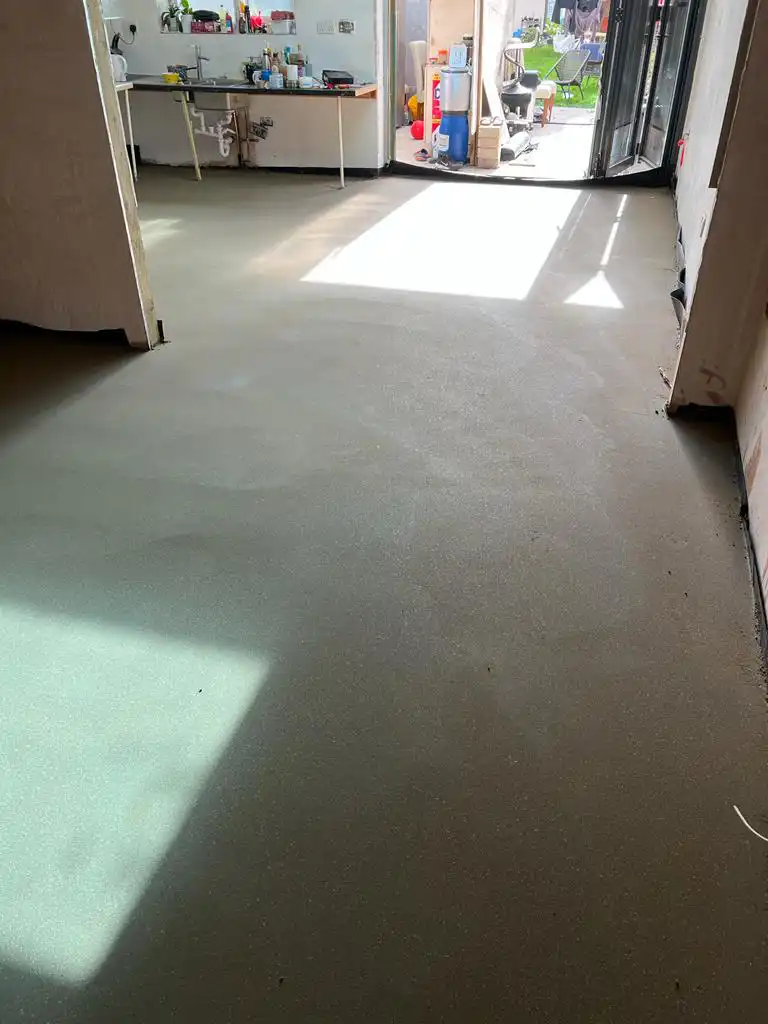
K & B Screeding’s own team, led by director Donatas Bardisevicius. Founded 2019, company 12298780.
See what customers say in our Google reviews and on our testimonials page.
Sand and Cement Screed from Slough to Cheshunt
On the map, Cheshunt sits east-north-east of Slough, about 28.5 miles from our base in a straight line (postcodes including EN8 and EN7), next to Waltham Cross (1.2 miles), Waltham Abbey (2.8 miles), Enfield (4.1 miles) and Hoddesdon (4.1 miles).
More on sand & cement screed, part of our screeding services.