
Rebuilding post-war ground floors in Harlow terraces
Harlow's post-war terraces were built to the standards of their time. Their ground floors are often thin concrete slabs with little or no insulation, and after decades of use they can be cracked, uneven or cold underfoot.
The lasting fix is to take up the old slab, dig down to the depth needed, and rebuild the floor. A compacted base goes in first, then insulation and a membrane, and finally the screed. Floating on insulation in a house, this screed should be 65mm deep as a minimum. Where it is bonded straight onto concrete that is still sound, 25 to 40mm is usual. The screed thickness guide lists depths for each case.
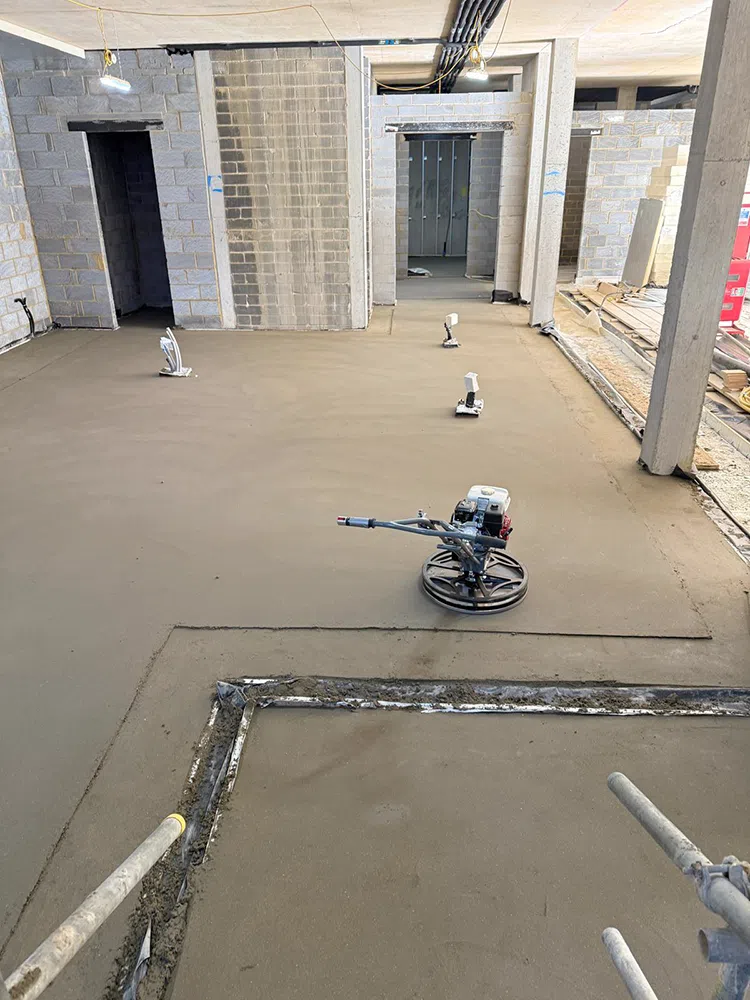
For a terrace rebuild like this, the traditional method has practical advantages. The mix is made next to the house and barrowed in, so it needs no pump and no lorry parked outside, which helps where the front door is some distance from the road. It copes with small kitchens, hallways, and stepped doorways. In a wet room it can be shaped to fall towards the drain. It also takes load earlier than calcium sulphate, so kitchen fitters can start sooner.
Where the floor will take heavy wear or the builder wants extra crack resistance, fibres can be added; see our fibre reinforced screed page. If the old floor turns out to be sound and only uneven, levelling compound for Harlow floors may be the cheaper route.
Garages, wet rooms and drying times in Harlow
Garage conversions are a natural use for sand and cement. The garage slab is normally lower than the rooms next to it, so insulation and screed make up the difference until the converted room is level with the hall. A typical layer-by-layer example is in screeding a garage conversion.
Showers you walk straight into, and full wet rooms, need floors that slope down to the drain. Because calcium sulphate cannot go where water may reach it, sand and cement, shaped by hand to those falls, is normally what goes down. Utility rooms and outbuildings are treated the same way.
Drying is slower than for liquid screed. Expect a 65mm Harlow floor to need several weeks before wood, vinyl or another moisture-sensitive finish, since this screed gives up its water at about a day per millimetre through the first 40mm and more slowly below that. A hygrometer test decides when it is ready. On a tight timetable, ask about a quicker drying mix.
Expect £18 to £25 per m² for this kind of screed under published 2026 UK figures, plus £1 to £3 per m² more if fibres are mixed in. If your project is outside Harlow, see sand and cement screed in Epping.
Sand and Cement Screed prices in Harlow
Sand and cement screed: £18 to £25 per m² supplied and laid (MyJobQuote, August 2026), so £450 to £630 for 25 m². MyJobQuote does not say whether these figures include VAT. See our floor screeding cost guide or screed calculator.
Who lays your sand and cement screed in Harlow
K & B Screeding’s own team, led by director Donatas Bardisevicius. Founded 2019, company 12298780.
See what customers say in our Google reviews and on our testimonials page.
Sand and Cement Screed from Slough to Harlow
On the map, Harlow sits east-north-east of Slough, about 35.8 miles from our base in a straight line (postcodes including CM20, CM18, CM17 and CM19), next to Sawbridgeworth (3.8 miles), Hoddesdon (4.7 miles), Epping (4.9 miles) and Ware (6.4 miles).
More on sand & cement screed, part of our screeding services.
