
Replacing damp solid floors behind Epping High Street
A period cottage floor that has failed usually shows it: damp patches under rugs, lifting tiles or a slab that rocks underfoot. Putting it right means breaking the old floor out, laying insulation and a damp proof membrane, and screeding on top. That is work a hand-laid mix handles well. It is mixed to the depth each area needs, so a room that drops towards the back door or has an old hearth to work around is no trouble.
On top of insulation it floats, and in a house we lay it no thinner than 65mm. If the concrete underneath is solid and just has a poor face, we can bond 25 to 40mm of screed directly to it and keep the doorway heights down. We check which approach fits once the old floor is open.
Another 13% of Epping's homes date from between the wars, and adding insulation under new flooring in those houses raises the same questions. In rooms where a covering is going down quickly, the mix can be modified with rapid drying additives, or with fibres for extra crack resistance; the fibre reinforced screed page covers that option.
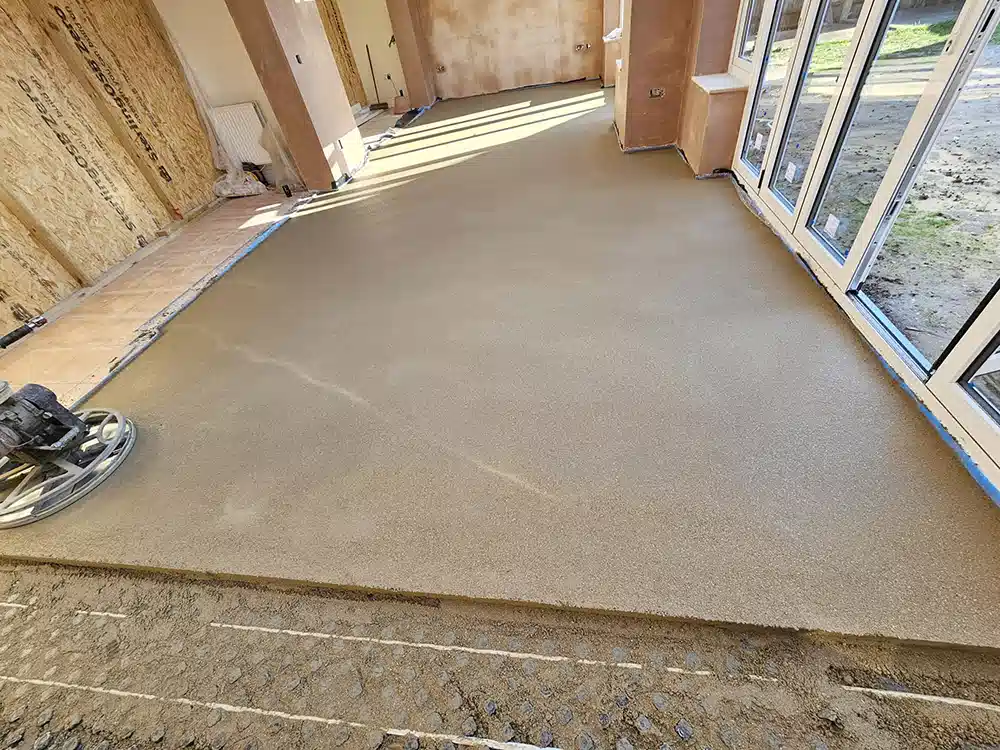
We pack it down and float it until the top is dense and level. If the flooring maker asks for tighter flatness than a hand finish gives, a thin coat of compound on top is the answer, described on our floor levelling page.
Wet rooms, garages and workshops around Epping
Unlike calcium sulphate, a cement screed copes in wet areas, so it is what goes under a wet room or a shower floor laid to fall towards the drain. The falls are formed by hand as the screed goes down, which is much easier to control with a semi-dry mix than with a flowing one.
Garage conversions are another use for a hand-laid screed. Garage floors often sit below the house and can run downhill to the door; the screed has to build that up until it lines up with the hall. What goes in under a converted garage floor, layer by layer, is in our garage floor screed guide.
For the workshops and storage units on Flux's Lane and at Bower Hill Industrial Estate, a commercial screed is laid at least 75mm deep when floating, and a hard wearing surface matters more than speed.
The trade-off is time. This mix is slower to dry than a liquid one, at around a millimetre a day to 40mm and less after that, and any underfloor heating stays off for 21 days at least. For depths by job type, see the screed thickness guide.
Sand and Cement Screed prices in Epping
Sand and cement screed: £18 to £25 per m² supplied and laid (MyJobQuote, August 2026), so £450 to £630 for 25 m². MyJobQuote does not say whether these figures include VAT. See our floor screeding cost guide or screed calculator.
Who lays your sand and cement screed in Epping
K & B Screeding’s own team, led by director Donatas Bardisevicius. Founded 2019, company 12298780.
See what customers say in our Google reviews and on our testimonials page.
Sand and Cement Screed from Slough to Epping
As the crow flies, our yard in Slough is about 34.5 miles from Epping, which lies to the east-north-east. Postcodes here include CM16, and Loughton (3.5 miles), Waltham Abbey (4.1 miles), Harlow (4.9 miles) and Chigwell (5.6 miles) are close by.
More on sand & cement screed, part of our screeding services.
