
Relaying older Chigwell solid floors by hand
Only 6% of Chigwell's homes were built before 1919, and 15% date from between the wars. Houses of that age often have solid floors laid with little or no damp proof membrane and no insulation. When an owner renovates, the usual answer is to dig the old floor out, lay insulation and a membrane, then finish with a fresh screed at the right height to meet door linings and skirting.
Sand and cement is well suited to this kind of job. It is mixed on site to the exact quantity each room needs, barrowed in, compacted and floated flat. That makes it economical on a single dining room, a hall or a run of small rooms where setting up a pump would cost more than the material saves.
Depth is the thing to plan around. A floating sand and cement screed in a house is laid at about 65mm, and a commercial floor at about 75mm. Where the screed is bonded straight onto a sound concrete base, 25 to 40mm is enough. Our screed thickness guide explains how the build-up adds up.
Chigwell's old village core keeps the twelfth century church of St Mary the Virgin and the seventeenth century Kings Head. For any building of real age, and especially one that is listed, check what the council's conservation officer expects before an original floor comes out.
Wet rooms, garages and early loads in Chigwell homes
Sand and cement is a cement based substrate, so it tolerates water in a way calcium sulphate screed does not. That makes it the usual choice for a Chigwell shower room or wet room laid to a fall, for a utility room with a floor drain, and for garages.
A fall is formed by hand, with the screed laid thicker at the door and thinner at the gully, which a flowing screed cannot do. Tile adhesives and tanking systems designed for cement bases then go straight on.
Garages are a common conversion in larger houses. The existing slab is often lower than the house, so the new floor has to be built up with insulation, a membrane and screed to meet the hall. Our garage conversion screed guide covers that height problem.
Where the programme is tight, the mix can be changed: a quick drying sand and cement screed shortens the wait, and fibres, which add £1 to £3 per m², help control cracking. Bear in mind that sand and cement dries more slowly than liquid screed, at roughly a day per millimetre for the first 40mm.
Sand and Cement Screed prices in Chigwell
Sand and cement screed: £18 to £25 per m² supplied and laid (MyJobQuote, August 2026), so £450 to £630 for 25 m². MyJobQuote does not say whether these figures include VAT. See our floor screeding cost guide or screed calculator.
Who lays your sand and cement screed in Chigwell
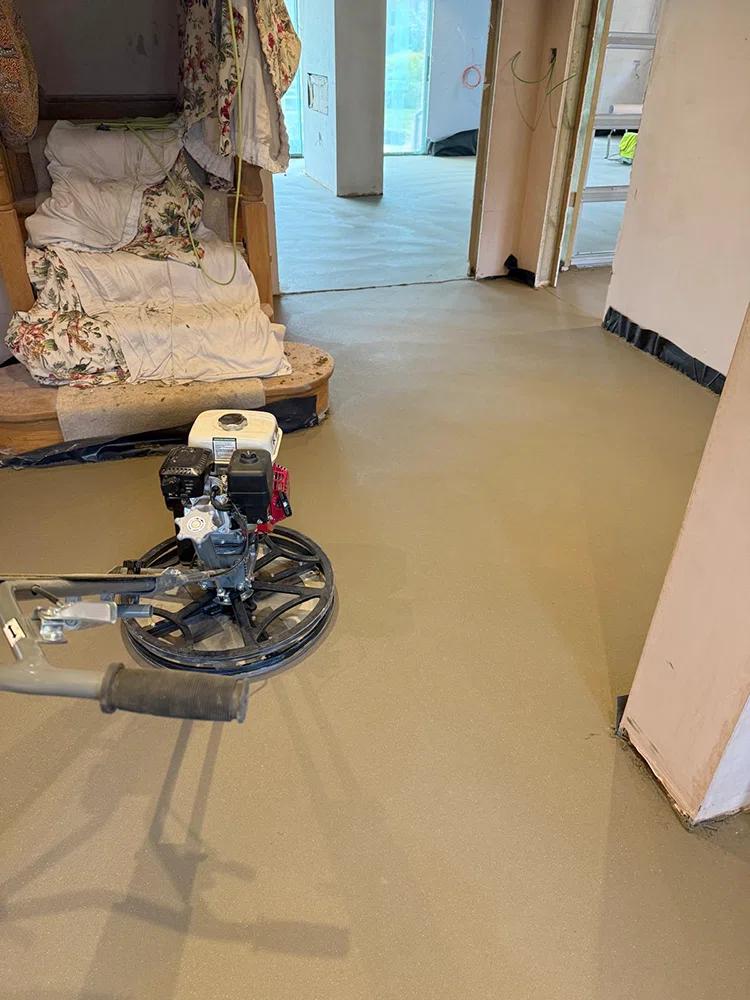
K & B Screeding’s own team, led by director Donatas Bardisevicius. Founded 2019, company 12298780.
See what customers say in our Google reviews and on our testimonials page.
Sand and Cement Screed from Slough to Chigwell
As the crow flies, our yard in Slough is about 31.6 miles from Chigwell, which lies to the east-north-east. Postcodes here include IG7, and Redbridge (2.4 miles), Loughton (2.5 miles), Waltham Forest (3.9 miles) and Waltham Abbey (5.3 miles) are close by.
More on sand & cement screed, part of our screeding services.
