
Reading a calcium sulphate grade for a Chigwell block
On Chigwell drawings an anhydrite floor is specified by a short code, taken from the European standard that covers screed materials. In CA-C25-F5, CA means calcium sulphate, C25 is a compressive strength of 25 N/mm2 and F5 a flexural strength of 5 N/mm2. The three grades in common use each suit a different load.
CA-C20-F4 covers domestic floors with light traffic, such as bedrooms and living areas in a house. CA-C25-F5 is the general choice for most homes, apartments and offices, and is the grade usually drawn for apartment floors. CA-C30-F6 is kept for heavier use, such as communal corridors or busier commercial space.
Alpha hemihydrate products sit alongside those grades. They are chosen when faster drying or a thinner section matters, for instance where an acoustic layer eats into the floor-to-ceiling height, and each one follows its own product data sheet for depth and drying.
The material's low shrinkage means bays can be large and joints few, which suits wide apartment floors. We plan the bay and joint layout with the designer before the pour, especially across doorways and at changes of room shape.
What anhydrite should not be is the floor of a room that may stay wet. For wet rooms, plant rooms or anywhere water may sit, a cement based liquid screed or a hand-laid traditional sand and cement floor is the safer choice.
Laitance, moisture tests and primers in Chigwell homes
A calcium sulphate screed dries with a thin, weak skin on top called laitance. It has to come off before any adhesive is used, or the flooring can lift with it. Once the floor is dry enough, the surface is sanded back to sound material and vacuumed.
Moisture is the next hurdle. Many flooring makers set a lower moisture limit for calcium sulphate than for cement based screeds, so a floor that would pass for tiles on sand and cement may still be too damp here. A hygrometer test is the proper check. Homes built since 2015 make up 6% of Chigwell's stock, and on new plots like these with underfloor heating, the heating can usually be used to force dry the screed from about 7 days.
Finally, the primer has to be compatible with calcium sulphate, and the adhesive is chosen to suit the same system. Our anhydrite screed explained guide walks through the steps. On a block of flats, the sanding, testing and priming are worth building into the fit-out programme as named tasks, so the flooring contractor does not arrive to a screed that is still too damp or still carrying its laitance.
Anhydrite & Flow Screed prices in Chigwell
Liquid flowing screed (which includes anhydrite): £24 to £31 per m² supplied and laid (MyJobQuote, August 2026), so £960 to £1,240 for 40 m². MyJobQuote does not say whether these figures include VAT. See our floor screeding cost guide or screed calculator.
Who lays your anhydrite and flow screed in Chigwell
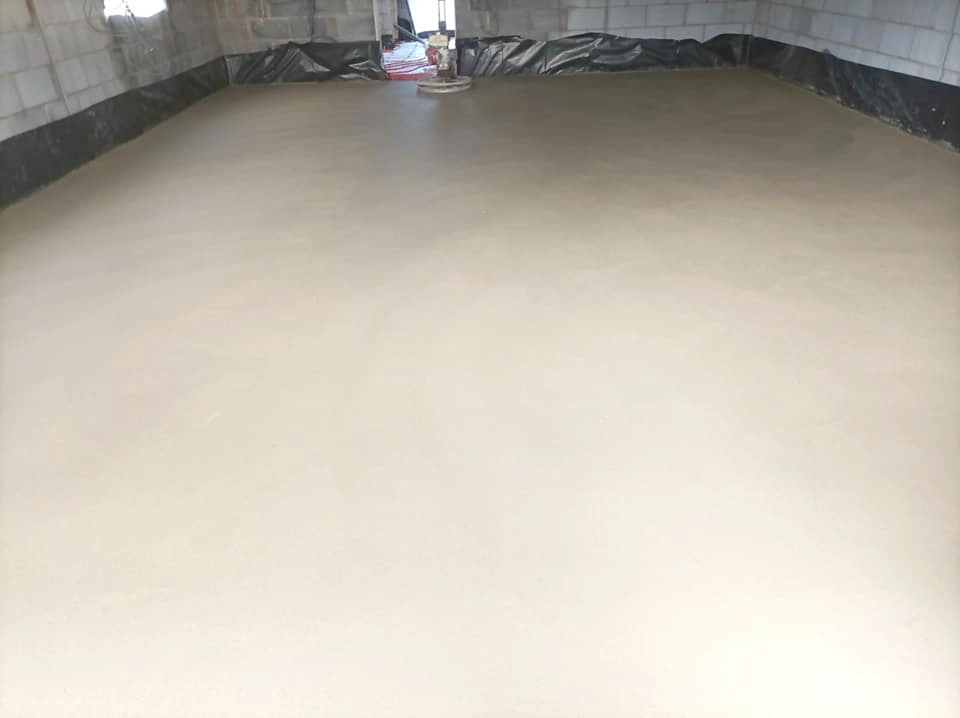
K & B Screeding’s own team, led by director Donatas Bardisevicius. Founded 2019, company 12298780.
See what customers say in our Google reviews and on our testimonials page.
Anhydrite & Flow Screed from Slough to Chigwell
As the crow flies, our yard in Slough is about 31.6 miles from Chigwell, which lies to the east-north-east. Postcodes here include IG7, and Redbridge (2.4 miles), Loughton (2.5 miles), Waltham Forest (3.9 miles) and Waltham Abbey (5.3 miles) are close by.
More on anhydrite screed, part of our screeding services.
