
Calcium sulphate grades for Waltham Cross apartment floors
Calcium sulphate screeds carry a code drawn from the European standard that governs screed materials. C is compressive strength and F flexural strength, with both figures in N/mm2. Three grades cover most buildings. For light domestic use there is CA-C20-F4. The middle grade, CA-C25-F5, covers the bulk of houses, apartment blocks and offices, leaving CA-C30-F6 for heavier wear.
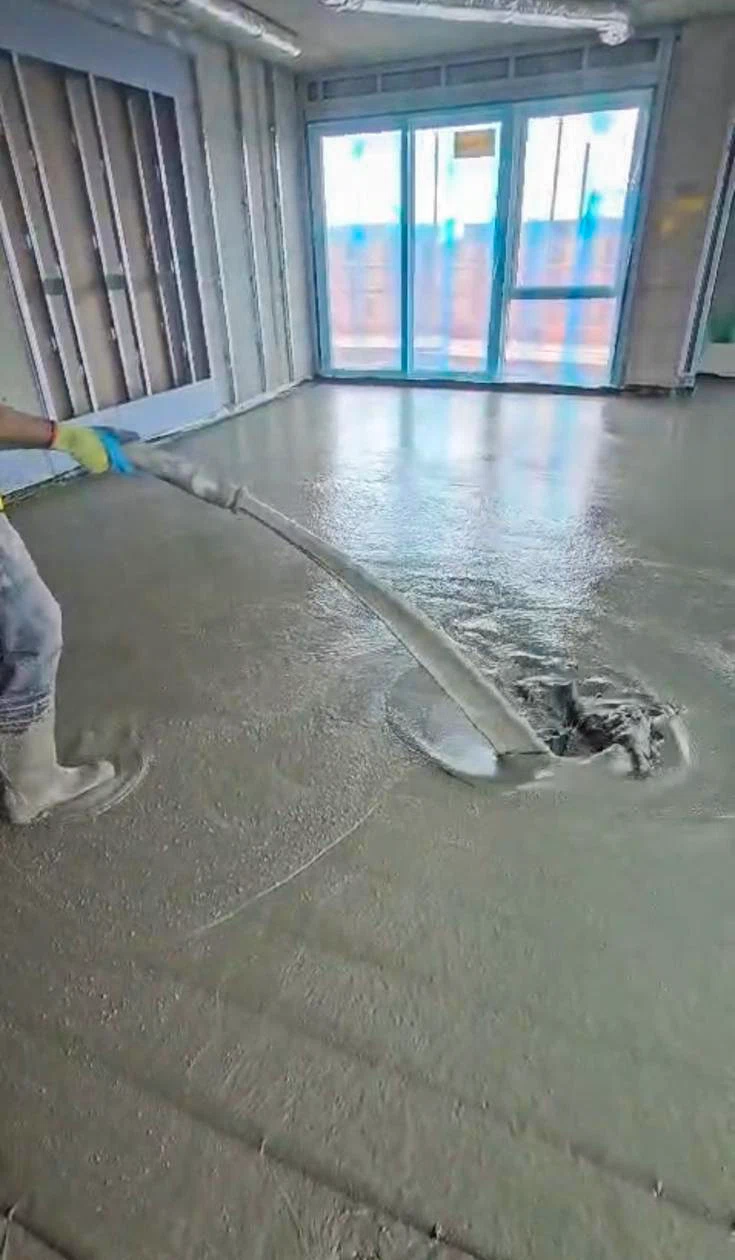
On a scheme like the flats proposed at The Pavilions, the engineer picks the grade and our pour matches it to the letter. If time is short or the depth available is small, a faster alpha hemihydrate material may be specified instead. Those come with their own depth and drying figures, and we follow that sheet over any general rule.
The reason apartment designers like the material is shrinkage. Shrinkage is very low as it sets, which lets an open-plan apartment go down in large bays with few joints. The joints we do need sit at thresholds and between heating zones, and we settle their layout before the pour.
The material has a limit. Keep it out of wet rooms, showers and any part of the building left open to the weather during construction. A cement based flowing screed, which we also lay, takes its place there. Our plain guide to anhydrite covers how the material behaves.
Laitance and moisture checks before Waltham Cross floors are finished
While it dries, calcium sulphate grows a thin, fragile skin on top, known as laitance. Glue flooring to it and the flooring is only holding onto that skin, which can part from the screed below, so it is sanded away first. When the screed has dried enough we sand it back to sound material, then seal it with a primer made for calcium sulphate.
Moisture testing comes next. A flooring maker may set a stricter moisture limit for calcium sulphate than for cement, so a reading that clears a tiled sand and cement floor might not clear this one. We test with a hygrometer rather than counting days on a calendar, and record the reading for the flooring fitter. Underfloor heating, where it has been fitted, can usually start force drying the floor at around day 7.
If the finished surface needs to be flatter for sheet vinyl or LVT, a thin levelling coat over the new screed follows the priming. For the same service nearby, see our calcium sulphate screed in Hoddesdon page.
Anhydrite & Flow Screed prices in Waltham Cross
Liquid flowing screed (which includes anhydrite): £24 to £31 per m² supplied and laid (MyJobQuote, August 2026), so £960 to £1,240 for 40 m². MyJobQuote does not say whether these figures include VAT. See our floor screeding cost guide or screed calculator.
Who lays your anhydrite and flow screed in Waltham Cross
K & B Screeding’s own team, led by director Donatas Bardisevicius. Founded 2019, company 12298780.
See what customers say in our Google reviews and on our testimonials page.
Anhydrite & Flow Screed from Slough to Waltham Cross
As the crow flies, our yard in Slough is about 28.4 miles from Waltham Cross, which lies to the east-north-east. Postcodes here include EN8, and Cheshunt (1.2 miles), Waltham Abbey (2.1 miles), Enfield (3.3 miles) and Loughton (4.8 miles) are close by.
More on anhydrite screed, part of our screeding services.