
Anhydrite grades on Hertford apartment and plot drawings
Strength is how this material is graded. Take CA-C25-F5: C means compressive strength and F means flexural strength, each given in N/mm2 under the European standard for screeds.
There are three common grades. CA-C20-F4 is meant for domestic rooms with light traffic, CA-C30-F6 for heavier use, and CA-C25-F5 sits between them, suiting the majority of houses, flats and offices.
Then there are the alpha hemihydrate products. They earn their place where drying speed or a thinner layer matters, and every one comes with its own data sheet to follow.
Some 13% of Hertford's homes went up between 2000 and 2014, and building has carried on since. Newer plots and apartment floors like these are where a calcium sulphate grade usually appears in a specification, and new build drawings often name the grade alongside the insulation and the underfloor heating layout. If the drawings name no grade, we recommend one to suit the use of each floor before the pour is booked.
Because it hardly shrinks, big bays can go down with few joints, and before pouring we mark where the joints go so they land at doorways and heating zones. Everything beneath the screed, from the insulation to the edge strip, is set out by our own people.
Calcium sulphate is ruled out on any floor that could get wet, and we offer cement based flowing screed there instead. For how the pumped pour itself works, see our page on pumped floor screed.
Sanding and testing anhydrite in Hertford before flooring
As it dries, anhydrite forms a weak skin on top known as laitance. Adhesive struggles to grip that skin, so once the screed has dried far enough we sand it away, vacuum the dust and prime with a product made to work with calcium sulphate. Standard cement primers are not a safe substitute.
Moisture is the other check. Many flooring manufacturers accept less moisture in calcium sulphate than they would in cement, so a dry-looking floor might still be too wet for wood or vinyl. A hygrometer reading, not a guess, decides when the floor is ready. Underfloor heating, where fitted, can usually be used to force dry it once about 7 days have gone by, shortening the wait.
Our drying and laitance notes are handed over on paper, letting the flooring fitter see what was done and when. On a block of flats, it is worth keeping that record for each floor, because pour dates and drying conditions differ from one level to the next. Our guide to anhydrite screed goes into more detail, and the same service runs in Welwyn Garden City.
Anhydrite & Flow Screed prices in Hertford
Liquid flowing screed (which includes anhydrite): £24 to £31 per m² supplied and laid (MyJobQuote, August 2026), so £960 to £1,240 for 40 m². MyJobQuote does not say whether these figures include VAT. See our floor screeding cost guide or screed calculator.
Who lays your anhydrite and flow screed in Hertford
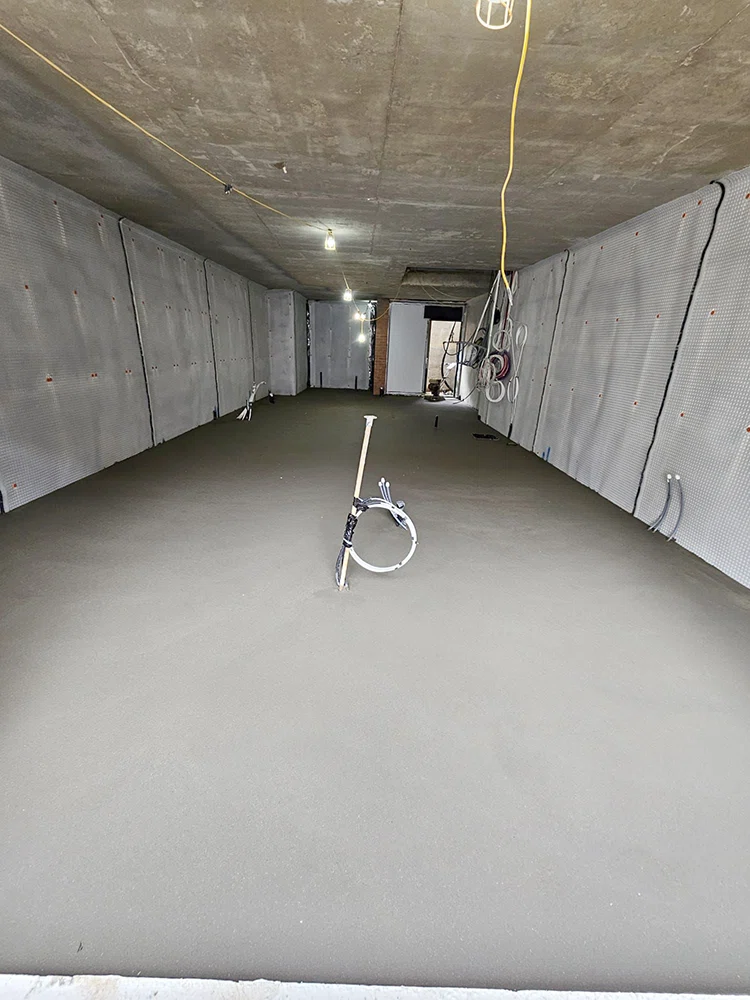
K & B Screeding’s own team, led by director Donatas Bardisevicius. Founded 2019, company 12298780.
See what customers say in our Google reviews and on our testimonials page.
Anhydrite & Flow Screed from Slough to Hertford
Hertford is about 30.5 miles north-east of our Slough base as the crow flies, with postcodes including SG14 and SG13. The nearest towns to it are Ware (2.2 miles), Hoddesdon (3.8 miles), Welwyn Garden City (5.6 miles) and Hatfield (6.5 miles).
More on anhydrite screed, part of our screeding services.
