
What the grade on a Ware specification means
On a drawing, anhydrite is described by a code like CA-C25-F5. CA marks it as calcium sulphate. After that, C gives compressive and F flexural strength, measured in N/mm2. Most buildings use one of three grades:
CA-C20-F4, for houses where traffic is light. CA-C25-F5, the usual choice across homes, apartments and offices. CA-C30-F6, where wear is heavier.
For a Ware apartment block or new build plot, the engineer or developer chooses the grade and we match it exactly. Now and then the drawings call for alpha hemihydrate instead, picked for quicker drying or a thinner build-up. Its depth and drying time then come from that product's own sheet.
Its big strength is low shrinkage, so open-plan apartments can be poured in wide sections that need few joints, even where kitchen, dining and living space run into one another. Joints still go at thresholds and between heating zones, and we plan that layout before pouring.
The practical limit is water. Calcium sulphate should not go where it may stay wet, including wet rooms and shower areas. There, a cement based flowing screed gives the same pumped finish and we can supply that instead. The material is explained at more length in our anhydrite screed guide; pumped screed in general has its own page, pumping liquid screed in Ware.
Sanding, priming and testing before flooring in Ware
Drying leaves calcium sulphate with laitance, a thin and weak surface skin. Adhesive spread on top of it grips only that skin, which can come away, so we sand it off first. Next comes priming, with a product made for calcium sulphate, because one designed for cement can let go.
Moisture is the other test. Flooring makers frequently ask for a drier floor on calcium sulphate than on cement, so this screed has to reach a lower reading than sand and cement would. We measure it with a hygrometer, not by the calendar. Pipes in the floor allow force drying, normally from about 7 days.
The sequence in a Ware flat is therefore pour, dry, sand, test, prime and then fit the floor. Skipping sanding or testing is a common reason flooring lifts. The flooring contractor gets a written note from us on drying and laitance, so they can see exactly what was done before they start fixing. If you are building in the wider area, see our anhydrite flow screed in Harlow page.
Anhydrite & Flow Screed prices in Ware
Liquid flowing screed (which includes anhydrite): £24 to £31 per m² supplied and laid (MyJobQuote, August 2026), so £960 to £1,240 for 40 m². MyJobQuote does not say whether these figures include VAT. See our floor screeding cost guide or screed calculator.
Who lays your anhydrite and flow screed in Ware
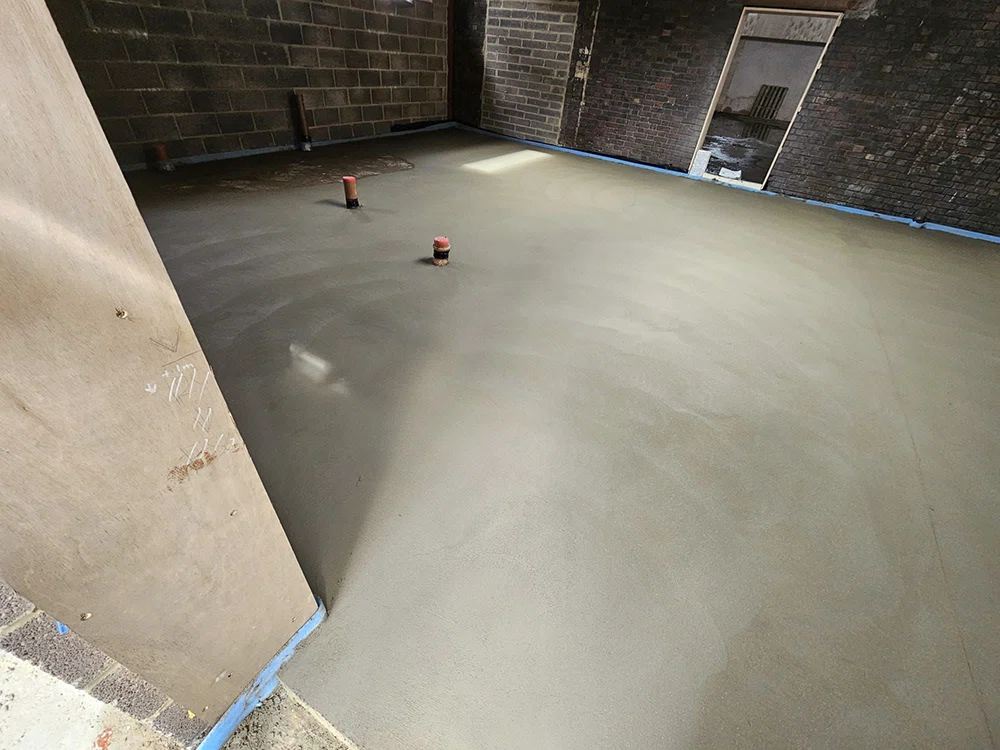
K & B Screeding’s own team, led by director Donatas Bardisevicius. Founded 2019, company 12298780.
See what customers say in our Google reviews and on our testimonials page.
Anhydrite & Flow Screed from Slough to Ware
Ware is about 32.7 miles north-east of our Slough base as the crow flies, with postcodes including SG12. The nearest towns to it are Hertford (2.2 miles), Hoddesdon (3.9 miles), Harlow (6.4 miles) and Welwyn Garden City (7.4 miles).
More on anhydrite screed, part of our screeding services.
