
Replacing hollow and cracked screeds in Ware houses
A sand and cement screed fails in a few recognisable ways. It sounds hollow when tapped, it cracks across the room, or it breaks up under a chair leg. Behind each is usually poor compaction, too thin a layer or a lost bond with the slab below. In Ware's semis and estate houses, floors like these are a common reason for starting again.
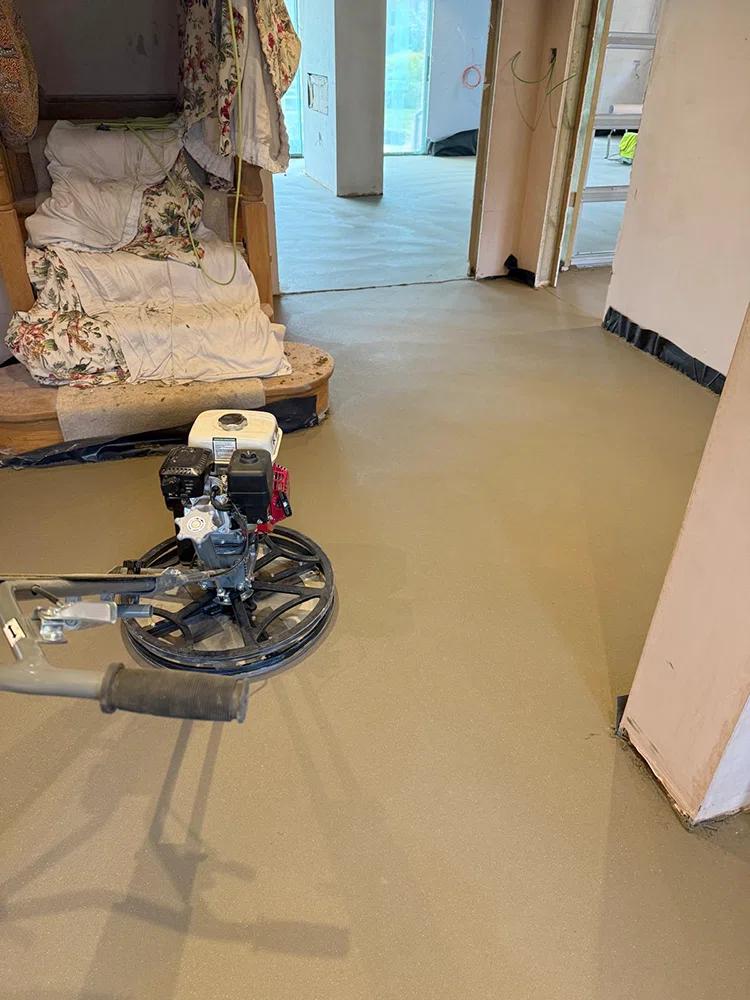
On a typical ground floor, the job starts by breaking out the failed screed and checking the base. If damp is a factor, a membrane goes down. Then a new screed is mixed on site, laid to depth, compacted and trowelled flat. Where damage is limited to a small area, our screed repairs service may be enough.
Depth depends on construction. Over insulation, a house floor wants about 65mm of screed, and a commercial one about 75mm. Fixed directly to a sound slab, a bonded layer can be just 25 to 40mm.
The same method suits other jobs. A wet room floor has to slope to its drain, and sand and cement can cope with the water there, which calcium sulphate cannot. Small rooms, hallways and awkward shapes are quicker by hand than setting up a pump. Where cracking is a concern, fibres can be added, which is what our fibre reinforced screed page covers, and rapid drying additives shorten the wait before flooring.
Garage conversions and Crib Street's older buildings
Garage conversions are a regular task on Ware's post-war houses. The old slab usually sits below the level of the house, is often uneven and has no insulation. A new sand and cement screed over insulation and a membrane lifts it to meet the hallway. Each layer of that is explained on our garage conversion screed page.
The historic centre is a different story. Ware keeps 202 listed buildings, including the timber-framed houses on Crib Street. In buildings like these a dense cement screed can trap moisture in old walls and floors, so the conservation officer normally expects a breathable build-up and thin levelling layers instead. Agree the approach with the council first, then we can price what is allowed. Where a sand and cement screed is not acceptable, the answer may be a thin levelling layer over the existing floor instead.
Patience is needed with drying too, more than with a pumped floor. Expect roughly one millimetre a day while the first 40mm dries out, then a slower rate, which puts a 65mm floor into weeks. The published 2026 UK range for this kind of screed is £18 to £25 per m².
Sand and Cement Screed prices in Ware
Sand and cement screed: £18 to £25 per m² supplied and laid (MyJobQuote, August 2026), so £450 to £630 for 25 m². MyJobQuote does not say whether these figures include VAT. See our floor screeding cost guide or screed calculator.
Who lays your sand and cement screed in Ware
K & B Screeding’s own team, led by director Donatas Bardisevicius. Founded 2019, company 12298780.
See what customers say in our Google reviews and on our testimonials page.
Sand and Cement Screed from Slough to Ware
Ware is about 32.7 miles north-east of our Slough base as the crow flies, with postcodes including SG12. The nearest towns to it are Hertford (2.2 miles), Hoddesdon (3.9 miles), Harlow (6.4 miles) and Welwyn Garden City (7.4 miles).
More on sand & cement screed, part of our screeding services.
