
Latex for Ware flats and refitted kitchens
Ordinary levelling compound is mixed with water. Latex screed swaps the water for a latex liquid, which gives the set layer a little flexibility and a strong grip on difficult surfaces. That is why the trade reaches for it on refits, where the base is whatever the last owner left behind.
In a Ware flat, the base under old carpet may be a screed or concrete slab carrying years of patches and glue. Firm, compatible adhesive residue can sometimes stay, but anything soft or flaking is scraped or ground off. After a primer matched to that base, latex is poured and spread to a few millimetres.
Post-war semis and estate houses present a different set of bases. Kitchens and bathrooms in them may have old quarry or ceramic tiles. If those are still firmly bonded, there is no need to break them out: they are scrubbed clean, given a primer designed for glazed or dense surfaces, and skimmed over. Rooms with timber floors are covered in flooring grade plywood first, because latex should never be laid on bare boards.
The finishes that gain most are the thin and flexible ones. Sheet vinyl, LVT, lino, rubber and safety flooring all show every lump below them, and carpet wears more evenly on a smooth base. Terraced houses make up 21% of Ware's homes, and where a terrace kitchen or hallway is in daily use, a skim of latex is far less disruptive than relaying the floor. For tiles and engineered wood, or where a floor must reach a flatness class, our floor levelling service is the page to read.
Damp, movement and Crib Street: Ware's limits for latex
Latex is thin, so it relies entirely on the floor underneath. Three conditions rule it out until they are put right.
A floor that moves. If overboarded timber bounces underfoot, the latex will crack along the board joints. The fixings, boards or joists are sorted first.
A floor that is damp. Latex is not a damp proof layer. Older solid floors are tested before work, and moisture rising through a slab has to be dealt with at its source.
A floor that is badly out of level. A few millimetres smooths; it does not rebuild. Where an old sand and cement screed in a post-war house has hollowed or cracked, the answer is to break it out and lay a new hand-laid screed, skimming afterwards only if the finish needs it.
Calcium sulphate screeds need particular care. The weak laitance on top must be sanded off and the surface primed, or the latex ends up bonded to a crust that can let go.
In the listed and timber-framed buildings on Crib Street and around the centre, the conservation officer has to approve the floor build-up first, so latex is only used there as part of an agreed approach. Hertford, just to the west, has its own page: latex screed in Hertford.
How we price latex screed in Ware
A fixed written price within 24 hours, once we know the area and the base. See our floor screeding cost guide.
Who lays your latex screed in Ware
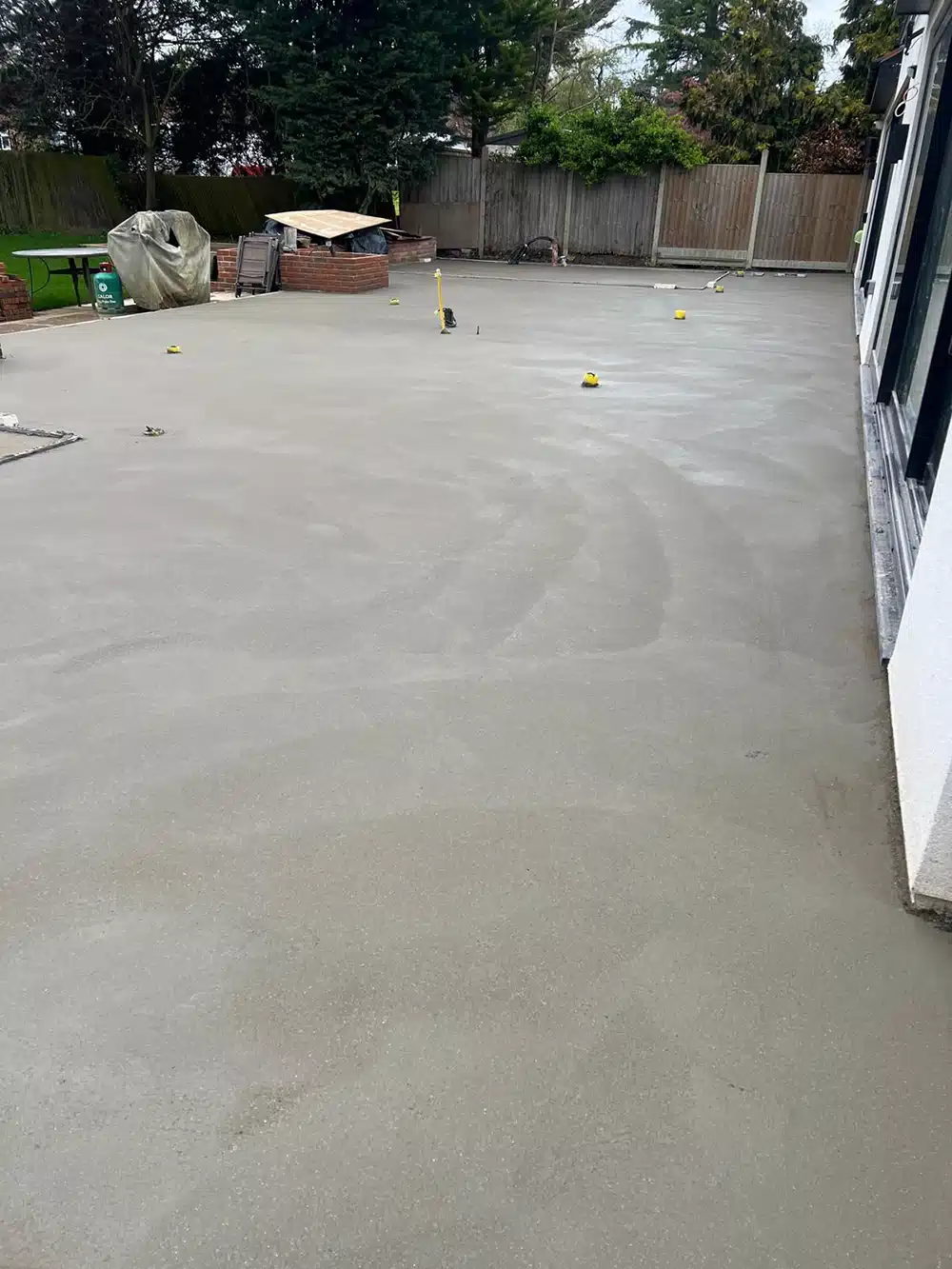
K & B Screeding’s own team, led by director Donatas Bardisevicius. Founded 2019, company 12298780.
See what customers say in our Google reviews and on our testimonials page.
Latex Screed from Slough to Ware
Ware is about 32.7 miles north-east of our Slough base as the crow flies, with postcodes including SG12. The nearest towns to it are Hertford (2.2 miles), Hoddesdon (3.9 miles), Harlow (6.4 miles) and Welwyn Garden City (7.4 miles).
More on latex screed, part of our screeding services.
