
Where pumped screed pays off in Ware homes
Liquid screed makes the biggest difference on large, open areas. In Ware that usually means one of three things.
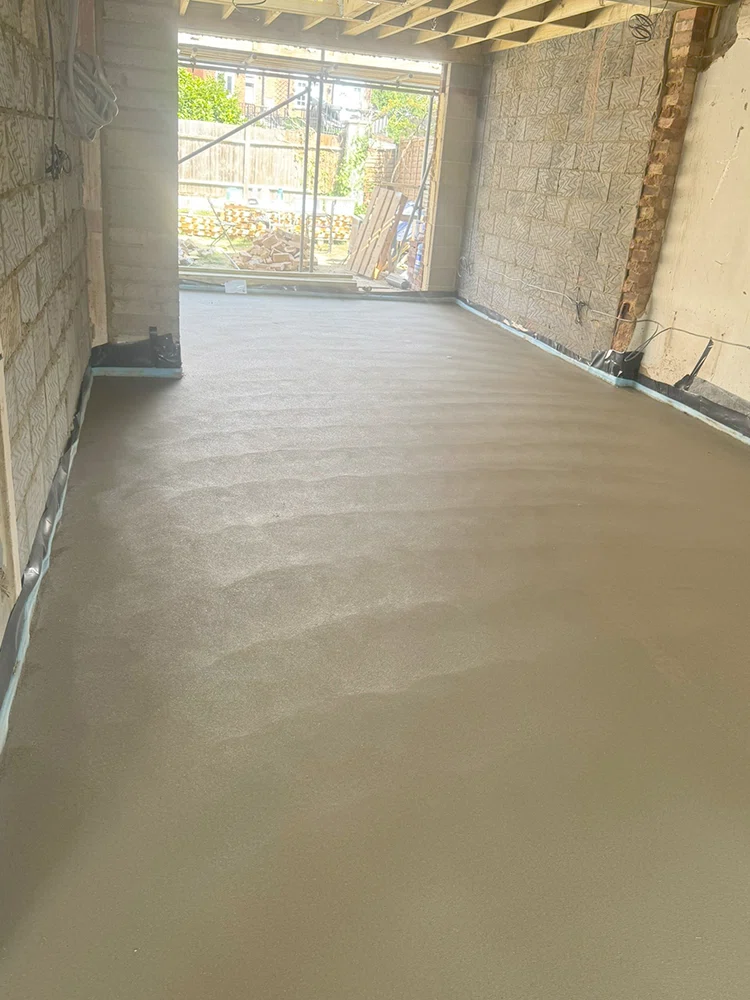
Top of the list is the back of a post-war or late 20th century semi or estate house, extended outwards with the wall to the old kitchen often taken out. Pumped in, the screed runs to every corner of that space and settles flat by itself, which makes SR1 or SR2 flatness straightforward. With so little shrinkage, a large knocked-through room gets by with few joints; laid by hand it would need many more.
The second is a garage conversion that joins the house. Once the old slab is insulated and membraned, a flowing screed brings it up to meet the hallway at a consistent level.
Flats are the third case. The hose climbs the stairwell to the right floor, so tonnes of sand and cement never have to be lugged up the steps.
Depth helps too. As a floating floor in a house it can be as little as about 35mm, where sand and cement would need about 65mm, which means less digging to bring a new floor level with an old doorstep. Over heating pipes, the build-up is covered on our page about heated screed floors.
There are calcium sulphate and cement based versions, and which one you want comes down to the flooring going on top and whether the room could ever get wet. Weighing pumped against hand-laid? The liquid or sand and cement comparison sets the two side by side.
Pump access and drying on a Ware job
Our pump and mixer park up on the drive or roadside, and the hose takes the shortest way in to the room being poured. Estate houses with a driveway are straightforward. If yours has restricted parking or a narrow way in, say so with your enquiry so we can work out where the lorry will go. The hose can travel through a hall or up a stairwell to a flat, provided the route is kept clear and protected.
Before the pour, the room is prepared: edge strip against every wall, membrane over the insulation with taped joints, and doorways dammed to hold the screed. We check the build-up on arrival rather than assuming it is right.
A floor that bears your weight by the second day is still a long way from dry. Before most coverings go on it has to pass a moisture test, and for the first 40mm each millimetre takes about a day, with deeper layers taking longer. Heating can speed up a calcium sulphate screed from about 7 days.
For the neighbouring county town, see our liquid screed in Hertford page.
Liquid Screed prices in Ware
Liquid screed: £24 to £31 per m² supplied and laid (MyJobQuote, August 2026), so £960 to £1,240 for 40 m². MyJobQuote does not say whether these figures include VAT. See our floor screeding cost guide or screed calculator.
Who lays your liquid screed in Ware
K & B Screeding’s own team, led by director Donatas Bardisevicius. Founded 2019, company 12298780.
See what customers say in our Google reviews and on our testimonials page.
Liquid Screed from Slough to Ware
Ware is about 32.7 miles north-east of our Slough base as the crow flies, with postcodes including SG12. The nearest towns to it are Hertford (2.2 miles), Hoddesdon (3.9 miles), Harlow (6.4 miles) and Welwyn Garden City (7.4 miles).
More on liquid screed, part of our screeding services.