
Reading anhydrite specifications for Hatfield apartments
A calcium sulphate screed is identified by a designation from the European standard for screed materials. The letters CA mark it as calcium sulphate, and the numbers after C and F give compressive and flexural strength in N/mm2. Most buildings use one of three: light domestic floors take CA-C20-F4, CA-C25-F5 suits the bulk of homes, apartments and offices, and heavier use calls for CA-C30-F6.
In a block of flats, the building's engineer chooses the grade and we pour exactly that, with no swaps. Communal corridors that take more traffic may call for a higher grade than the flats themselves. An alpha hemihydrate product turns up in some specifications, picked where quicker drying or a slimmer section matters, and its product sheet governs how we lay it.
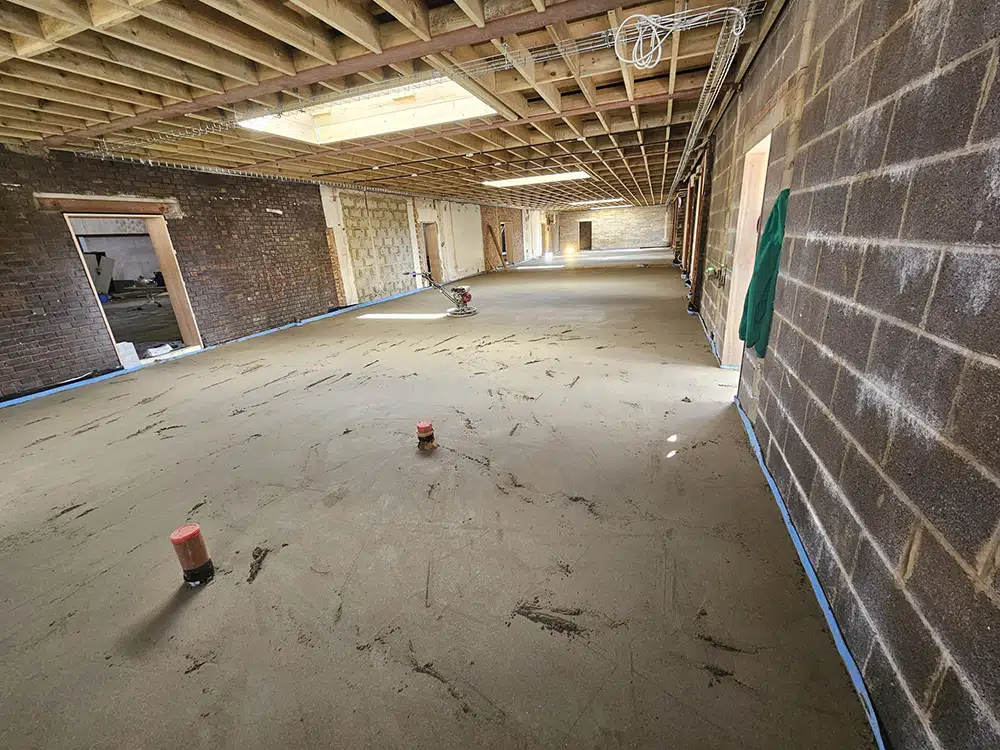
Because it barely shrinks while setting, calcium sulphate can go down in big bays with few joints. That suits apartment floors and new build plots, where one pour covers a whole floor over insulation and often heating. Before pour day we set out where the bays and joints go, putting joints at door thresholds and where heating zones meet.
Only 8% of Hatfield's homes were built from 2015 onwards, so new build plots are a smaller part of the picture than existing flats. Where an existing flat has its floor renewed, the build-up beneath, including any acoustic layer, is checked before anything is poured. For how the material works, read anhydrite screed explained.
Laitance and moisture checks in Hatfield flats
As calcium sulphate dries, a thin, weak and powdery skin called laitance forms on top. Adhesives, levelling compounds and primers will not hold to it properly. So we wait for the screed to dry far enough, sand the laitance away and then apply a primer that is compatible with calcium sulphate. Flats in Hatfield also bring latex levelling, and that compound needs the same clean, primed surface underneath; see floor levelling in Hatfield.
Moisture is tested before any flooring. The moisture limit many flooring makers set for calcium sulphate is lower than the one for cement screed, so a dry-looking floor can still let the flooring down. We test with a hygrometer. In a floor with underfloor heating, switching it on to force dry is usually possible from about 7 days, and the wait drops considerably.
Long spells of damp soften calcium sulphate, so we keep it out of wet rooms, walk-in showers and any floor where a leak is a risk. Those areas take a flowing screed with a cement base instead, or hand-laid sand and cement for Hatfield floors. In a flat, that means planning the bathroom separately from the rest of the floor.
Anhydrite & Flow Screed prices in Hatfield
Liquid flowing screed (which includes anhydrite): £24 to £31 per m² supplied and laid (MyJobQuote, August 2026), so £960 to £1,240 for 40 m². MyJobQuote does not say whether these figures include VAT. See our floor screeding cost guide or screed calculator.
Who lays your anhydrite and flow screed in Hatfield
K & B Screeding’s own team, led by director Donatas Bardisevicius. Founded 2019, company 12298780.
See what customers say in our Google reviews and on our testimonials page.
Anhydrite & Flow Screed from Slough to Hatfield
As the crow flies, our yard in Slough is about 24.4 miles from Hatfield, which lies to the north-east. Postcodes here include AL10, AL9 and AL4, and Welwyn Garden City (2.7 miles), Potters Bar (5 miles), St Albans (5.2 miles) and Hertford (6.5 miles) are close by.
More on anhydrite screed, part of our screeding services.
