
Why open-plan Chigwell ground floors suit a pumped screed
A flowing screed earns its keep on big, uninterrupted floors. When the back wall of a Chigwell house comes out and a new kitchen, dining and family space runs the full width of the plot, one continuous pour covers the lot. Because the material levels itself, a surface regularity of SR1 or SR2 is readily reached, and low shrinkage means far fewer joints than a hand-laid floor of the same size.
Depth matters as much as speed. A floating liquid screed in a house starts from about 35mm, compared with about 65mm for sand and cement. On an extension that has to finish flush with an existing hallway, those 30mm or so can be the difference between a level threshold and a step.
Semi-detached houses make up 26% of Chigwell's homes, and where one gains a rear extension the same continuous pour applies. Newer homes, 13% of the town's stock built since 2000, usually have an insulated floor build-up that suits a flowing screed from the start.
Two families of material are sold as liquid screed: calcium sulphate and cement based. Both are pumped the same way, but they dry, accept flooring and cope with water differently, so the choice is made per room. The calcium sulphate flow screed page deals with that material and its grades, and liquid screed compared with sand and cement weighs the two methods side by side.
Pump access and drying on a Chigwell job
On a Chigwell house the mixer and pump are parked outside, ideally on the driveway, and the screed comes indoors along a hose. Where the lorry has to stop on the road, a cone and a clear pavement route are usually enough, but shared drives and narrow gates are worth mentioning when you ask for a price. The hose runs through a door or window, along a hall or up a stair to an upper floor flat, as long as the route is protected. Dust sheets and corner guards go down first.
Before the pour the room is checked: edge strip round every wall, membrane lapped and taped with no gaps, doorways dammed and pipes clipped down so they cannot float. We can supply the build-up through our insulation and membranes service.
Walking on the floor within 24 to 48 hours is normal. Drying is slower: allow about a day per millimetre for the first 40mm, then longer, until a moisture test clears it for the chosen floor covering. The screed drying times guide explains the numbers.
Liquid Screed prices in Chigwell
Liquid screed: £24 to £31 per m² supplied and laid (MyJobQuote, August 2026), so £960 to £1,240 for 40 m². MyJobQuote does not say whether these figures include VAT. See our floor screeding cost guide or screed calculator.
Who lays your liquid screed in Chigwell
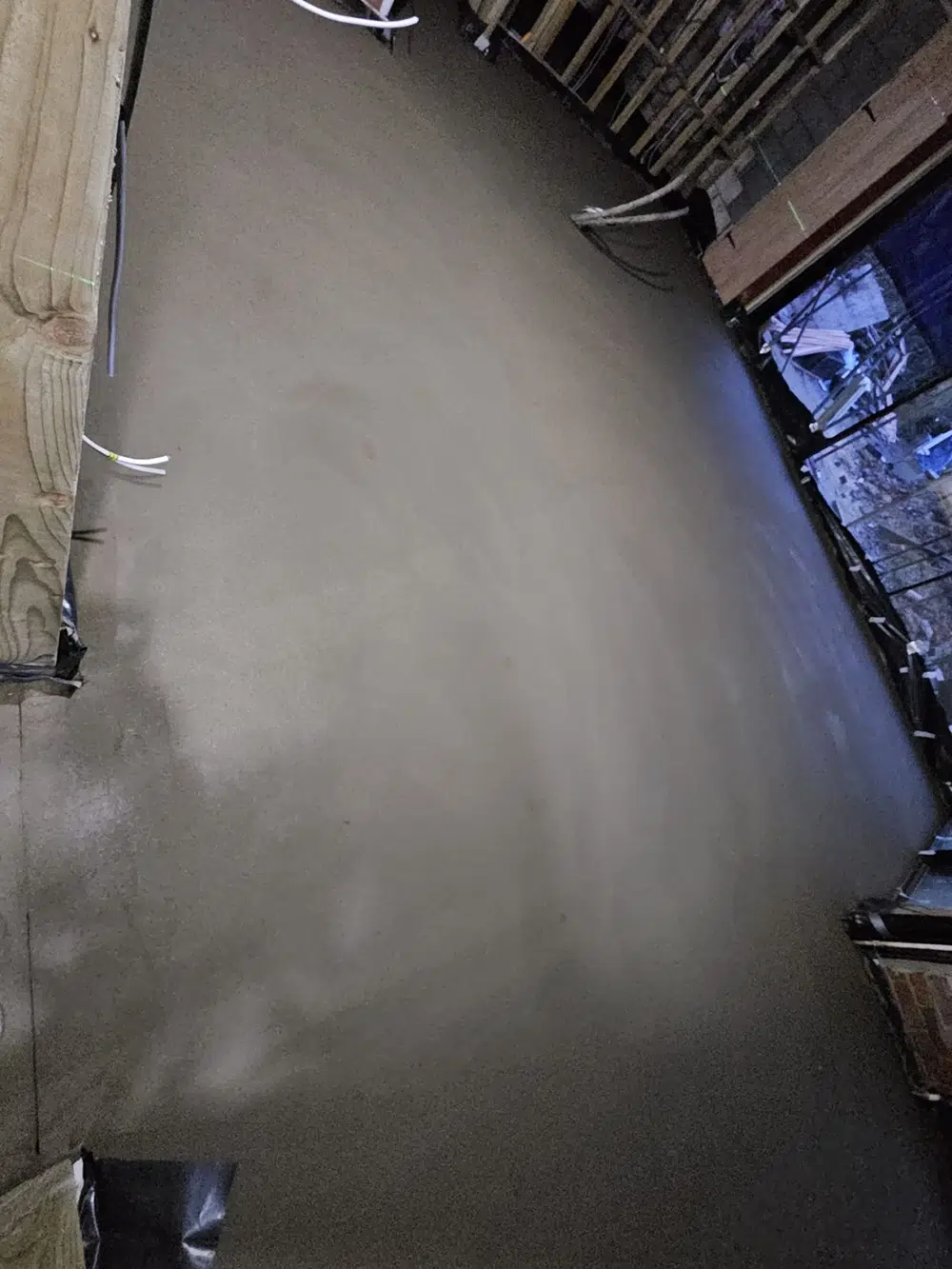
K & B Screeding’s own team, led by director Donatas Bardisevicius. Founded 2019, company 12298780.
See what customers say in our Google reviews and on our testimonials page.
Liquid Screed from Slough to Chigwell
As the crow flies, our yard in Slough is about 31.6 miles from Chigwell, which lies to the east-north-east. Postcodes here include IG7, and Redbridge (2.4 miles), Loughton (2.5 miles), Waltham Forest (3.9 miles) and Waltham Abbey (5.3 miles) are close by.
More on liquid screed, part of our screeding services.
