
Relaying old screed on Ninefields and Roundhills
Some 32% of Waltham Abbey's homes were built between 1945 and 1972. Houses on estates such as Ninefields and Roundhills went up in the 1960s and 1970s, and they are now due for new kitchens, bathrooms and extensions. That work usually starts with breaking out the old screed, then laying insulation and a membrane, then a new screed at a level that meets the existing rooms.
Sand and cement suits that sequence well. Because we batch it at the house, each room can take its own depth to suit the old levels around it. It is laid by hand, which handles narrow hallways, kitchens with many corners and doorways that must meet an existing threshold. Its cement binder also makes it the base to use in a bathroom, or anywhere that must carry weight early.
Laid floating on insulation, it goes in at roughly 65mm in a house and 75mm in commercial buildings. Where the slab is sound but headroom is short, we prepare its surface and bond 25 to 40mm of screed straight onto it. That approach is explained under bonded screed, and adding fibres to make a fibre reinforced screed helps resist cracking for between £1 and £3 extra per m² on published rates.
Older buildings need the same care. Some 8% of homes predate 1919, and where a solid floor in one of them has failed, it is rebuilt in the same way.
Wet rooms and garage conversions in Waltham Abbey
In a wet room the floor must slope to the outlet, and we form that slope with the trowel as the screed goes down. Sand and cement also tolerates water, whereas a calcium sulphate screed is weakened by it. So under a walk-in shower or a tiled wet room, this is the usual base, with tanking applied before the tiles.
Garage conversions are a similar story. Garage bases normally sit below the house, so the converted room needs insulation and enough screed on top to come up to the hall floor. Each layer is set out in screeding a garage floor.
The main drawback is drying time: a 65mm hand-laid floor takes far longer to be ready for tiles, LVT or wood than a thin pumped screed. A rapid drying mix shortens that. On 2026 published rates a fast drying mix costs between £20 and £28 per m², while a standard one is between £18 and £25.
Because the mix is made on site, a bathroom or garage job needs only room for materials and a mixer near the door, not space for a pump lorry.
Sand and Cement Screed prices in Waltham Abbey
Sand and cement screed: £18 to £25 per m² supplied and laid (MyJobQuote, August 2026), so £450 to £630 for 25 m². MyJobQuote does not say whether these figures include VAT. See our floor screeding cost guide or screed calculator.
Who lays your sand and cement screed in Waltham Abbey
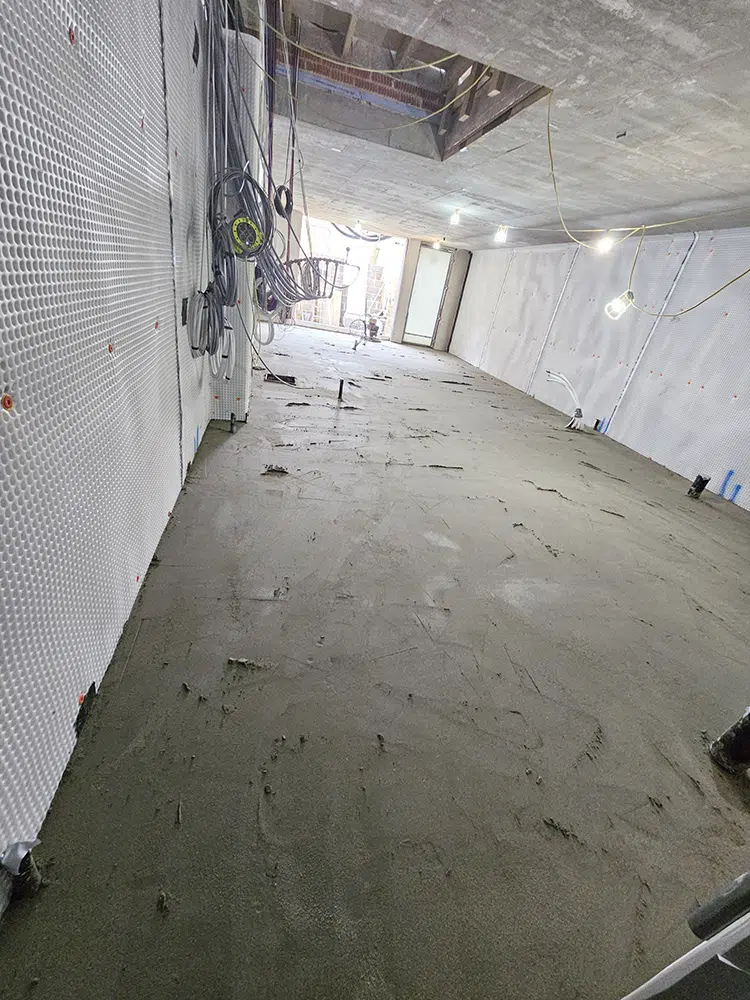
K & B Screeding’s own team, led by director Donatas Bardisevicius. Founded 2019, company 12298780.
See what customers say in our Google reviews and on our testimonials page.
Sand and Cement Screed from Slough to Waltham Abbey
Waltham Abbey is about 30.4 miles east-north-east of our Slough base as the crow flies, with postcodes including EN9. The nearest towns to it are Waltham Cross (2.1 miles), Cheshunt (2.8 miles), Loughton (3 miles) and Epping (4.1 miles).
More on sand & cement screed, part of our screeding services.
