
Relaying solid floors in Brentwood's Victorian town centre
Plenty of solid floors in Victorian houses have no working damp proof membrane. Moisture comes up through them, coverings lift and timber skirtings start to rot. Patches seldom hold for long, so the lasting repair is to remove the floor and build the layer again, properly protected from the ground this time.
Here is how that goes. We break out and clear the old floor, then level and compact the ground beneath. A damp proof membrane goes down with lapped joints, turned up at the walls. If depth allows, insulation follows, and then a floating sand and cement screed, usually 65mm for a house or 75mm for commercial floors, is laid and compacted on top.
Older town centre houses suit this material because their rooms tend to be small and divided, and a screed laid by hand reaches every corner without needing a pump. You also end up with a cement surface, which some tile adhesives and finishes require.
If the slab underneath is sound and just needs a new top surface, a bonded screed 25 to 40mm thick, stuck straight to it, can be enough and saves depth. See our guide to choosing screed depth for how each thickness is decided. Where the base must be cleaned or shot blasted before a bonded layer, our preparation work for floors covers it.
Wet rooms, garages and small spaces across Brentwood
Sand and cement is not only for whole ground floors. Turning a bathroom into a wet room means the floor must slope gently towards the drain, and that sloped screed has to be cement based, because calcium sulphate cannot be left wet. A barrow and a bucket are all that has to come through the front door. We shape those falls by hand, something a flowing screed cannot do as well.
Garages come up too. Turn one into a study or bedroom and you usually find the floor sits low with no insulation, so we raise it with insulation and new screed to match the house. Each layer of that build-up, from membrane to finished screed, is drawn out in our guide to screeding a converted garage.
Expect a longer wait than with a liquid floor. Think of the first 40mm as drying at a day apiece per millimetre, with everything deeper going slower still, so a 65mm floor laid in a Brentwood semi is a matter of weeks, and the tiler should be booked with that in mind. If the programme is tight in a Brentwood renovation, a fast drying mix can help: published 2026 figures give £20 to £28 per m² for it, compared with £18 to £25 for a standard mix. Cloakrooms and utility rooms follow the same logic, since laying them by hand is easier than bringing in a pump.
Sand and Cement Screed prices in Brentwood
Sand and cement screed: £18 to £25 per m² supplied and laid (MyJobQuote, August 2026), so £450 to £630 for 25 m². MyJobQuote does not say whether these figures include VAT. See our floor screeding cost guide or screed calculator.
Who lays your sand and cement screed in Brentwood
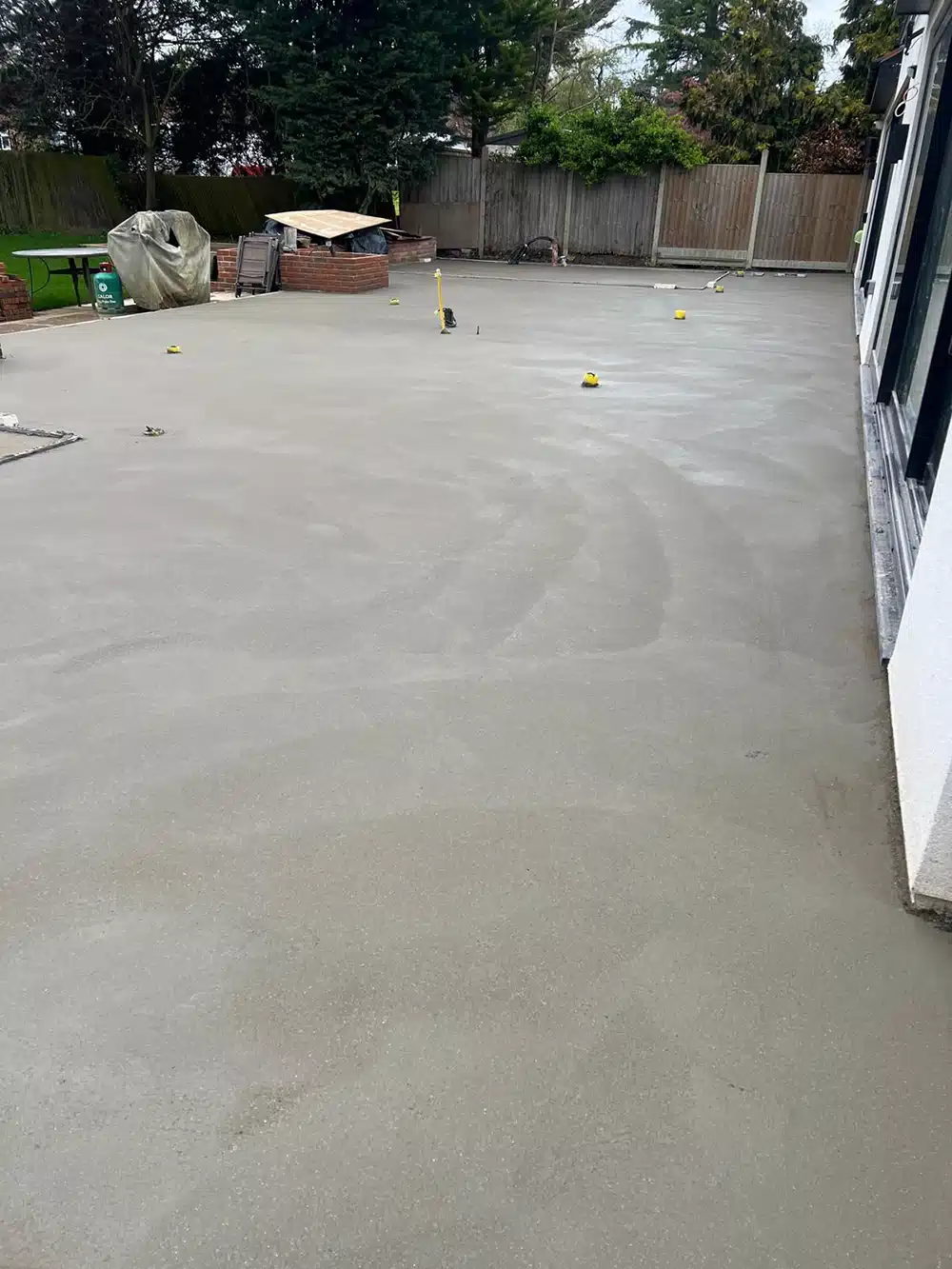
K & B Screeding’s own team, led by director Donatas Bardisevicius. Founded 2019, company 12298780.
See what customers say in our Google reviews and on our testimonials page.
Sand and Cement Screed from Slough to Brentwood
As the crow flies, our yard in Slough is about 41.4 miles from Brentwood, which lies to the east. Postcodes here include CM15, CM14 and CM13, and Billericay (4.8 miles), Havering (5.4 miles), Basildon (7.2 miles) and Stanford-le-Hope (9.1 miles) are close by.
More on sand & cement screed, part of our screeding services.
