
Heated kitchen and garden room extensions in Cheshunt
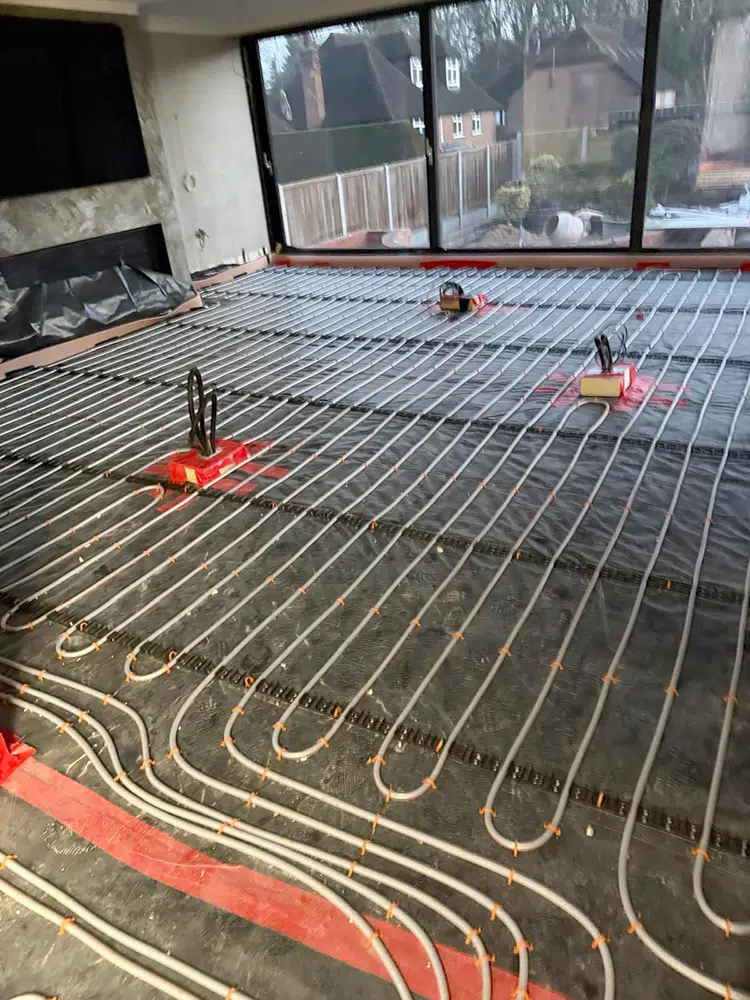
Semis make up 30% of Cheshunt's homes and detached houses 15%, and insulated slabs for kitchen and garden room extensions are a standard part of refurbishing them. Garden rooms in particular make a good case for underfloor heating. They tend to have large areas of glass and little wall space for radiators, and a warm floor frees that space.
Whether the system works well depends on the screed over it. Pumped screed wants 25mm or more of cover, so the finished depth comes to roughly 45 to 50mm, and as a liquid it closes in round every pipe without trapping air. A sand and cement floor asks for about 45mm, and the floor layer must pack it tight round each pipe by hand. If the cover is too thin, the floor may crack above the pipe runs.
Height is the practical constraint. The new floor must finish level with the existing kitchen, and in a retrofit, where heating goes into an older room, lifting the old floor may only free up limited depth. The thinner liquid option often makes the difference between heating fitting and not.
Before the pour we check insulation, membrane and edge strip, since those decide how much of the heat goes up into the room rather than down into the ground. We can supply the full build-up; see insulation and membranes. For how pipe cover fits into total depth, read the screed thickness guide.
Commissioning heated floors at Cheshunt Lakeside and beyond
On large phased developments such as Cheshunt Lakeside and Brookfield Garden Village, pumped liquid screed over underfloor heating is routinely part of the specification. For owners of those homes, and for anyone finishing their own extension, the important part is what happens after the pour.
Resist the urge to run the heating straight after the pour. Calcium sulphate wants about 7 days of rest before the first warmth; for sand and cement, make it 21 days at minimum. Then the temperature is raised gradually, following the screed maker's schedule, rather than switched to full.
Commissioning also helps the floor dry, particularly with calcium sulphate, which can be force dried with the heating from about 7 days. A moisture reading under the limit set by the flooring maker must come before any tiles, LVT or engineered wood.
Pouring liquid screed over heating pipes is published at between £20 and £35 per m² in 2026. The pour itself is covered on our Cheshunt liquid screed page, and for a job in a neighbouring town, see underfloor heating screed in Waltham Cross.
Underfloor Heating Screed prices in Cheshunt
Liquid screed over underfloor heating: £20 to £35 per m² supplied and laid (trade2base, June 2026), so £700 to £1,230 for 35 m². trade2base gives these figures excluding VAT. See our floor screeding cost guide or screed calculator.
Who lays your underfloor heating screed in Cheshunt
K & B Screeding’s own team, led by director Donatas Bardisevicius. Founded 2019, company 12298780.
See what customers say in our Google reviews and on our testimonials page.
Underfloor Heating Screed from Slough to Cheshunt
On the map, Cheshunt sits east-north-east of Slough, about 28.5 miles from our base in a straight line (postcodes including EN8 and EN7), next to Waltham Cross (1.2 miles), Waltham Abbey (2.8 miles), Enfield (4.1 miles) and Hoddesdon (4.1 miles).
More on underfloor heating screed, part of our screeding services.