
Matching floor heights for heated Potters Bar extensions
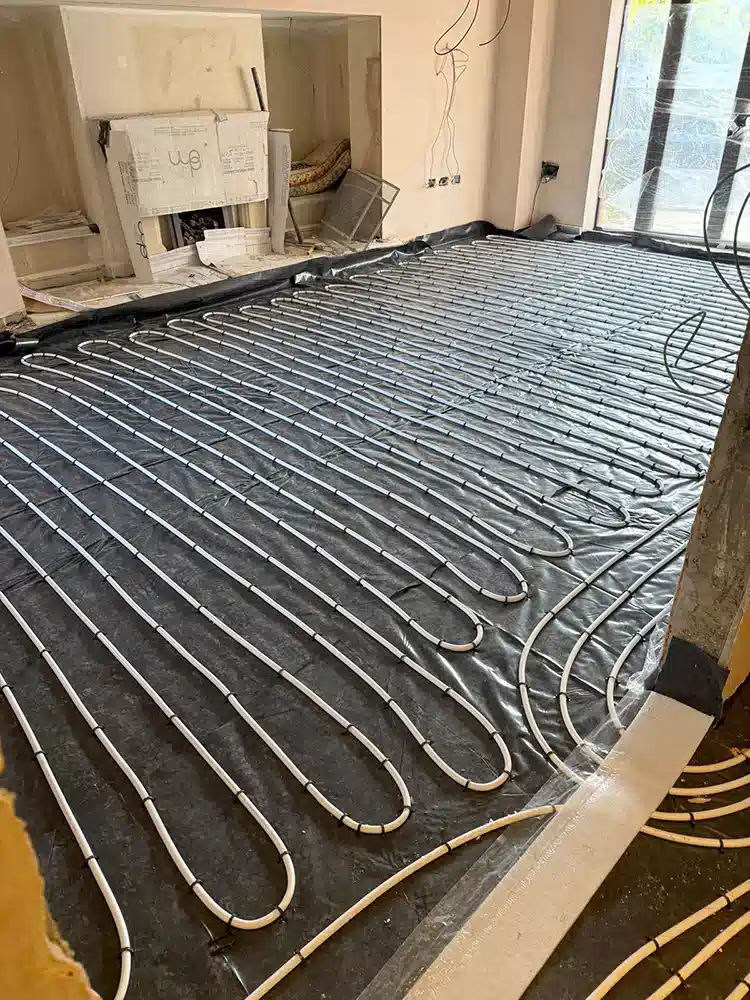
Put heating into a new extension on a semi and its floor still has to finish flush with the original rooms. That fixes the total depth, and everything has to fit inside it: insulation, the pipes, and the screed with enough cover over them.
Start with the cover. With liquid, 25mm above the pipes is the minimum, so the screed usually ends up 45 to 50mm thick. Sand and cement asks for about 45mm of cover, making the whole layer deeper. In a tight space the thinner liquid build-up leaves more room for insulation, which matters because without it the heat drains into the ground.
Where the heating continues into the existing kitchen, the original floor usually has to come out. Taking it up also deals with the old problems these houses can have, such as a missing damp proof membrane or a floor that has settled. The new build-up then runs through the extension and the kitchen at one level.
Flowing screed has another advantage around the pipes. Poured round the pipes, it leaves no trapped air, so warmth travels evenly and the floor heats up quicker. Ahead of pouring we look over the insulation, the membrane and the edge strip, and bring any that are missing. Before any of that, measure the room: the available depth decides the system. Our screed thickness guide sets out the depths, and insulation and membrane preparation covers the layers below.
Heating up new floors near Dugdale Hill and The Avenue
The new homes planned for the High Street and the garden suburb sites west of Dugdale Hill and off The Avenue are the kind of schemes where liquid screed over underfloor heating is commonly used. For a site team, the screed programme and the heat-up schedule need to fit together across many plots.
The rules are the same on one plot or fifty. Heat can usually go into calcium sulphate from day 7 after the pour, but sand and cement must wait 21 days or more. After that, the temperature rises gradually, is held, and comes down before flooring. Rushing it can crack the screed, and a cracked heated floor is costly to open up again. We hand over the schedule in writing for the heating engineer and flooring contractor.
Expect £20 to £35 per m² for liquid screed over a heated floor, going by the 2026 published range. Single extensions follow the same steps on a smaller scale, and the heating engineer should keep a record of each stage. For pumped access to upper floors, see our pumped liquid screed page, and for nearby towns, read about underfloor heating screed in Barnet.
Living in a Potters Bar semi while heated screed dries
Knocking through to an open plan kitchen in a Potters Bar semi usually means the family stays at home while the floor goes in. A heated screed puts the kitchen out of action for longer than people expect, so the programme is worth setting out before the pour.
The first two days are hands off. A liquid screed is normally walkable after 24 to 48 hours. Until then the room is closed, so plan meals, the route to the back garden and access to the boiler or manifold before the pour.
The rest of the house can carry on as normal. Only the new heated floor waits for its own start date and schedule, so any radiators elsewhere in the house can stay on, which helps when the work runs into the colder months.
Light work can carry on above the floor. After it is walkable, careful trades can work on the screed with boards to protect it, but heavy loads, stacked materials and wet plaster should stay off it, and any spill is cleared straight away.
The flooring comes last. Tiles, LVT or wood wait for a moisture test, however finished the rest of the room looks. A temporary kitchen elsewhere in the house is worth setting up early, because drying a screed properly takes weeks, and the plan we leave in writing shows when each stage can follow.
Underfloor heating screed prices in Potters Bar
Liquid screed over underfloor heating: £20 to £35 per m² supplied and laid (trade2base, June 2026), so £700 to £1,230 for 35 m². trade2base gives these figures excluding VAT. See our liquid screed cost per m² guide, the floor screeding cost guide or the screed calculator.
Who lays your underfloor heating screed in Potters Bar
K & B Screeding’s own team, led by director Donatas Bardisevicius. Founded 2019, company 12298780.
See what customers say in our Google reviews and on our testimonials page.
Underfloor heating screed from Slough to Potters Bar
As the crow flies, our base in Slough is about 22.5 miles from Potters Bar, which lies to the east-north-east. Postcodes here include EN6, and Borehamwood (4.1 miles), Hatfield (5 miles), Enfield (5.6 miles) and Barnet (5.7 miles) are close by.
Where the screed lorry must park in a marked bay in Potters Bar, a bay suspension from Hertsmere Borough Council (parking suspension) covers it; the quote tells you if it is needed. An extension floor usually needs building regulations approval (Part L sets the insulation standard in England); the council building control service for Potters Bar is Hertfordshire Building Control.
More on underfloor heating screed, part of our screeding services. For every screed we lay locally, see floor screeding in Potters Bar.
Further reading: screed thickness guide and underfloor heating on a concrete floor.
