
Heated floors in renovated St Albans terraces
When a terrace's floor is dug out, the new build-up has to fit between the dug level and the old door thresholds, and underfloor heating adds another layer to that sandwich. Insulation, pipes and screed all compete for the same depth.
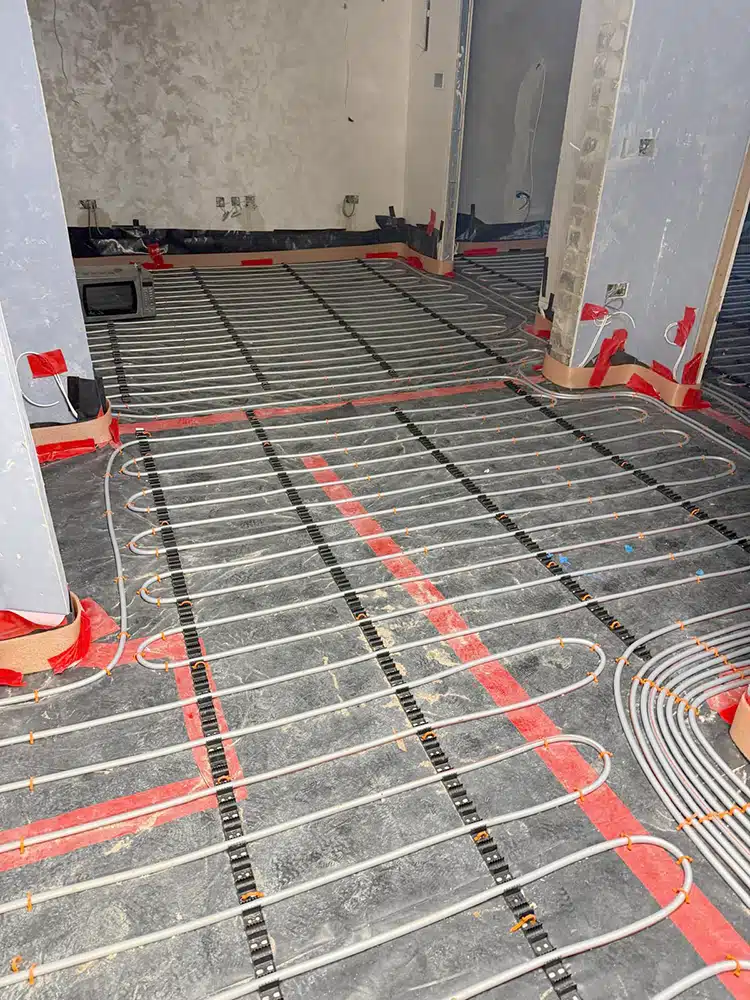
The screed choice often settles it. Liquid wants no less than 25mm over the pipes, so the layer typically totals 45 to 50mm. Sand and cement asks for roughly 45mm above those loops, making for a deeper build-up overall. In a narrow Victorian house where the staircase and front door set the finished level, liquid screed often leaves room for thicker insulation, which is what keeps a heated slab efficient and responsive.
Encapsulation matters as much as depth, and it is easy to overlook. Liquid screed wraps each pipe with nothing trapped against it, and the heat spreads up to the surface evenly. Sand and cement can match that only if it is tamped hard along every loop.
We never fit the loops ourselves. That falls to your heating engineer, who also pressure tests them; before pouring we look over the boards, membrane and edge strip, and can provide them ourselves through insulation and membrane supply. For how the pour itself works, see liquid screed in St Albans, and for depths across different build-ups, the thickness guide for heated floors.
Heat-up schedules for St Albans extensions and new homes
A new extension is the simplest place to add underfloor heating, because its floor levels are designed from scratch. Homes built since 2015 make up 7% of the St Albans stock, and new homes are commonly designed with heating laid in a flowing screed from the start.
Whatever the house, the heating has to wait once the screed is down. An anhydrite pour in a Fleetville back room can usually be warmed after a week, about 7 days; a sand and cement one sits cold for 21 days minimum. When the system does come on, the flow temperature starts low and climbs a little at a time over several days; full heat on the first morning is the mistake to avoid. Those steps are written down for your heating engineer to follow.
Hurried warm-ups are behind a good share of cracked and debonded floors. Done properly, gentle heating is also the quickest way to dry a calcium sulphate floor before flooring goes down.
Money-wise, a heated liquid floor is listed at £20 to £35 per m² in the published 2026 figures. If the finished floor will be tiles or LVT, a final skim may be needed, which our levelling service covers.
Heated extensions on St Albans inter-war and post-war semis
Inter-war and post-war semis in St Albans generate extension floors that must match existing levels. If the new room is to be heated from below while the old house keeps its radiators, that split works, but the screed has to be planned around where the heated floor stops.
The new floor is built from scratch: insulation on the slab, membrane, pipes clipped down, then screed. Its finished level is set by the old kitchen or dining room floor next to it, so the depth of every layer is worked back from that line before the groundworker pours the slab.
At the opening into the old house, the heated screed meets an unheated floor. The two expand and move differently, so a joint is formed on that line, with edge strip against the old floor. Where tiles or stone will run straight through from the extension into the house, the flooring fitter needs to know where the joint is, so a movement joint can be carried up through the finish.
It is worth deciding early whether the heating should run on into the old kitchen as well. That is easier to plan before the extension slab goes in than after, because the old floor will need breaking out, insulating and rescreeding to the same level. Your heating engineer sets the zones and controls; our part is a screed of the right depth over every pipe.
Underfloor heating screed prices for St Albans floors
Liquid screed over underfloor heating: £20 to £35 per m² supplied and laid (trade2base, June 2026), so £700 to £1,230 for 35 m². trade2base gives these figures excluding VAT. See our liquid screed cost per m² guide, the floor screeding cost guide or the screed calculator.
Who lays your underfloor heating screed in St Albans
K & B Screeding, led by director Donatas Bardisevicius. Founded 2019, company 12298780.
See what customers say in our Google reviews and on our testimonials page.
Underfloor heating screed from Slough to St Albans
As the crow flies, our base in Slough is about 20.1 miles from St Albans, which lies to the north-east. Postcodes here include AL1, AL3 and AL4, and Harpenden (4.5 miles), Hatfield (5.2 miles), Hemel Hempstead (5.7 miles) and Welwyn Garden City (6.7 miles) are close by.
If the screed lorry has to stand on the road in St Albans, a bay suspension can be requested from St Albans City and District Council (parking suspension permit); we will say on the quote if it is needed. The council building control service for St Albans is the St Albans and Watford Building Control shared service. A new extension floor usually needs building regulations approval, and Part L covers its insulation in England.
More on underfloor heating screed, part of our screeding services. For every screed we lay locally, see floor screeding in St Albans.
Further reading: screed depth for underfloor heating and underfloor heating on a concrete floor.