
Heated extensions meeting older floors in Bushey
Semis are 30% of Bushey's homes and detached houses another 22%, and rear and side extensions are among the most common building jobs on them. Whatever is heated in the new part must end flush with the old rooms, which in these houses may sit on suspended timber or a thin concrete slab.
Start from that finished level and work down. Take away the floor covering and adhesive, then the screed, then the pipes and insulation, and what is left is the level the new slab must be set at. For liquid screed, allow a minimum of 25mm on top of the pipes, which typically means 45 to 50mm overall. Sand and cement placed by hand needs about 45mm on top of them, which makes the whole floor deeper. Where height is tight, the liquid option often decides whether heating fits at all.
Retrofit is harder. Putting heating into an older room means lifting the existing floor, and in a 1920s or 1930s house that is a chance to add the damp proof membrane the original floor may lack.
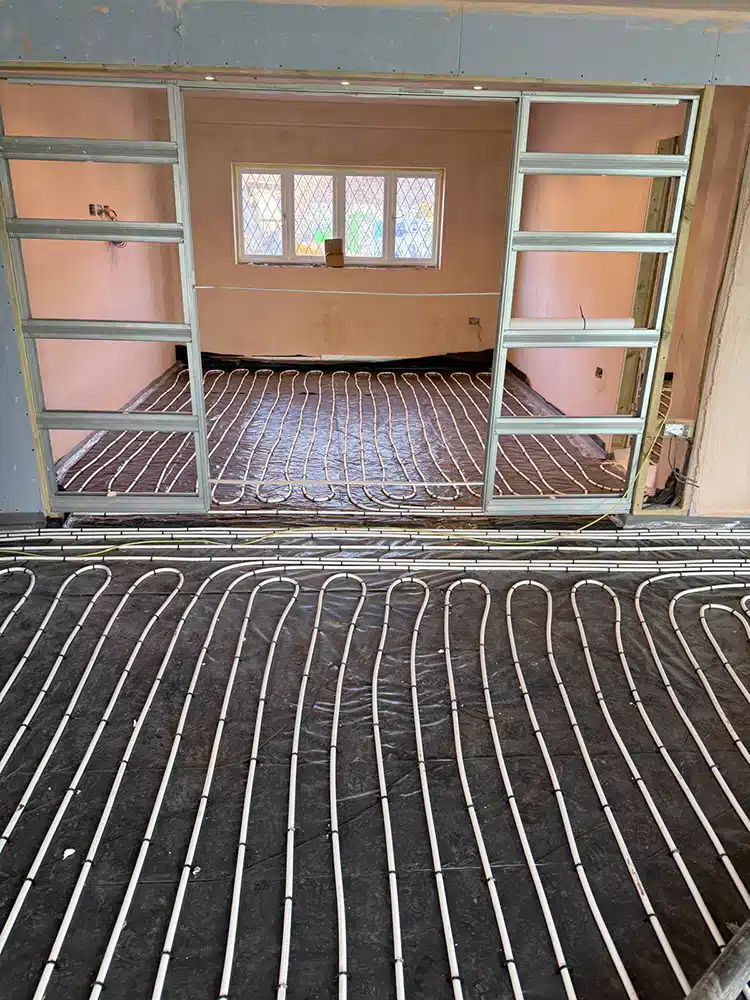
Both screeds have to wrap each pipe completely, since a pocket of trapped air holds the heat back from the floor surface. Poured liquid screed manages that by itself. We check the insulation, membrane and edge strip before the pour; the Bushey liquid screed page explains the pour, and the hand-laid screed option covers traditional work.
Commissioning underfloor heating in a Bushey home
The screed and the heating have to be introduced to each other slowly. A calcium sulphate floor is normally ready for its first warmth at about 7 days old. Give a sand and cement floor no fewer than 21 days. Either way, follow the heat-up schedule from the screed maker and bring the temperature up step by step to working level, never straight to full. Rushing it risks cracking a new floor.
Running the heating also speeds drying, and that counts, since tiles, LVT or engineered wood can only go down once the screed passes a moisture test. A calcium sulphate screed dries noticeably faster once the heating is running, while sand and cement dries more slowly whatever you do.
The surface should also be checked for flatness once it has dried. A thin layer of floor levelling compound can correct any small steps where the extension meets the old house, which is worth doing before large tiles or a long run of LVT.
Expect published 2026 prices of £20 to £35 per m² for liquid screed on a heated floor. Our guide to screed costs sets out what moves a quote within that range, from depth and area to access for the pump.
Underfloor Heating Screed prices in Bushey
Liquid screed over underfloor heating: £20 to £35 per m² supplied and laid (trade2base, June 2026), so £700 to £1,230 for 35 m². trade2base gives these figures excluding VAT. See our floor screeding cost guide or screed calculator.
Who lays your underfloor heating screed in Bushey
K & B Screeding’s own team, led by director Donatas Bardisevicius. Founded 2019, company 12298780.
See what customers say in our Google reviews and on our testimonials page.
Underfloor Heating Screed from Slough to Bushey
On the map, Bushey sits north-east of Slough, about 14.4 miles from our base in a straight line (postcodes including WD23 and WD7), next to Watford (1.5 miles), Harrow (3.8 miles), Borehamwood (4.2 miles) and Rickmansworth (4.5 miles).
More on underfloor heating screed, part of our screeding services.
