
Pipe cover for heated Chorleywood ground floors
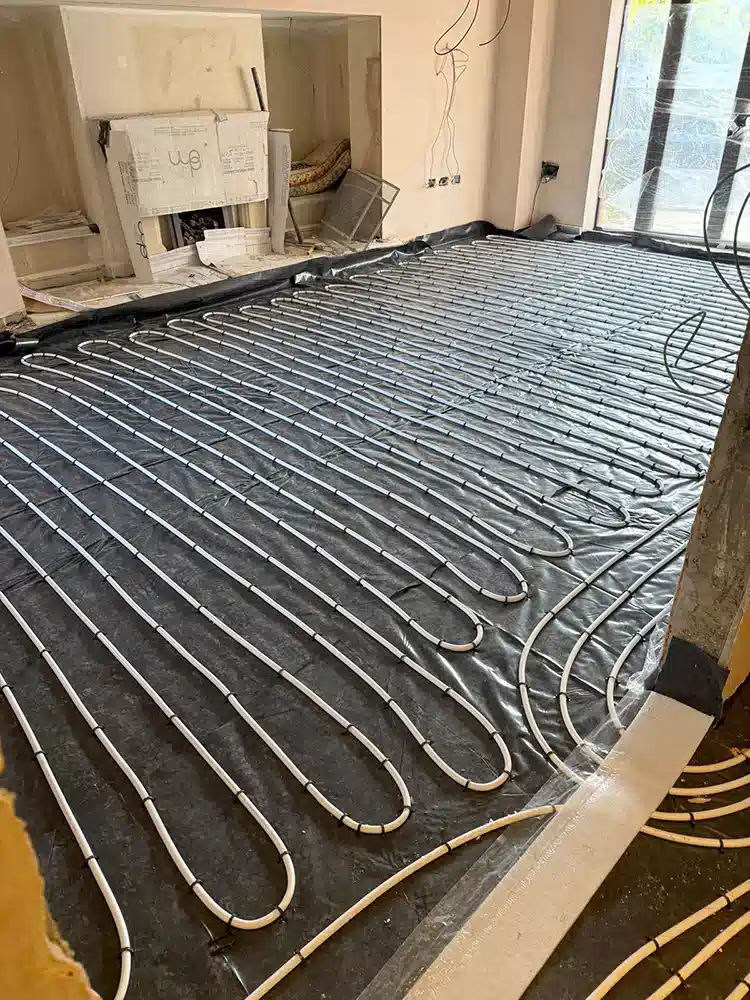
The screed is the part of an underfloor heating system that holds the heat and passes it to the room. Too thin and it cracks over the pipes; too thick and the floor is slow to warm. The rule is cover measured above the top of the pipe. Liquid needs 25mm minimum above the pipes, so the total depth ends up at roughly 45 to 50mm. With sand and cement the cover rises to about 45mm, and the floor gets deeper to match.
On a whole floor installation in a Chorleywood detached house, that difference adds up across a large area. Pumped liquid screed wraps every pipe with no trapped air and gets to SR1 or SR2 without ruling by hand. That is why calcium sulphate liquid screed is a frequent pick over heating; grades and laitance are explained on our Chorleywood anhydrite screed page.
Sand and cement is not ruled out, though. In a wet room with heating, or where the finish needs a cement base, it is the right choice even though it needs more depth.
Before any screed goes down we check the insulation, the membrane and the perimeter edge strip that lets the screed expand as it warms, and we supply them where they are part of our price. For liquid screed laid over heating, trade2base's June 2026 figures give £20 to £35 a square metre.
Retrofit heating in older Chorleywood houses
Fitting heating into a house that already stands is where the depth runs short. In Chorleywood, 47% of homes date from 1945 to 1972, and older houses in the conservation areas have floors that must stay level with neighbouring rooms and doors. Lifting the old finish and laying insulation, pipes and a new screed has to fit within the depth available.
That usually points to liquid screed, because 25mm of cover keeps the total build lower than sand and cement can manage. Where even that is too deep, we say so plainly rather than squeeze in a screed that will crack.
Heated extensions and garden rooms have more freedom, since the slab level is set during the build. There the choice of screed can follow the finish and the programme.
Once poured, the heating waits. Over calcium sulphate the heating can normally come on at around 7 days; a sand and cement floor stays unheated for at least 21. Even then the heating goes up in small steps over several days rather than straight to full, so the floor dries evenly. You get that warm-up plan in writing, and our screed drying guide covers the weeks after. The same rules apply to underfloor heating screed in Amersham, about 4 miles away.
Underfloor Heating Screed prices in Chorleywood
Liquid screed over underfloor heating: £20 to £35 per m² supplied and laid (trade2base, June 2026), so £700 to £1,230 for 35 m². trade2base gives these figures excluding VAT. See our floor screeding cost guide or screed calculator.
Who lays your underfloor heating screed in Chorleywood
K & B Screeding’s own team, led by director Donatas Bardisevicius. Founded 2019, company 12298780.
See what customers say in our Google reviews and on our testimonials page.
Underfloor Heating Screed from Slough to Chorleywood
As the crow flies, our yard in Slough is about 10 miles from Chorleywood, which lies to the north-north-east. Postcodes here include WD3, and Rickmansworth (2.5 miles), Amersham (4 miles), Chesham (5.2 miles) and Watford (5.4 miles) are close by.
More on underfloor heating screed, part of our screeding services.