
Relaying old solid floors in Chorleywood houses
A ground floor from the early twentieth century was often laid straight onto the ground with little or no insulation and a damp proof layer that has long since failed. When a refurbishment lifts the old finish, the floor underneath may be cracked, hollow or damp. Patching rarely lasts. A lasting repair means digging the old floor out, putting down insulation and a membrane, then laying fresh screed on top.
Hand-laid sand and cement fits that kind of rebuild well. It is mixed on site to the depth each room needs, so an uneven dig does not matter, and it can be worked into small rooms, alcoves and awkward doorways where a pump hose gains little. Where it sits over insulation in one of these houses, we lay it at 65mm.
Levels are the constraint in Chorleywood. In the Chorleywood Common and Station Estate conservation areas, the rebuilt floor often has to meet an older suspended timber floor in the next room, or a solid floor that is staying, without raising the threshold. The Station Estate also carries an Article 4 direction. We work out the finished height first, from the existing floors and doors, then set the dig depth, insulation thickness and screed depth to reach it.
If the build has to stay thinner, it can be bonded to a sound slab instead at 25 to 40mm. Expect it to dry more slowly than liquid: about one day for each millimetre to 40mm, then longer, which makes a 65mm floor a long wait. Every build-up and its depth is listed in our screed depth guide.
Wet rooms, garages and small rooms in Chorleywood
Certain rooms in a house want cement screed, whatever goes in elsewhere. A shower or wet room floor has to slope towards its drain and cope with being soaked. Sand and cement is shaped to those falls by hand and is not weakened by water the way a calcium sulphate screed can be. Where the rest of a large Chorleywood house is poured in anhydrite, the bathrooms and utility can be laid in sand and cement for this reason.
Garages are another fit. Turning a garage built into or onto a Chorleywood house into a room normally means lifting its floor to the house level, with insulation and a membrane going in beneath the new screed. Our garage conversion screed guide walks through that build-up layer by layer.
Hand-laid screed also suits floors that need to take load early, or that need a cement substrate for a particular adhesive or finish. For extra crack resistance we can mix fibres in, at £1 to £3 per m² on published figures, and rapid drying additives cut the wait when the build is on a tight timetable.
For small rooms the numbers favour it too. There is no pump to bring, so a single cloakroom or porch is priced on materials and labour alone. On MyJobQuote's August 2026 prices, hand-laid sand and cement runs from £18 to £25 per m².
Sand and Cement Screed prices in Chorleywood
Sand and cement screed: £18 to £25 per m² supplied and laid (MyJobQuote, August 2026), so £450 to £630 for 25 m². MyJobQuote does not say whether these figures include VAT. See our floor screeding cost guide or screed calculator.
Who lays your sand and cement screed in Chorleywood
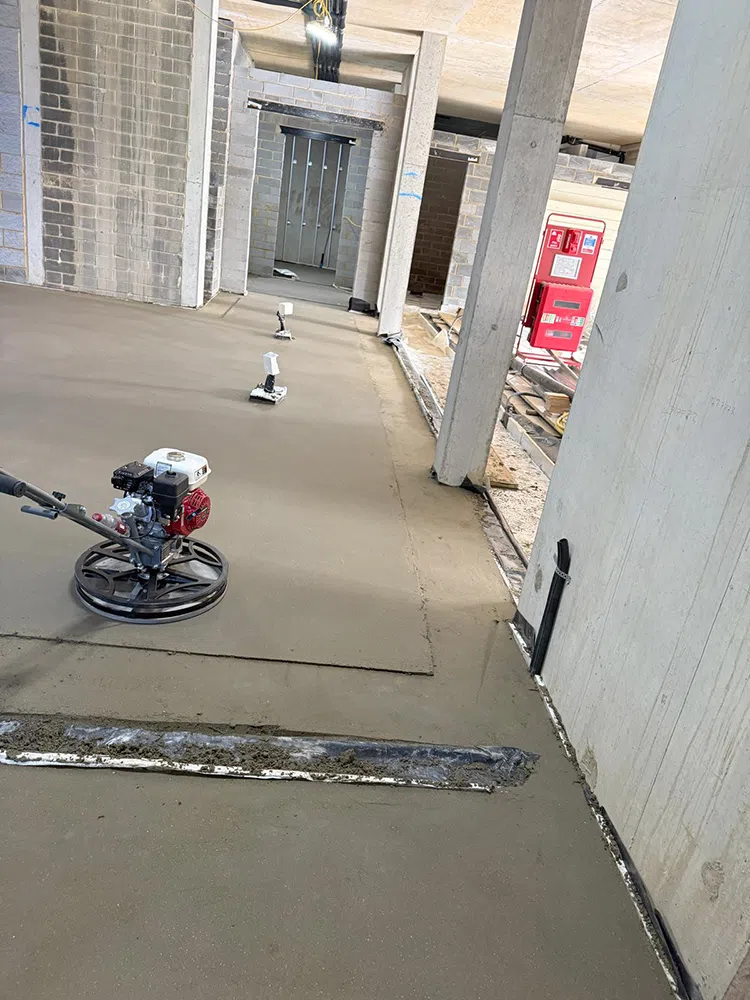
K & B Screeding’s own team, led by director Donatas Bardisevicius. Founded 2019, company 12298780.
See what customers say in our Google reviews and on our testimonials page.
Sand and Cement Screed from Slough to Chorleywood
As the crow flies, our yard in Slough is about 10 miles from Chorleywood, which lies to the north-north-east. Postcodes here include WD3, and Rickmansworth (2.5 miles), Amersham (4 miles), Chesham (5.2 miles) and Watford (5.4 miles) are close by.
More on sand & cement screed, part of our screeding services.
