
Relaying Newtown's Victorian floors with sand and cement
Put a solid floor with no membrane under a Victorian terrace and damp works its way up, spoiling whatever covers it. New tiles laid straight on top seldom last. The fix is to break that floor out, get a new base ready and build it back up in layers: insulation, then a damp proof membrane, then fresh screed. Breaking out the old floor and readying the base is the job of our floor preparation service.
Where the new floor floats on insulation, as it would in a rebuilt Newtown kitchen, sand and cement goes down about 65mm thick. With a sound old slab left in place and little height to spare, we fix a thinner bonded layer straight onto it, somewhere between 25 and 40mm. The screed thickness guide matches each depth to its build-up.
Terraced houses are 26% of Chesham's homes, and the way they are planned suits a site mix. Rooms are small, hallways tight, and the kitchen is often at the back with no way round outside, so barrowing the screed through and laying it room by room is easier than setting up a pump. Each area can have its own depth, which helps when an old floor drops from front to back or the hallway and kitchen sit a little apart in height.
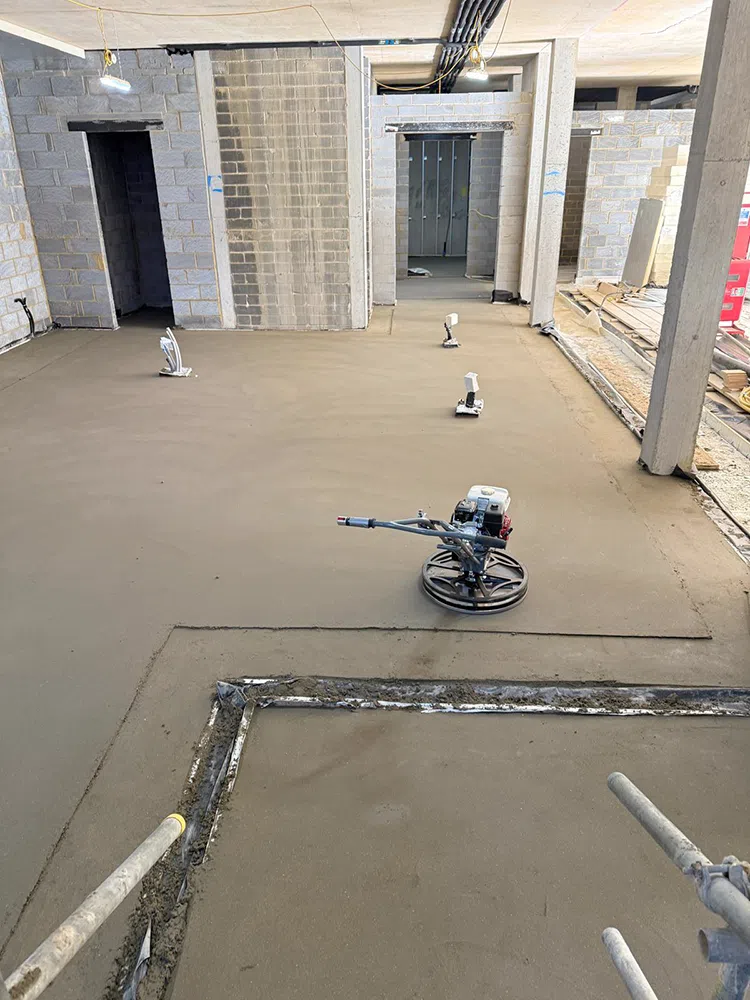
Once compacted and floated, the surface is dense and level, ready for tiles, wood or sheet flooring when it has dried.
Wet rooms, garages and drying time in Chesham
Some rooms in a Chesham house want cement screed whatever the rest of the floor is made of. A wet room with a level-access shower must fall to its drain, and hand-laid sand and cement can be shaped to those falls. Calcium sulphate cannot cope with being wet, which is why bathrooms and utility rooms in town houses stay with cement.
Garage conversions suit it as well. In most garages the slab is a step down from the house; with insulation and a membrane laid, screed brings it up to hallway level. Our guide to garage conversion floors takes you through each layer.
If a floor must take weight early, say a workshop or a garage still in use, sand and cement is the safer bet. Fibres can be added for strength at £1 to £3 per m², or you can specify quick drying sand and cement screed when time is short.
Allow for drying, too. Expect a hand-laid floor to dry slower than a pumped one: roughly a day for each millimetre up to 40mm, then slower still, which puts a 65mm floor at several weeks before most finishes.
Sand and Cement Screed prices in Chesham
Sand and cement screed: £18 to £25 per m² supplied and laid (MyJobQuote, August 2026), so £450 to £630 for 25 m². MyJobQuote does not say whether these figures include VAT. See our floor screeding cost guide or screed calculator.
Who lays your sand and cement screed in Chesham
K & B Screeding’s own team, led by director Donatas Bardisevicius. Founded 2019, company 12298780.
See what customers say in our Google reviews and on our testimonials page.
Sand and Cement Screed from Slough to Chesham
As the crow flies, our yard in Slough is about 12 miles from Chesham, which lies to the north. Postcodes here include HP5, and Amersham (1.9 miles), Berkhamsted (4.5 miles), Chorleywood (5.2 miles) and Tring (6.5 miles) are close by.
More on sand & cement screed, part of our screeding services.
