
Renewing floors in Southcourt, Quarrendon and Queens Park
When an older floor fails, the surface may crumble, crack or sink, or it may simply sit too low for a new insulated floor. If a whole room has gone, we break the old floor out, put down membrane and insulation, then screed over the top, so the room ends up with a proper modern build-up rather than another repair. Where only part of a floor has failed, a patch in sand and cement can be cut in to match the surrounding level.
The Queens Park conservation area adds period houses that need sympathetic floor replacement. Homes built before 1919 are 6% of the town, and older rooms are rarely level or square. Laying by hand suits them, because the screed can be worked into awkward shapes, and each room can be laid to its own depth.
Thickness follows the method. Floated on insulation, the minimum is 65mm for a house and 75mm for commercial premises. Bonded to sound concrete with an agent between the two, it can drop to 25 to 40mm; see bonded sand and cement screeding for when that is possible. Fibres can be added to cut cracking, for an extra £1 to £3 on each square metre.
Sand and cement also gives a cement substrate, which some adhesives and tiles prefer, and it can take load sooner than calcium sulphate in the same position.
Garages, wet rooms and small jobs in Aylesbury
A few jobs call for sand and cement even in a brand new Berryfields house. Water in a wet room has to run to the drain, so the floor is formed with a slope, which hand-laid screed can follow accurately. Under the tanking we use cement screed, since calcium sulphate is unsuitable where a floor may stay wet.
Garage conversions are another. Garage floors often sit a step down from the house and can fall towards the door. Bringing it up to the house level with insulation and a new screed turns it into a habitable room; the garage floor screed guide covers the steps.
For small rooms, mixing on site keeps the job in proportion. A single room does not need a pump.
The trade-off is drying. Think 40 days or so for the first 40mm of a 65mm screed, and a slower rate after that, so pick the flooring date with care. If the floor only needs a thin correction, floor levelling may be enough. Over in Thame, a few miles south-west, the same work is described on our Thame screeding page.
Sand and Cement Screed prices in Aylesbury
Sand and cement screed: £18 to £25 per m² supplied and laid (MyJobQuote, August 2026), so £450 to £630 for 25 m². MyJobQuote does not say whether these figures include VAT. See our floor screeding cost guide or screed calculator.
Who lays your sand and cement screed in Aylesbury
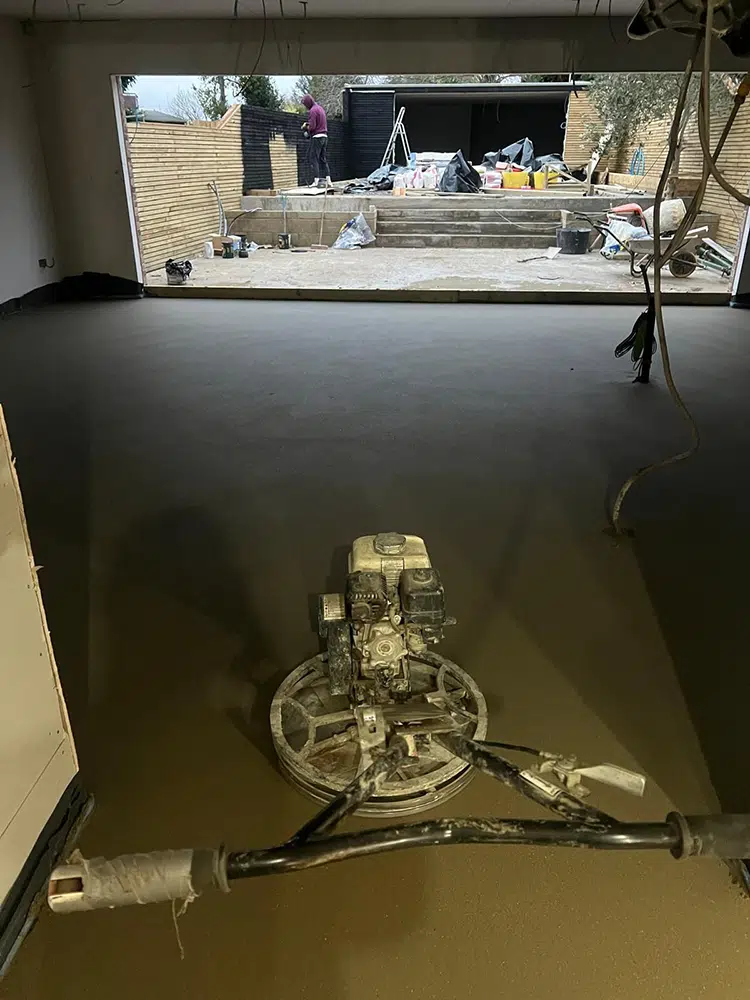
K & B Screeding’s own team, led by director Donatas Bardisevicius. Founded 2019, company 12298780.
See what customers say in our Google reviews and on our testimonials page.
Sand and Cement Screed from Slough to Aylesbury
As the crow flies, our yard in Slough is about 21 miles from Aylesbury, which lies to the north-north-west. Postcodes here include HP20, HP21, HP18 and HP19, and Tring (6.6 miles), Thame (8.7 miles), Leighton Buzzard (9.4 miles) and Berkhamsted (10.8 miles) are close by.
More on sand & cement screed, part of our screeding services.