
Relaying floors in older buildings near Market Square
Leighton Buzzard's centre is old. The High Street has more than 70 listed buildings, among them a bank designed by Alfred Waterhouse on Market Square, and the town grew on the Grand Junction Canal from 1800 and the London and Birmingham Railway from 1838. Pre-1919 buildings account for 9% of Leighton Buzzard's homes.
In buildings of that age, floor work starts with what is there. The owner should confirm what is allowed before anything original is removed, and the build-up should be agreed before the screed goes on. Where a failed solid floor is replaced, the usual approach is to break it out, lay a damp proof membrane and insulation, then lay a new screed. Getting the base clean and sound first is the job of floor preparation.
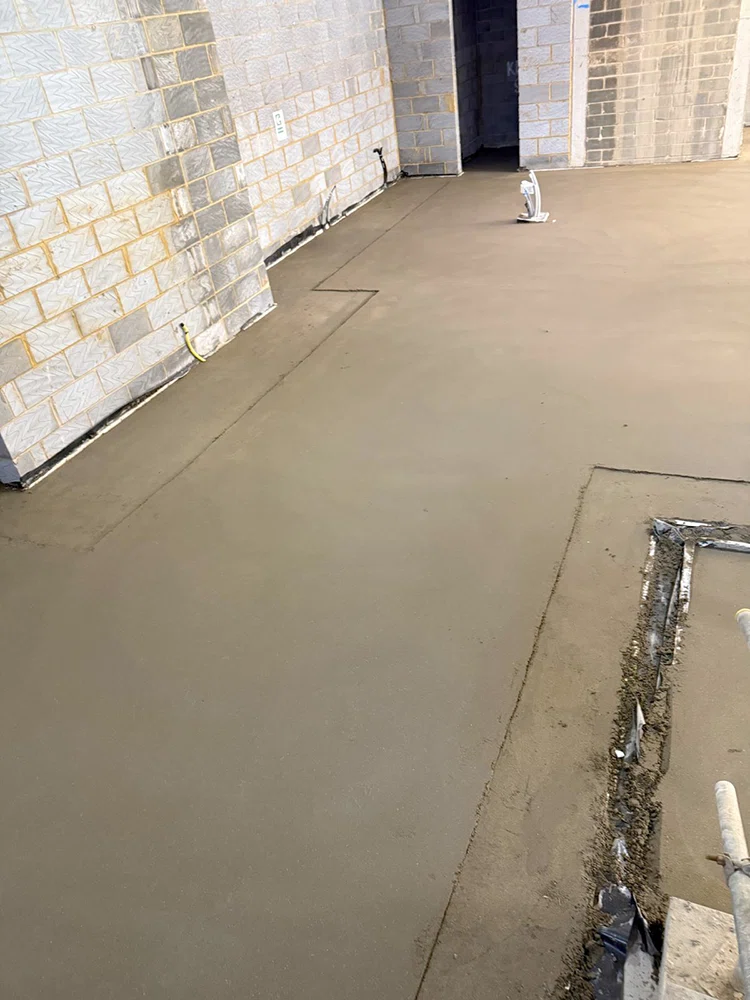
That is careful, room-by-room work, and a hand-laid mix fits it: we batch it for each area and depth, barrow it in through narrow doorways, then compact and float it until it is dense and level. It can be finished to meet an existing threshold or step exactly.
Its thickness is set by the layers below; where it floats on a house's insulation, plan for about 65mm. Where a sound slab only needs a new topping, a bonded screed of 25 to 40mm tied to it can be used, costing about £12 to £18 per m² (trade2base, June 2026) on published 2026 figures. The screed depth guide covers each option.
Leighton Buzzard terraces, garages and wet rooms
Leighton Buzzard has a good number of terraces, 26% of its homes. A terrace often has small rooms and no side access, which is where a screed barrowed in and laid by hand works well.
Wet rooms are the other clear use. Calcium sulphate screed cannot go where it may get wet, so shower rooms and wet rooms take a cement based screed, laid to fall towards the drain by hand. The fall is built into the screed, not the tile bed.
Garage conversions need the old slab raised to the level of the house with insulation and a membrane, then a screed on top. The guide to garage floor screeds shows the layers.
Pick it too when the flooring maker asks for a cement base, or when the floor must carry weight early. Adding fibres to the mix lowers the risk of cracking and costs roughly £1 to £3 per m² on top.
Its drawback is drying. At 65mm deep that means weeks rather than days, because each of the first 40 millimetres takes about a day and the rest take longer. Where time is short, fast drying sand and cement is an option.
Hard wearing screeds for Harmill and Chartmoor Road units
Steel fabricators and manufacturers have taken space along Grovebury Road, on the Harmill Industrial Estate and on Chartmoor Road, and occupiers like these need hard wearing, level concrete and screed floors. Where a unit's floor has worn out but the slab underneath is sound, a new sand and cement screed is one way to put it back into service.
Commercial floors are built deeper than houses. A floating sand and cement screed in a commercial building goes down at about 75mm, against 65mm in a home. Where levels at roller doors and thresholds cannot rise much, a thinner bonded screed onto the prepared slab is the alternative.
Preparation decides whether a bonded screed stays down in a working unit. Oil, cutting fluid and old floor paint soak into concrete over the years, and they must be taken back to clean, sound material by grinding or shot blasting before the bonding slurry goes on. Leave them in place and the new screed can let go in patches.
The mix can then be made tougher. A higher strength screed gives better resistance to wear from trolleys and steady foot traffic.
There are limits. A floor carrying heavy racking, machine bases or forklifts may need a structural slab, which we do not lay, so we look at the loads before recommending a screed.
Sand and cement screed prices in Leighton Buzzard
Sand and cement screed: £18 to £25 per m² supplied and laid (MyJobQuote, August 2026), so £450 to £630 for 25 m². MyJobQuote does not say whether these figures include VAT. See our screed cost per m³ and per tonne guide or screed calculator.
Who lays your sand and cement screed in Leighton Buzzard
K & B Screeding’s own team, led by director Donatas Bardisevicius. Founded 2019, company 12298780.
See what customers say in our Google reviews and on our testimonials page.
Sand and cement screed from Slough to Leighton Buzzard
Leighton Buzzard is about 26.6 miles north of our Slough base as the crow flies, with postcodes including LU7. The nearest towns to it are Houghton Regis (6.1 miles), Dunstable (6.2 miles), Bletchley (6.2 miles) and Tring (8.5 miles).
If the screed pump has to stand on the road in Leighton Buzzard, a suspension or dispensation can be requested from Central Bedfordshire Council (parking suspension and dispensation); we will say on the quote if it is needed. New floors in Leighton Buzzard extensions usually need building regulations approval, with Part L insulation rules in England; Central Bedfordshire Council Building Control is the council building control service.
More on sand & cement screed, part of our screeding services. For every screed we lay locally, see floor screeding in Leighton Buzzard.
Further reading: screed thickness guide and sand and cement screed mix ratio.
