
Relaying old ground floors in Luton's pre-1919 terraces
A solid floor with no membrane lets ground moisture wick up into the finish, which is why floors without one can show lifting tiles, damp skirting or a crumbling surface. Patching it rarely lasts. What works is to break the old floor up, excavate far enough for the new layers, and build back with a damp proof membrane, insulation and screed.
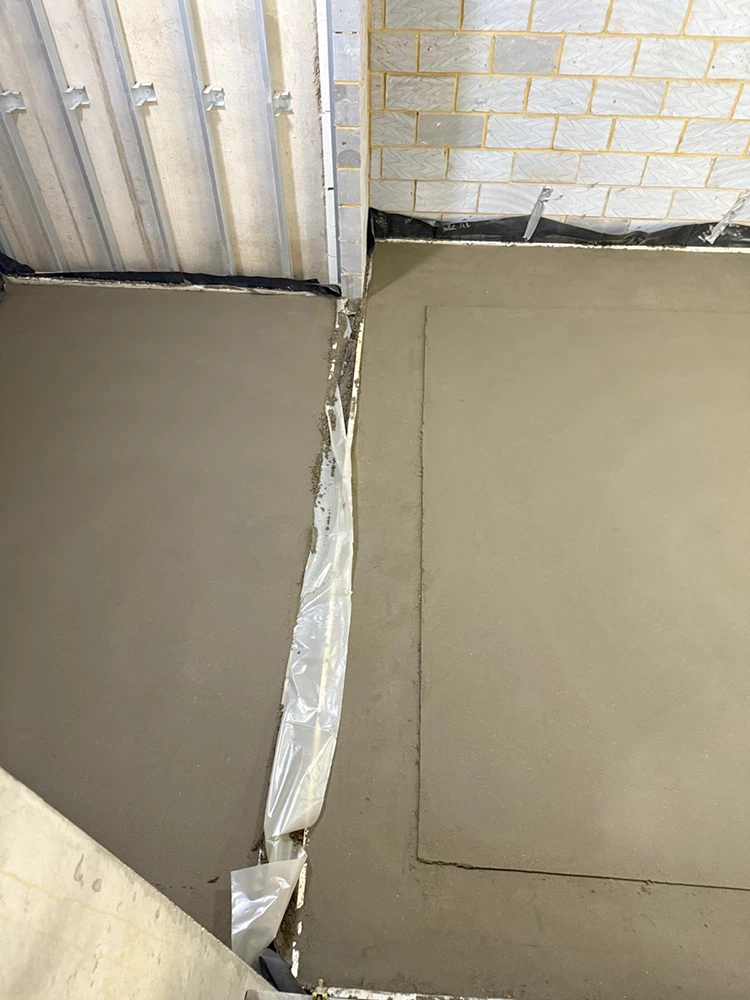
Sand and cement is what we use for that kind of dig-out. It is mixed on site to suit each room, so a narrow kitchen, a back hall and a small bathroom can all be done in one visit with barrows rather than a pump. Each room is tamped down by hand and trowelled flat and hard, so the tiler or floor fitter has a firm base.
Depth matters. Where the new screed floats on insulation, as it will in a dug-out terrace floor, plan on about 65mm; our guide to screed depths explains why a thinner layer tends to crack. If a sound concrete slab is staying and the screed is bonded onto it, 25 to 40mm is usually enough.
The inter-war semis need similar attention. Some 20% of Luton's homes were built between 1919 and 1944, and replacing old ground floors in their kitchens and bathrooms is a common part of a refit. The membrane and insulation that go under the screed are covered on our insulation and membranes page.
Wet rooms, garages and small Luton floors
Certain rooms in a Luton refit call for cement screed regardless of what the rest of the house gets. Take a wet room or a level-access shower: its floor needs a gentle fall to the gully, and a mix spread by hand can be trowelled to exactly that angle. Water does not harm a cement screed the way it harms calcium sulphate, which is why those rooms get sand and cement.
Garages are another good fit. When a garage becomes living space, its floor normally has to come up to the level of the house with insulation added, and screed laid by hand handles that depth and any odd corners. There is more on raising a garage floor in our garage conversion guide.
The catch is time. Sand and cement dries more slowly than a liquid screed, and the rough rule of about 1 day per mm for the first 40mm means a 65mm floor needs weeks before sensitive flooring goes down. A rapid drying additive cuts the wait, and mixing in fibres to help stop cracks costs £1 to £3 per m² on top, which our fibre reinforced screed page explains.
On small or awkward floors, such as a back hall or a cloakroom in a Luton terrace refit, the cost is also easier to control than with a pumped screed.
Sand and Cement Screed prices in Luton
Sand and cement screed: £18 to £25 per m² supplied and laid (MyJobQuote, August 2026), so £450 to £630 for 25 m². MyJobQuote does not say whether these figures include VAT. See our floor screeding cost guide or screed calculator.
Who lays your sand and cement screed in Luton
K & B Screeding’s own team, led by director Donatas Bardisevicius. Founded 2019, company 12298780.
See what customers say in our Google reviews and on our testimonials page.
Sand and Cement Screed from Slough to Luton
As the crow flies, our yard in Slough is about 25.9 miles from Luton, which lies to the north-north-east. Postcodes here include LU1, LU3, LU4 and LU2, and Dunstable (4.6 miles), Houghton Regis (4.7 miles), Harpenden (5.1 miles) and Hitchin (7.6 miles) are close by.
More on sand & cement screed, part of our screeding services.
