
Replacing tired ground floors in older Flitwick houses
When a kitchen is opened up in a Flitwick house, the floor underneath can be in worse condition than expected. An old screed may have cracked, hollowed or sunk, or the floor may have no insulation. If it cannot be levelled, it comes up and a new one goes in. Digging out also gives the chance to add insulation and a damp proof membrane that the original floor may never have had.
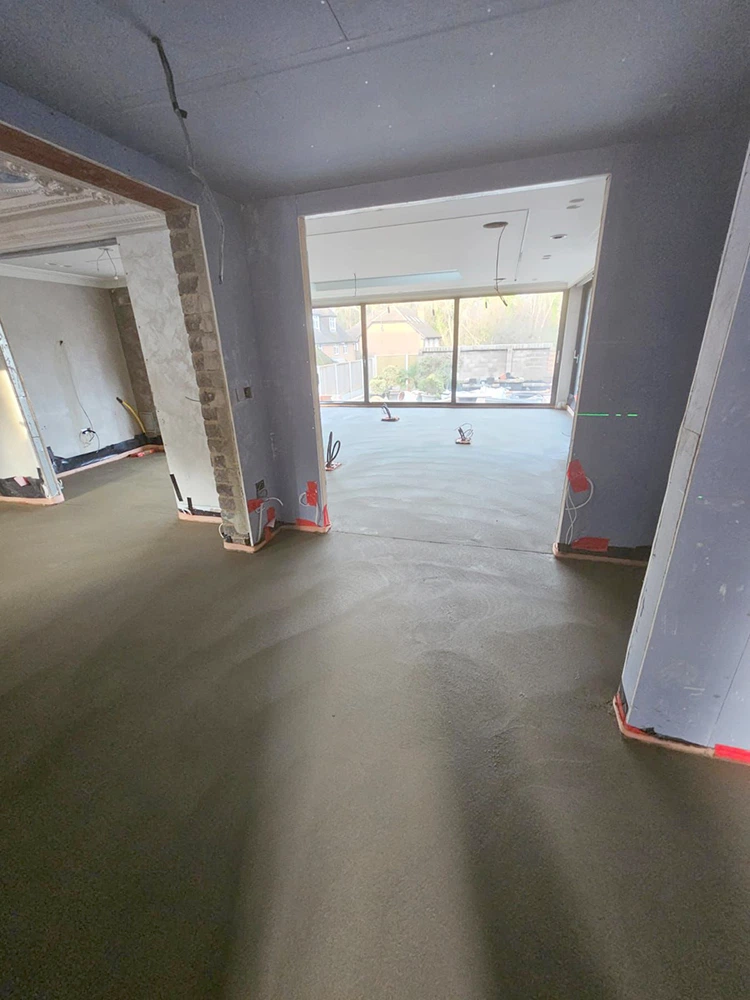
For that kind of rebuild, we would normally lay a cement screed by hand rather than pump one in. We batch it for each room and depth, barrow it through tight doorways, then compact and float it until it is dense and level. A house floor floating on insulation gets 65mm; commercial premises get 75mm. A bonded screed, fixed to a prepared concrete base, can be 25 to 40mm; see our bonded screed service.
The town's older houses need the same care. Homes from 1945 to 1972 make up 20% of Flitwick's stock, and pre-1919 buildings just 6%. Whichever age the house, we break out the old solid floor, fit insulation with a membrane over it, then screed.
Because ground floor construction varies, the first step is always to check what is there. If the floor is sound but uneven, levelling compound in Flitwick may be enough without a new screed.
Wet rooms, garages and falls in Flitwick homes
Bathrooms and other rooms that get wet need a sand and cement base. A wet room, or a shower with no tray, has to slope down to its drain, and that slope is shaped by hand across the floor. Calcium sulphate screeds are weakened by water, so they are not used where water may sit.
Garage conversions often use sand and cement too. Since the garage slab is generally below the level of the house, we raise it with insulation, membrane and screed until it is flush with the hall. Each layer is listed in the garage conversion floor guide. A garage kept for a car or workshop needs a floor that can take early load, which cement screed provides.
The catch is drying time. Reckon on a day a millimetre up to 40mm, then longer per millimetre, which can mean weeks for 65mm. If the kitchen fitter already has a date, a faster drying cement mix brings the wait down. Mixing in fibres helps the screed resist cracking, for an added £1 to £3 a square metre. For a job further afield, see sand and cement screed in Bedford.
Sand and Cement Screed prices in Flitwick
Sand and cement screed: £18 to £25 per m² supplied and laid (MyJobQuote, August 2026), so £450 to £630 for 25 m². MyJobQuote does not say whether these figures include VAT. See our floor screeding cost guide or screed calculator.
Who lays your sand and cement screed in Flitwick
K & B Screeding’s own team, led by director Donatas Bardisevicius. Founded 2019, company 12298780.
See what customers say in our Google reviews and on our testimonials page.
Sand and Cement Screed from Slough to Flitwick
As the crow flies, our yard in Slough is about 33.2 miles from Flitwick, which lies to the north. Postcodes here include MK45, and Houghton Regis (6.8 miles), Kempston (7.8 miles), Dunstable (8.1 miles) and Luton (9.2 miles) are close by.
More on sand & cement screed, part of our screeding services.
