
Grinding older slabs on Maulden Road Industrial Estate
Flitwick's main employment area, the Maulden Road Industrial Estate, was laid out on plans from the late 1960s. When one of its older units is converted to a new use, the floor often needs attention first. An older unit floor can carry painted walkways, thin sealer coats, tile adhesive and repairs patched in at different heights.
A grinder clears that in a controlled way. Diamond segments on spinning heads cut the surface down in thin layers, taking off coatings, laitance and residue as well as trowel marks and ridges where bays meet. The bare slab that remains can be checked for cracks and level, then repaired, levelled with compound or screeded to suit the new use. Damaged areas go to concrete floor repair before any topping.
It is worth being clear about the limits. Grinding takes down local high spots; it cannot correct a floor that falls or dips across a wide area. Removing that much would undermine the slab, so we grind the peaks and then level with compound or lay a screed. On a screed, the amount removed is kept in check, since grinding too far can leave it thinner than its minimum.
For large areas with thick coatings, shot blasting or scarifying may be faster, and our floor preparation work covers those methods. Grinding suits smaller units, edges and floors where control matters more than speed.
Flitwick extensions, garages and lifted carpets
In Flitwick's houses, grinding solves three common problems.
The first is the extension join. A single storey extension built onto a 30 to 50 year old house has to match the existing floor, and even a well built one can leave a small lip at the old back wall. Grinding takes the lip down so a thin top coat can blend the two; see latex over the ground surface for that next step.
The second is old adhesive. When carpet or vinyl is lifted during a kitchen opening, the floor is often left with glue that primers will not bond to. Grinding removes it, along with any paint.
The third is the garage, especially before a conversion, where oil, paint and flaking sealer must come off.
Dust control applies to all three. Because concrete, screed and tiles all contain silica, grinding them releases respirable crystalline silica dust that harms the lungs. Extraction is fitted to the machine every time we grind, and we sheet off doorways and the rest of the house, and keep the area closed while we work.
Houghton Regis is 6.8 miles away, and grinding in Houghton Regis works the same way.
How we price floor grinding in Flitwick
A fixed written price within 24 hours, once we know the area and what has to come off. See our floor screeding cost guide.
Who grinds your concrete floor in Flitwick
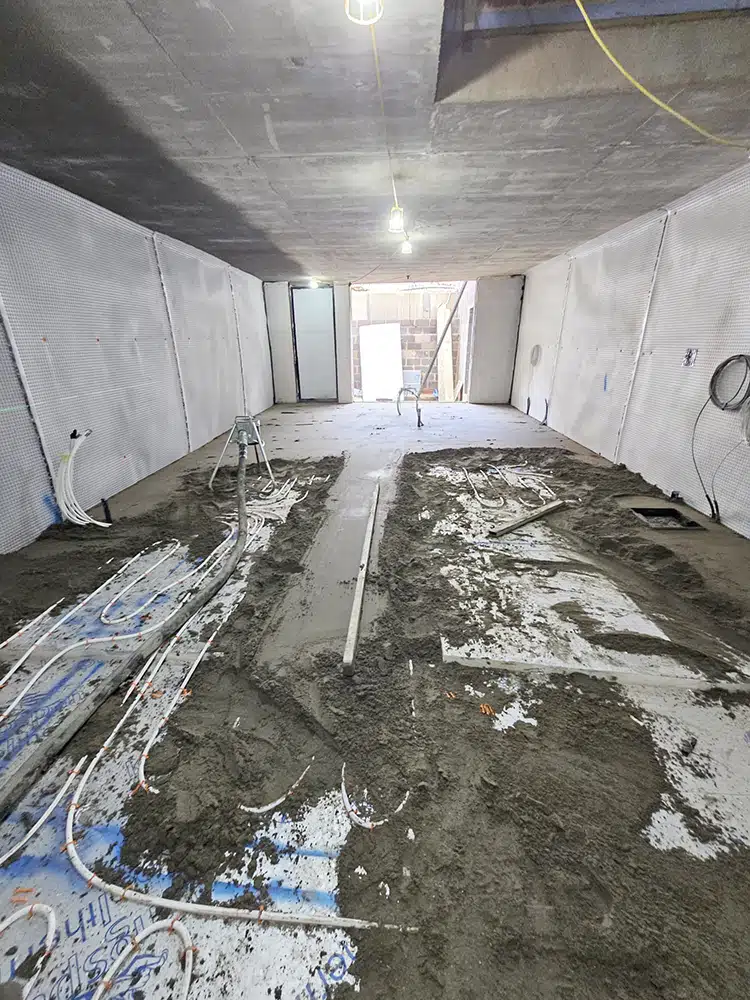
K & B Screeding’s own team, led by director Donatas Bardisevicius. Founded 2019, company 12298780.
See what customers say in our Google reviews and on our testimonials page.
Concrete Floor Grinding from Slough to Flitwick
As the crow flies, our yard in Slough is about 33.2 miles from Flitwick, which lies to the north. Postcodes here include MK45, and Houghton Regis (6.8 miles), Kempston (7.8 miles), Dunstable (8.1 miles) and Luton (9.2 miles) are close by.
More on floor grinding, part of our screeding services.