
Levelling opened-up kitchens in Flitwick houses
Thin floor finishes need a flat base. For LVT, vinyl or large format tiles the usual requirement is SR1 under BS 8204: a 2m straightedge with no gap beneath it bigger than 3mm. The looser classes, SR2 and SR3, allow 5mm and 10mm. A floor that looks flat can still fall short when checked with a straightedge.
In a Flitwick house, unevenness usually comes from a few places. When a kitchen is opened up, the old kitchen and dining room floors may be at slightly different levels, or one may have been patched. When an extension is added, the new floor may not line up exactly with the old one. Terraced houses make up 23% of Flitwick's homes, and in narrow ground floors these small steps are easy to see once a thin floor finish goes down.
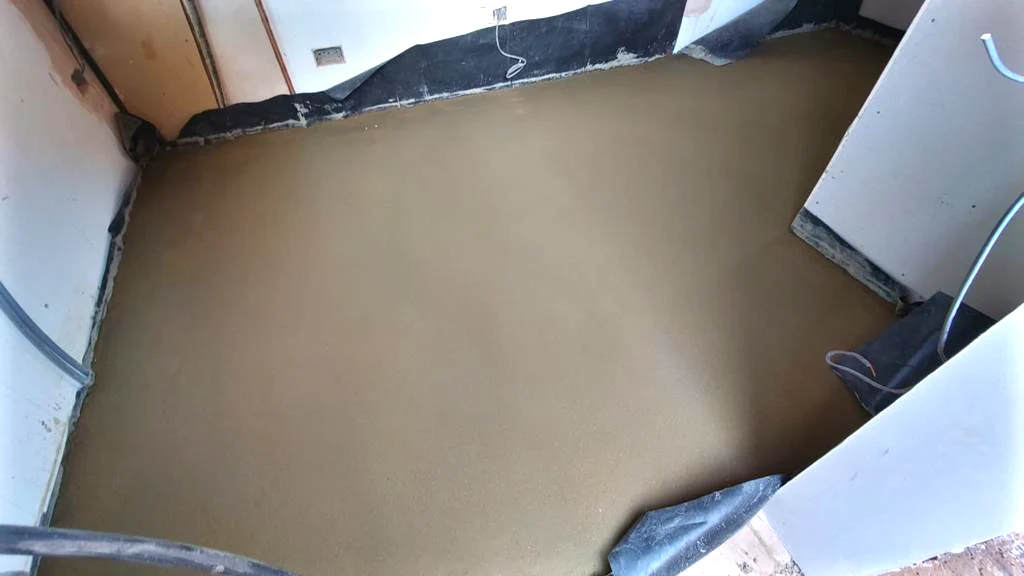
Levelling starts with preparation. First we clear off old adhesive, paint and anything loose, and fill any cracks. Priming comes next, with a product chosen for what the floor is made of, because concrete, cement screed and calcium sulphate do not all take the same one. The compound is then poured and spread, usually at about 2mm to 10mm, and it flows to a smooth, flat finish that is checked again with the straightedge once it has set.
If the base is weak, floor preparation comes first. On a small area needing only a very thin layer, latex screed for shallow levelling might do the job.
Change of use at the Maulden Road Industrial Estate
Commercial floors in Flitwick are concentrated in one place. The industrial estate on Maulden Road dates from planning in the late 1960s, and its older units are the kind where a slab needs repair, levelling or a fresh screed before a new tenant moves in. When one of them changes use, the floor is usually the first thing to check. Old adhesive, paint lines and patch repairs are ground or stripped off, and the slab is surveyed for cracks and level. If a unit changes from storage to office use, for example, the floor may need levelling for carpet tiles, vinyl or safety flooring.
A damaged slab needs repairs to the concrete before any compound goes on. Levelling compound is a thin layer; it cannot fix a slab that is cracked, broken or out by a large amount.
Push it well beyond its rated depth to save a floor that ought to be screeded and it may crack or lift. When we price your job, we will tell you if the floor is past what compound can fix, and that relaying it in sand and cement would be the better repair.
How we price floor levelling in Flitwick
A fixed written price within 24 hours, once we know the area and the base. See our floor screeding cost guide.
Who levels your floor in Flitwick
K & B Screeding’s own team, led by director Donatas Bardisevicius. Founded 2019, company 12298780.
See what customers say in our Google reviews and on our testimonials page.
Floor Levelling from Slough to Flitwick
As the crow flies, our yard in Slough is about 33.2 miles from Flitwick, which lies to the north. Postcodes here include MK45, and Houghton Regis (6.8 miles), Kempston (7.8 miles), Dunstable (8.1 miles) and Luton (9.2 miles) are close by.
More on floor levelling, part of our screeding services. Not sure whether you need a thin compound or a full flowing screed? See self levelling screed explained.
